Relying on manual packing creates severe throughput bottlenecks and inflates hidden costs. Upgrading to a smart automatic carton packing line can secure a 1-year ROI by integrating core processes like an auto case erector and robotic case packer. Our systems eliminate the wages of up to 20 workers while delivering 24/7 production stability. Stop guessing your operational costs—read on or contact us today for a custom ROI calculation.
As a Chief Manufacturing Engineer, the most common objection I hear regarding end-of-line automation is the initial capital expenditure. However, when you benchmark a manual process against an Industry 4.0 integrated system, the manual line is almost always more expensive over a 36-month horizon. This article breaks down the exact data points, from labor reduction to OEE improvements, to help you build a mathematically sound ROI model for your facility.
Table of Contents
- The Financial Risk of Manual Packaging Bottlenecks
- Defining the Automated Carton Packing Ecosystem
- Labor Cost Reduction: Reallocating Human Capital
- OEE and Throughput: The 90% Efficiency Standard
- Quality Control: Eliminating the Rework Tax
- Industry 4.0: Digital Twins and Predictive Maintenance
- Case Study: The Regional Food Manufacturer Transition
- Calculating Your 1-to-3 Year Payback Period
- Conclusion
1. The Financial Risk of Manual Packaging Bottlenecks
Before evaluating the solution, we must quantify the problem. Manual packing is rarely a fixed cost; it is a highly variable liability.
Manual packaging relies entirely on human stamina, making it vulnerable to fatigue, inconsistent cycle times, and shift disruptions. These manual bottlenecks prevent upstream filling and processing machines from running at full capacity, stranding your capital investments and artificially capping your daily factory output.
The Hidden Costs of Human Limitations
To understand the financial risk, we analyze the limitations of manual labor from an ergonomic, operational, and scaling perspective.
- Example 1: The Fatigue Curve. A manual operator erecting and taping boxes might hit 15 cartons per minute at 8:00 AM. By 3:00 PM, due to repetitive strain and fatigue, that rate often drops to 9 cartons per minute. This 40% drop in throughput forces the entire production line to slow down.
- Example 2: Scaling for Peak Demand. When a massive order drops, a manual line requires hiring temporary labor. Temporary workers have higher error rates and require training, meaning your cost-per-unit actually increases during your busiest, most critical production windows.
Automated systems do not experience fatigue curves. They provide a flat, predictable output that allows for precise capacity planning.
2. Defining the Automated Carton Packing Ecosystem
An automated system is not merely a faster version of a manual table. It is a completely different architectural approach to material handling.
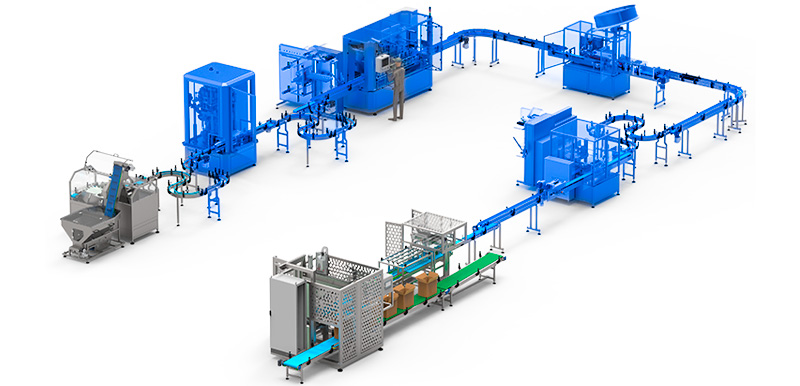
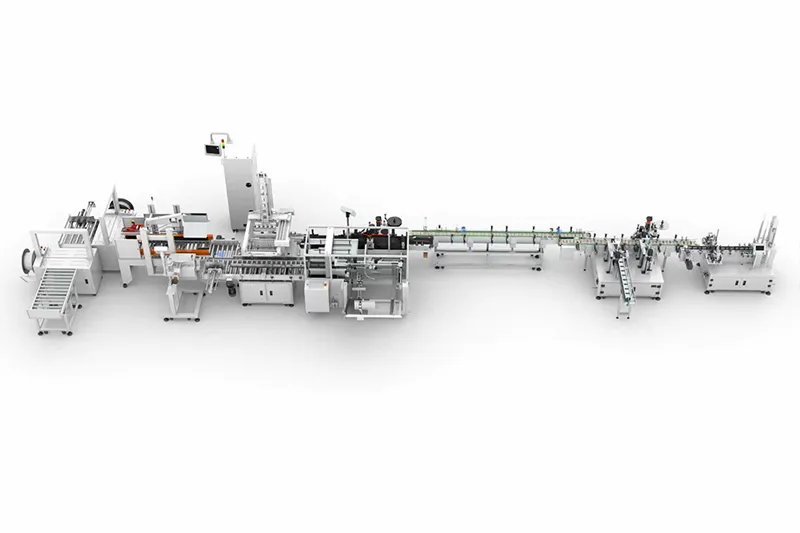
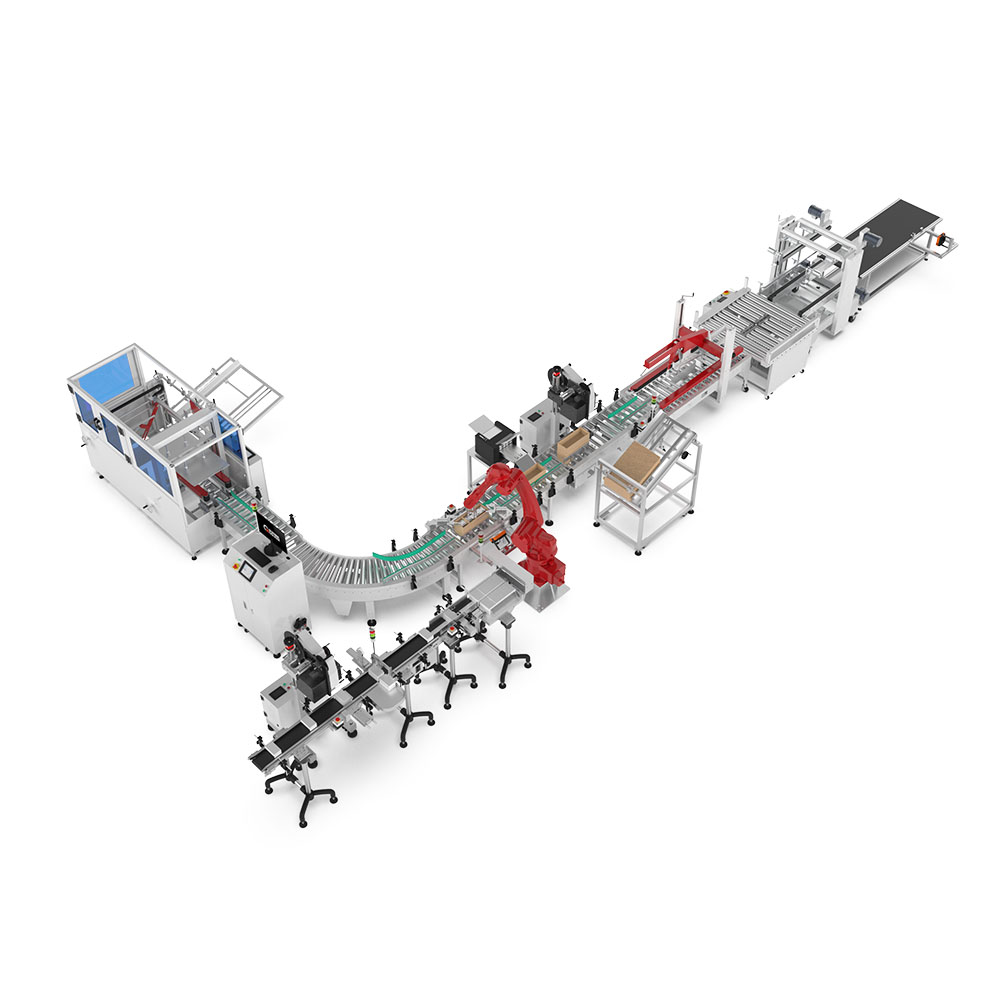
Modern carton packing production lines significantly outperform traditional setups by integrating case erecting, robot loading, sealing, check weighing, and palletizing into one continuous workflow. Controlled by central PLCs and smart sensors, these systems eliminate isolated bottlenecks and maintain 24/7 operational stability without human intervention.
From Physical Labor to Technical Supervision
The transition to automation fundamentally changes how your floor operates.
- Example 1: Workflow Continuity. In a manual setup, a worker builds a box, passes it to a loader, who passes it to a taper. If one person stops, the line stops. An integrated automated carton packing system uses synchronized servo conveyors. The box is erected and immediately indexed into the robotic loading zone, creating a seamless, uninterrupted flow.
- Example 2: The Operator’s New Role. Automation does not remove humans from the factory; it elevates them. Operators transition from performing repetitive, joint-destroying packing motions to monitoring the HMI (Human-Machine Interface) and loading raw materials (like corrugated blanks and glue pellets) into the machine’s magazines.
This shift makes the overall line efficiency drastically higher and more consistent.
3. Labor Cost Reduction: Reallocating Human Capital
Labor is the most visible line item on a manufacturing P&L. Automation attacks this cost directly.
Automated lines drastically reduce dependence on manual operators, typically cutting direct packaging labor hours by 35% to 42%. In high-volume facilities, employing a small team of technical supervisors to monitor a centralized automated line is mathematically far more economical than paying multiple operators to staff independent manual stations.
The Economics of Headcount Reduction
We evaluate labor savings not just in hourly wages, but in fully loaded costs, including benefits, turnover, and injury claims.
- Example 1: Multi-Shift Operations. If a line requires 6 people per shift, running 3 shifts requires 18 headcount. By automating, you might reduce this to 2 people per shift (6 headcount). The savings of 12 fully loaded salaries often pays for the robotic packer in the first 14 months.
- Example 2: SKU Changeovers. Manual changeovers require operators to physically move tables, adjust tape heads, and recalibrate scales—often taking 45 minutes. A modern automated line handles SKU changeovers via HMI recipes in under 5 minutes, turning 40 minutes of idle labor into productive uptime.
4. OEE and Throughput: The 90% Efficiency Standard
Overall Equipment Effectiveness (OEE) is the gold standard metric for manufacturing. It measures Availability, Performance, and Quality.
Automated carton packing systems consistently achieve an OEE of ~90%, significantly outperforming the ~80% or lower baseline of manual processes. Capable of processing hundreds to thousands of units per hour, these systems replace fluctuating human rhythms with high-speed, mathematical precision that guarantees production targets are met.
Analyzing the 10% OEE Gap
A 10% increase in OEE on a high-volume line translates to millions of dollars in additional shippable product annually.
- Example 1: Micro-Stops. Manual lines suffer from “micro-stops”—a dropped box, a jammed tape dispenser, an operator taking a water break. Automated lines use accumulation buffers to absorb minor upstream delays, keeping the performance metric near 100%.
- Example 2: Speed vs. Consistency. While an automated line can process thousands of units per hour, its true value is its continuous run capability. A robot packing at 100 cartons per minute for 24 hours straight will always beat a manual team that sprints at 120 cartons per minute but requires breaks, shift changes, and variable pacing.
5. Quality Control: Eliminating the Rework Tax
Speed is irrelevant if you are packing the wrong products or shipping unsealed boxes. Manual fatigue inevitably leads to costly mistakes.
Automated inspection and check weighing modules integrated into the line significantly lower artificial error rates and eliminate the costly “rework tax.” By removing human visual inspection, the system guarantees consistent outbound quality, preventing unsealed, underweight, or incorrect cartons from ever reaching the palletizing stage.
The Financial Impact of Flawless Packing
Rework costs include the labor to unpack, the wasted corrugated material, and the potential customer fines for shipping errors.
- Example 1: Inline Check Weighing. If a manual operator forgets to place an instruction manual inside a box, the customer receives an incomplete product. An automated check weigher detects the missing 50-gram variance instantly and triggers a pneumatic reject arm, solving the issue internally.
- Example 2: Vision Systems. Automated vision sensors verify that every barcode is readable and every tape seal is perfectly aligned. This reduces the scrap rate to near zero, saving substantial amounts of raw material over a fiscal year.
6. Industry 4.0: Digital Twins and Predictive Maintenance
The highest-tier ROI comes from systems that actively protect their own uptime.
Modern Industry 4.0 smart packaging lines utilize digital twins, real-time data analytics, and intelligent sensors to enable predictive maintenance. By providing early warnings for potential mechanical faults, the system avoids catastrophic breakdowns, thereby extending equipment lifespan and drastically reducing the financial impact of unplanned downtime.
Moving from Reactive to Proactive
You cannot achieve a fast ROI if your machine is constantly broken. Industry 4.0 prevents this.
- Example 1: Servo Motor Monitoring. Instead of running a servo motor until it burns out (causing a 6-hour line stoppage), the system monitors torque and temperature. It alerts the maintenance team to a 5% heat increase, allowing them to replace the bearing during a scheduled 15-minute shift change.
- Example 2: Digital Twin Simulation. Plant managers can use a digital twin—a virtual replica of the automated carton packing line—to simulate a new box size or a 20% speed increase before ever running the physical machine. This ensures that new SKUs won’t cause unexpected bottlenecks when introduced to the actual floor.
7. Case Study: The Regional Food Manufacturer Transition
To prove these data points, we look at a real-world deployment where manual labor was holding back factory growth.
A regional food manufacturer upgraded from multiple independent packing stations to a fully integrated automated carton packing production line. This strategic move reduced their manual packaging headcount from 8 operators down to 2 technical supervisors, drastically minimizing errors and ensuring continuous, predictable output across their facility.
Operational Wins
Before the upgrade, the manufacturer struggled with fluctuating outputs. The new system integrated a case erector, a robotic packer, vision inspection, and a palletizer.
- Labor Shift: The 8 manual operators were replaced by 2 supervisors who managed the HMI and loaded raw corrugated blanks.
- SKU Flexibility: The manufacturer produced three different box sizes. The new system executed format changes via the touchscreen, eliminating the 40-minute mechanical changeovers that previously plagued the manual line.
- Result: The factory achieved a stable takt time, allowing their sales team to confidently accept larger orders without fear of production delays.
8. Calculating Your 1-to-3 Year Payback Period
When presenting this investment to your CFO, you need to map out the payback period cleanly.
The ROI for an automatic carton packing machine is typically realized within just 1 year. By combining the savings from eliminating 20 manual roles, eradicating rework costs, and boosting OEE to 90%, the capital expenditure is rapidly offset by daily operational savings.
ROI Comparison Table (Annualized Estimate)
| Cost Center | Manual Packing Setup | Automated Carton Packing Line | ROI Driver |
| Direct Labor | Very High (10+ operators/day) | Low (2-3 supervisors/day) | Wages, benefits, turnover costs |
| Downtime Costs | High (Reactive maintenance) | Low (Predictive maintenance) | Protected revenue generation |
| Material Waste | 3-5% (Human error/damage) | < 0.5% (Precision handling) | Reduced consumable spend |
| OEE | ~75 – 80% | ~90%+ | Increased total daily yield |
If your facility runs two or three shifts, the labor savings alone will push your ROI timeline closer to the 12-to-18-month mark.
9. Conclusion
The debate between manual and automated carton packing is essentially a choice between variable instability and engineered predictability. An automated carton packing production line transforms your end-of-line process from a labor-heavy bottleneck into a high-yield, data-driven asset. By achieving 90% OEE, integrating predictive maintenance, and cutting direct labor hours by up to 42%, the system pays for itself rapidly—usually within 1 to 3 years. For mid-to-large-scale manufacturers, automating is no longer just an operational upgrade; it is a financial necessity. Backed by our Harvard-educated consultant, JOYDA provides seamless ERP/MES integration to guarantee your success. Ready to see the math for your factory? Contact us now to get a Free ROI Assessment within 48 hours.
Frequently Asked Questions
1. Is an automated line too rigid if we change carton sizes frequently?
No. Modern systems are highly modular. Using servo-driven guides and HMI recipes, format changes for different SKUs can be executed in under 5 minutes without manual tools.
2. How exactly does automation improve material utilization?
Automated erectors and sealers use precise, mathematical application. They fold boxes perfectly square (preventing jam damage) and apply the exact millimeter of glue or tape required, eliminating the waste common in manual taping.
3. What does “digital twin” mean in the context of packaging?
A digital twin is a virtual software replica of your physical packaging line. It uses real-time data to simulate how the line will perform under different conditions, allowing engineers to test new speeds or box sizes safely in a virtual environment before running them on the actual floor.
4. We only run one shift. Is the ROI still 1 to 3 years?
If you run a single shift, the payback period will lean closer to the 3-year mark. The 1-to-2-year ROI is typically seen in facilities running 2 or 3 continuous shifts, as the labor savings multiply.
5. Do we need software engineers to run the line?
No. The advanced PLC logic is pre-programmed by the manufacturer. Your operators interact with a user-friendly touchscreen (HMI) designed for standard factory personnel.
6. How does predictive maintenance actually work?
Sensors measure data like vibration, temperature, and pneumatic pressure. The system establishes a baseline of “normal” operation. If a motor starts drawing 10% more amperage than normal, the system flags it as a wear issue before it actually breaks.
7. Can an automated line handle fragile products?
Yes. Robotic loaders can be outfitted with specialized end-of-arm tooling, such as soft vacuum cups or padded grippers, to handle delicate items far more gently and consistently than human hands.
8. What happens if a bad product gets packed?
Integrated vision sensors and check weighers identify the error immediately. A pneumatic reject system will push the defective carton off the line into a rework bin without stopping the rest of the production flow.