Predictive maintenance in packaging lines is the use of IoT sensors and machine-learning models to catch early warning signs of equipment failure—such as a rise in motor temperature or a micro-vibration in a bearing—so maintenance can be scheduled before a breakdown. On high-volume lines it typically cuts unplanned downtime by 30–50% and lowers annual maintenance cost by up to 40%. This guide explains how it works, the measurable ROI, and how to set it up on your line.
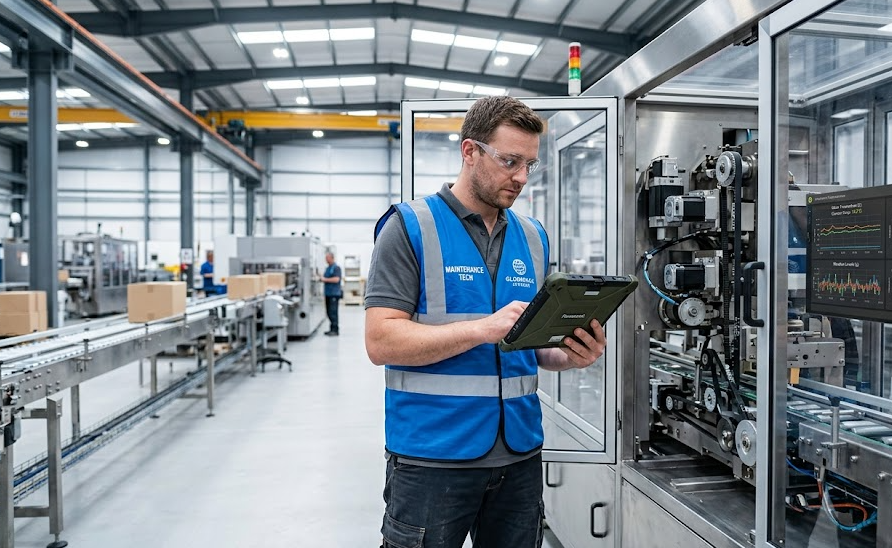
If your line is losing production to unexpected bottlenecks, the shift from reactive repair to data-driven maintenance is one of the highest-impact moves in Industry 4.0 packaging. Below we break down the workflow, the numbers, and a practical setup path.
Table of Contents
- What Is Predictive Maintenance in Packaging?
- The Real Cost of Fix-After-Failure
- How Predictive Maintenance Reduces Downtime (4-Step Workflow)
- The Measurable ROI: Downtime, Cost and OEE
- How to Set Up Predictive Maintenance on Your Line
- Which Sensors and Data You Need
- Predictive vs Preventive vs Reactive Maintenance
- Case Study: Eliminating Unexpected Bottlenecks
- Frequently Asked Questions
- Secure Your Uptime with Joyda Totalpack
1. What Is Predictive Maintenance in Packaging?
Predictive maintenance answers one question: when will this machine fail? Instead of waiting for a breakdown or replacing parts on a fixed calendar, it uses live sensor data to spot the small deviations that precede failure—abnormal vibration, rising temperature, or a slow drift in cycle time.
It sits at the top of the Industry 4.0 end-of-line architecture: IoT sensors let the line see its own health, a data pipeline makes that information flow, and the MES coordinates action. Predictive maintenance turns that data into a forecast you can plan around.
2. The Real Cost of Fix-After-Failure
Before Industry 4.0, most lines ran on two inefficient models:
- Reactive maintenance: run the machine until it breaks. This causes sudden stoppages, wasted labor, and missed shipping deadlines.
- Preventive maintenance: replace parts on a fixed schedule regardless of condition. Good parts get thrown away, wasting budget and causing avoidable planned downtime.
Packaging downtime commonly costs $10,000 to $50,000 per hour once you add scrapped material and delayed logistics. You need a system that tells you exactly when to act.
3. How Predictive Maintenance Reduces Downtime (4-Step Workflow)
To reduce downtime on a packaging line, the system runs a continuous loop:
- Continuous data collection. IoT sensors on motors, bearings, and pneumatic cylinders measure vibration, temperature, load, and cycle time around the clock.
- Condition monitoring. The system learns the baseline of normal operation for each machine.
- Pattern recognition. Machine-learning models compare live data to historical failure patterns—for example, a micro-vibration spike that has always preceded a bearing collapse.
- Failure prediction and scheduling. The system warns days or weeks ahead, naming the exact component degrading, so maintenance lands inside an already planned window.
4. The Measurable ROI: Downtime, Cost and OEE
The financial case is consistent across plants that make the shift:
| Metric | Legacy (Reactive or Preventive) | Predictive Maintenance |
| Unplanned downtime | High, frequent mid-shift failures | Reduced 30–50% |
| Failure warning | None—instant breakdown | Days or weeks ahead |
| Maintenance cost | Emergency repairs, rush parts | Up to 40% lower |
| Component lifespan | Replaced too early or run to failure | Maximized safely |
| OEE (Overall Equipment Effectiveness) | Volatile | +10–18% |
Worked example: a line running 6,000 productive hours per year that loses 5% to unplanned downtime loses 300 hours. At a conservative $15,000 per hour of stoppage, that is $4.5M per year. Cutting that loss by 40% returns about $1.8M annually—before counting saved spare parts and overtime.
5. How to Set Up Predictive Maintenance on Your Line
You do not need a full digital overhaul to start. A phased path works:
- Map critical assets. List the machines whose failure stops the whole line—carton erectors, sealers, palletizers, case packers.
- Choose a sensor strategy. New lines are often IoT-ready; older lines can be retrofitted with edge gateways on key components.
- Establish a normal baseline. Collect 2–4 weeks of healthy-operation data so the system knows what good looks like.
- Connect data to MES or SCADA. Stream readings to a dashboard your team already watches.
- Train models and set thresholds. Start with the failure modes you see most, then expand.
- Fold alerts into the schedule. Route every warning to a planned maintenance window, not an emergency call-out.
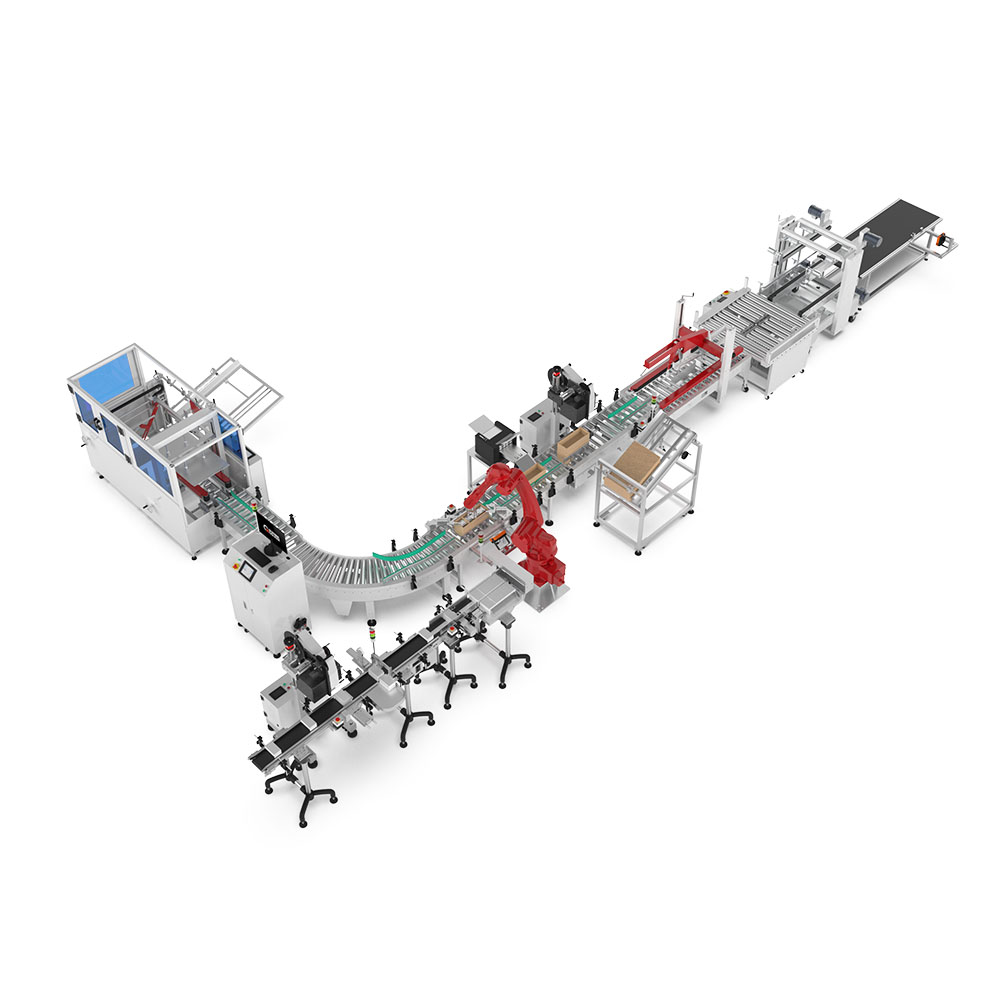
Joyda end-of-line systems—such as the automatic carton packing line—are built IoT-ready, so the sensor layer is already in place and simply needs to be connected.
6. Which Sensors and Data You Need
| Sensor | Detects | Failure it predicts |
| Vibration | Bearing or gear wear, imbalance | Bearing collapse, misalignment |
| Temperature | Motor overheating, friction | Motor burnout |
| Current draw | Motor working harder than normal | Failing drive or motor |
| Acoustic | Air leaks in pneumatics | Seal or gasket failure |
| Cycle time | Slowdowns, micro-jams | Wear in feeders and servos |
7. Predictive vs Preventive vs Reactive Maintenance
| Dimension | Reactive | Preventive | Predictive |
| Trigger | Failure occurs | Calendar schedule | Condition of the asset |
| Downtime | High | Medium | Low |
| Parts cost | High (run to failure) | Medium (wasted life) | Low (fully used) |
| Labor | Firefighting | Planned | Planned and efficient |
| Best for | Low-value assets | Stable, low-wear assets | Critical high-value lines |
8. Case Study: Eliminating Unexpected Bottlenecks
Before: machines ran until failure. A carton erector or sealer stopping abruptly halted the entire line. Maintenance reacted under time pressure, and surprise failures made spare-parts inventory unpredictable—often requiring expensive rush shipping.
After: the line was upgraded with sensors on key components. Models began flagging abnormal patterns, such as torque spikes on the palletizer arm, weeks before failure. Repairs moved into planned weekend windows.
Results: unplanned stoppages dropped sharply, throughput stabilized, and spare-part waste fell because components were replaced only when genuinely needed. The line moved from a liability into a predictable, controllable asset.
9. Frequently Asked Questions
9.1 What is the difference between preventive and predictive maintenance?
Preventive is calendar-based (replace a belt every 6 months regardless of condition). Predictive is condition-based (replace it only when sensors show it has stretched beyond safe limits).
9.2 What sensors are used for predictive maintenance on a packaging line?
The most common are vibration (bearing or gear wear), temperature (motor overheating), current draw (motor strain), and acoustics (pneumatic air leaks).
9.3 Does predictive maintenance require a massive IT infrastructure?
No. It needs a solid data pipeline (edge gateways plus local or cloud servers). Modern lines are often IoT-ready, so the hardware is already present and only needs connecting to your MES or a predictive platform.
9.4 Can predictive maintenance eliminate 100% of unplanned downtime?
No system predicts every random event (for example, an operator dropping a tool into a machine). But it consistently removes 30–50% of downtime caused by natural mechanical wear.
9.5 How far in advance can the system predict a failure?
Depending on the component and model, warnings range from a few hours (rapidly deteriorating seals) to several weeks or months (gradually degrading motor bearings).
9.6 Will it overwhelm the team with false alarms?
A well-calibrated system learns your line’s normal baseline and filters noise at the edge, sending alerts only when a verified degradation pattern is recognized.
9.7 How do I start a predictive maintenance program on an existing line?
Start small: map your critical assets, add sensors to the top two or three, build a healthy baseline, then connect alerts to your maintenance schedule. See the step-by-step path in section 5 above.
9.8 What ROI can I expect from condition monitoring?
Most plants see 30–50% less unplanned downtime, up to 40% lower maintenance cost, and a 10–18% gain in OEE within the first year of deployment.
10. Secure Your Uptime with Joyda Totalpack
Predictive maintenance is not just buying sensors—it is deploying intelligent systems that understand the mechanical realities of the packaging floor. By anticipating wear before it hits output, you protect your most valuable asset: uptime.
Joyda Totalpack integrates predictive maintenance directly into end-of-line packaging architectures, turning equipment data into guaranteed, schedulable uptime.
Tired of unexpected failures disrupting your shipping schedule? Contact our integration team to explore how our Industry 4.0 packaging solutions can make your line predictable—and request a free uptime audit for your facility.