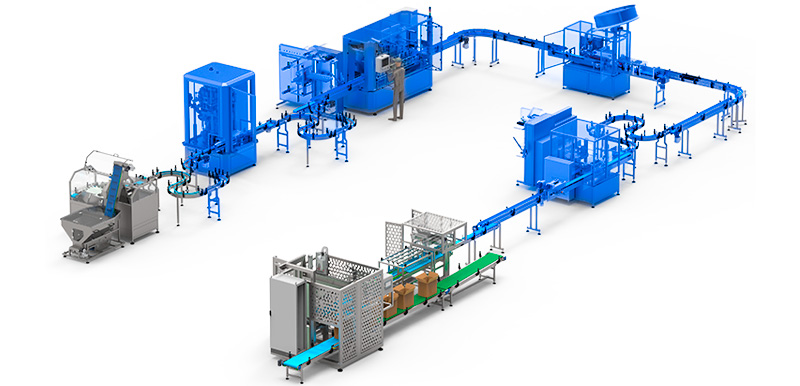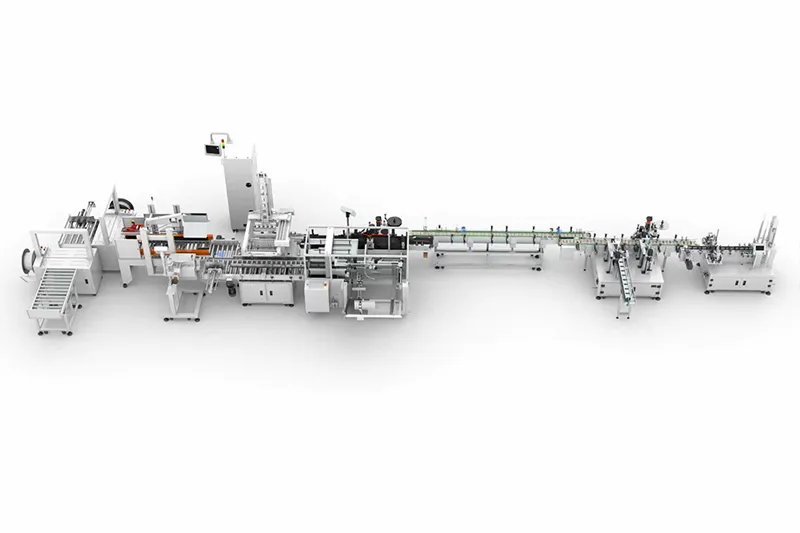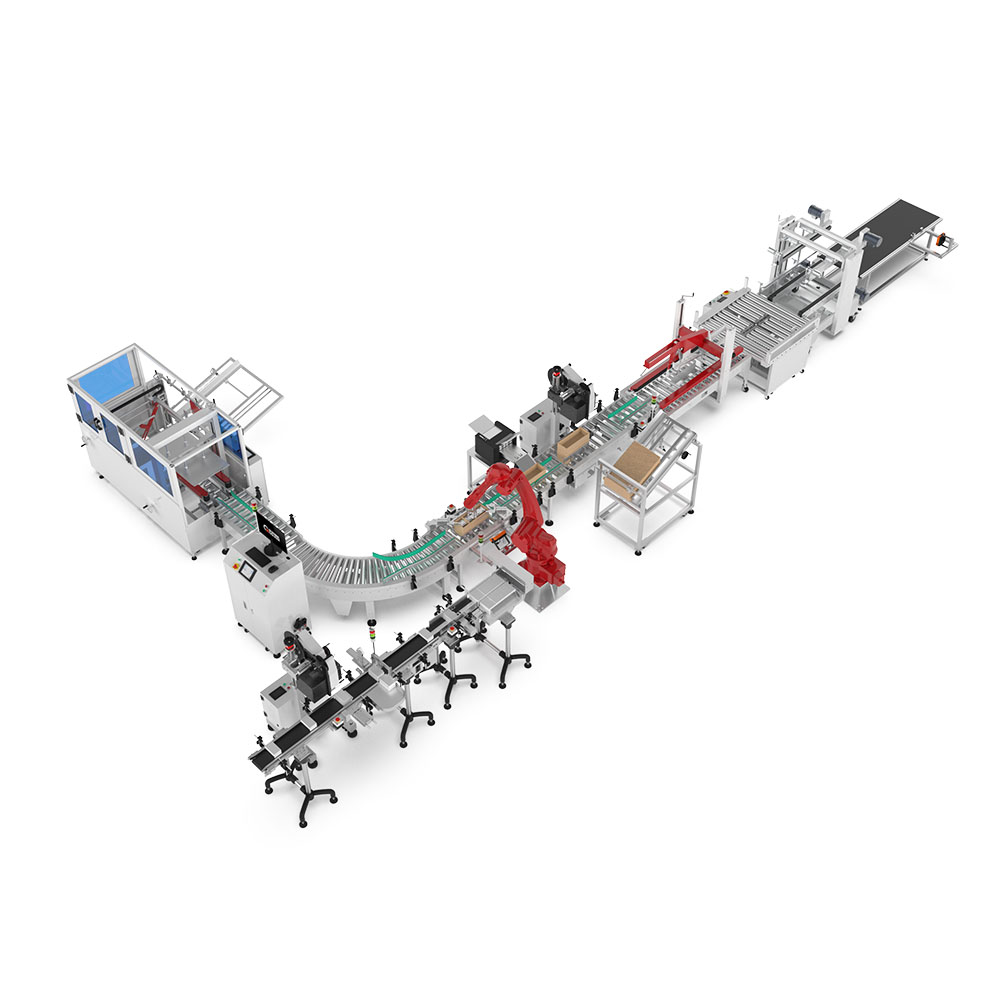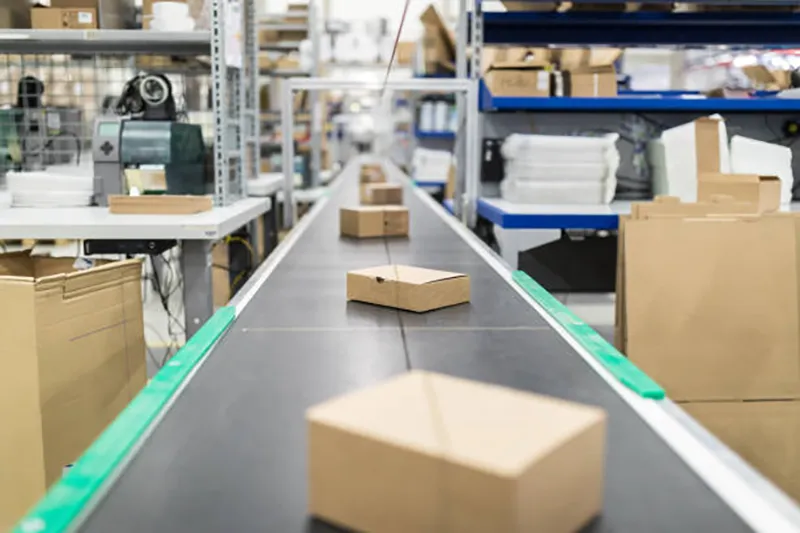
The food manufacturing industry is under continuous pressure to improve packaging efficiency while strictly maintaining product quality, safety, and delivery reliability. As consumer demand increases and product varieties become more diversified, traditional packaging operations face growing challenges. Food manufacturers commonly encounter increasing labor costs, severe workforce shortages, high-speed production requirements, and the need for frequent product changeovers. When production managers lack visibility into packaging operations, packaging line bottlenecks and inconsistent performance severely limit output. For many food factories, the challenge is not simply adding more machines, but creating a more coordinated and transparent production environment. Industry 4.0 provides a smarter approach by connecting packaging equipment, automation systems, and production data into an integrated manufacturing ecosystem, allowing food manufacturers to optimize packaging processes proactively and eliminate hidden inefficiencies.
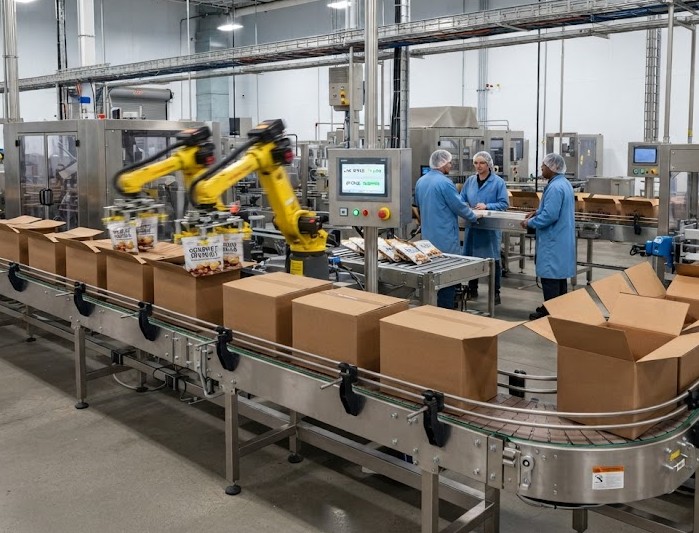
Table of Contents
- Achieving Real-Time Monitoring in Food Packaging Production
- Improving Packaging Line Coordination and Material Flow
- Reducing Packaging Downtime to Protect Production Schedules
- Supporting High-Speed Food Packaging Operations
- Increasing Production Flexibility for Multi-SKU Food Products
- Enhancing Food Packaging Traceability and Compliance
- Reducing Material Waste and Improving Resource Efficiency.
- Industry Application Scenarios: Food Sector Efficiency Gains
- Evaluating Smart Factory Partners for Food Packaging
- Conclusion
1. Achieving Real-Time Monitoring in Food Packaging Production
Industry 4.0 food packaging solutions achieve real-time monitoring by automatically collecting operational data from connected equipment, allowing production managers to instantly identify machine slowdowns and packaging delays.
In traditional food manufacturing, production managers often rely on manual inspections and operator reports to manage packaging lines. This outdated methodology creates massive delays in identifying production slowdowns, equipment abnormalities, and unexpected performance changes. By the time a paper report highlights a drop in output, the shift has ended, and the production capacity is permanently lost.
Smart packaging systems resolve this by deploying connected sensors and PLCs that collect continuous operational information from every machine on the line. Manufacturers gain immediate visibility into critical operational points:
- Dynamic OEE Calculation: Automatically tracking availability, performance, and quality rates without manual data entry.
- Micro-Stop Logging: Recording sub-minute machine stoppages that operators typically fail to document, uncovering hidden capacity losses.
- Live Throughput Tracking: Comparing real-time case packing speeds against the target daily production schedule.
- Automated Fault Diagnostics: Instantly displaying exact error codes (e.g., “Pneumatic pressure drop at Station 3”) on centralized dashboards.
Expert Decision Logic for Manufacturers:
- Local HMI Monitoring is recommended when operating a single, high-speed packaging line where immediate operator intervention is the priority.
- Cloud-Connected MES Integration is more suitable when managing a multi-line food factory. If your facility requires plant-wide visibility, centralized scheduling, and remote diagnostics for executive decision-making, investing in a full MES (Manufacturing Execution System) is strictly required over basic localized monitoring.
2. Improving Packaging Line Coordination and Material Flow
Connected automation systems improve packaging line coordination by synchronizing product feeding, carton forming, case packing, and sealing processes, ensuring smoother material flow and eliminating inter-process waiting times.
Food packaging inherently involves multiple sequential processes. When machines operate independently as isolated units, production efficiency is severely compromised. In a disconnected line, uneven production speeds cause material waiting times, and poor communication between machines inevitably leads to product jams or equipment starvation.
Industry 4.0 solutions integrate these individual units so that different packaging processes work together as a single coordinated production line. The technical benefits of this synchronization include:
- Auto-Regulating Conveyor Speeds: Upstream and downstream conveyors adjust speeds dynamically using VFDs (Variable Frequency Drives) to prevent product collisions.
- Seamless Handshakes: Digital signals between the case erector and the robotic packer ensure a box is only formed when enough product is ready to be loaded.
- Elimination of Buffer Zones: Reducing the physical footprint of the line by removing the need for long accumulation conveyors.
Expert Decision Logic for Manufacturers:
- Asynchronous independent controls are acceptable when handling highly durable, non-perishable ambient foods where accumulation on a conveyor does not affect product quality.
- Synchronized Line-Level Control is strongly recommended when packaging frozen foods, dairy, or fragile baked goods. In these environments, product cannot be allowed to stagnate on a conveyor due to temperature sensitivity or structural fragility. A turnkey integrated system guarantees continuous, uninterrupted material flow.
3. Reducing Packaging Downtime to Protect Production Schedules
Smart monitoring reduces packaging downtime by utilizing predictive maintenance to detect degrading equipment conditions before sudden failures occur, protecting tightly controlled food production schedules.
Unexpected machine failures cause catastrophic losses in food manufacturing. Because production schedules—especially for perishable or temperature-sensitive goods—are tightly controlled, a sudden breakdown can result in spoiled batches, delayed logistics deliveries, and significantly reduced production capacity.
Industry 4.0 introduces smart monitoring and predictive maintenance to combat unexpected mechanical failures. Instead of waiting for a machine to break, IoT sensors track physical degradation indicators:
- Servo Motor Torque: Detecting abnormal resistance that indicates a jammed bearing or failing gearbox.
- Vibration Analysis: Identifying misalignment in high-speed rotary carton formers.
- Thermal Monitoring: Spotting overheating electrical components or mechanical friction points before a fire or failure risk occurs.
Expert Decision Logic for Manufacturers:
- Preventative (Calendar-based) Maintenance is suitable for secondary, low-stress packaging equipment where replacement parts are cheap and swap times are under five minutes.
- Predictive (IoT-based) Maintenance is highly recommended for critical end-of-line bottlenecks, such as the central robotic palletizer or high-speed case packer. Deploying predictive sensors on these assets ensures you only replace components when actual wear dictates, maximizing machine uptime and ROI.
4. Supporting High-Speed Food Packaging Operations
Industry 4.0 supports high-speed food packaging operations by combining intelligent control systems with automated case packing and robotic palletizing to consistently manage large production volumes without labor bottlenecks.
Food manufacturers must frequently handle extremely large production volumes, continuous 24/7 operation requirements, and strict delivery deadlines. Relying on manual processes for repetitive end-of-line packaging becomes a severe limitation when production demand increases, as human operators fatigue and introduce speed variations.
Automation combined with intelligent Industry 4.0 control systems helps factories maintain consistent packaging performance regardless of volume. By utilizing robotics, factories achieve:
- Consistent Cycle Times: Robots operate at exact, predictable speeds, allowing for highly accurate logistics forecasting.
- Heavy Payload Handling: Eliminating ergonomic risks for workers dealing with heavy bulk food cases or beverage trays.
- Continuous 24/7 Operation: Supporting peak seasonal demands without the need to hire and train temporary labor.
Expert Decision Logic for Manufacturers:
- Standard Mechanical Drop Packers are recommended when dealing with a single, uniform food product (like standard beverage cans) running at extremely high, continuous speeds.
- Vision-Guided Robotic Case Packers are the superior choice when handling delicate items (like bagged snacks or baked goods) that require precise spatial orientation. The robotic arm adjusts its grip based on real-time vision data, preventing product crushing and maintaining presentation quality.
5. Increasing Production Flexibility for Multi-SKU Food Products
Smart manufacturing systems increase production flexibility for multi-SKU food products by providing centralized control over equipment adjustments, significantly reducing setup times during frequent packaging format changes.
Modern food manufacturers rarely produce just one item; they manage multiple SKUs, diverse packaging formats, and continuous product variations. In a traditional factory, frequent changes lead to significantly longer setup times, reduced production efficiency, and increased operator workload as technicians manually adjust guides and change machine recipes.
Industry 4.0 smart manufacturing systems improve production flexibility by digitizing and automating these changeovers. Centralized PLC controls enable:
- One-Touch Recipe Changes: Operators select a new SKU on the HMI, and all connected machines automatically update their operating parameters.
- Servo-Driven Auto-Adjustments: Mechanical guides, sealing tape heads, and conveyor widths physically adjust themselves via servo motors to match the new carton dimensions.
- Flexible End-of-Arm Tooling (EOAT): Robotic arms utilize quick-change or multi-functional grippers to handle different product shapes without requiring hours of mechanical reconfiguration.
Expert Decision Logic for Manufacturers:
- Manual changeovers with quick-release levers are cost-effective when a factory runs less than three SKU variations per week and changeover speed is not a critical bottleneck.
- Automated recipe-driven servo adjustments are strictly required when operating a high-mix food packaging facility with daily or multi-shift SKU changeovers. The investment in servo-automated changeovers quickly pays for itself by reclaiming hundreds of hours of lost production time annually.
6. Enhancing Food Packaging Traceability and Compliance
Digital production systems enhance food packaging traceability by automatically capturing detailed production records and equipment data, ensuring accurate compliance and faster quality issue resolution.
Food manufacturers face strict quality management regulations and compliance requirements that demand highly accurate production information. Traditional manual recording systems create massive difficulties in tracking production history, quickly identifying the source of contamination, and reviewing historical production data during an audit.
Industry 4.0 provides a robust digital infrastructure for perfect traceability. Key capabilities include:
- Automated Batch Tracking: Linking exact raw material batches to specific, serialized final packaging cartons.
- Vision System Verification: Automatically scanning barcodes, expiration dates, and lot codes to ensure 100% label accuracy before palletizing.
- Digital Audit Trails: Maintaining a tamper-proof digital log of exactly which operator was logged into the machine during a specific production run.
Expert Decision Logic for Manufacturers:
- Basic barcode scanning is sufficient when tracking standard, low-risk consumer packaged goods for internal inventory purposes.
- Full RFID and digital-twin traceability is recommended when packaging high-risk or highly regulated foods (like baby formula, pharmaceuticals, or export-grade frozen meats). Deep MES integration ensures you can execute a targeted product recall in minutes rather than days.
7. Reducing Material Waste and Improving Resource Efficiency
Industry 4.0 reduces material waste and improves resource efficiency by analyzing production data to pinpoint inefficient processes, allowing manufacturers to optimize packaging accuracy and material utilization.
Packaging inefficiencies do more than just slow down production; they result in expensive material waste, incorrect packaging operations (such as bad seals or misapplied labels), and excessive downtime while operators clear jammed cartons.
Through continuous production data analysis, smart systems identify the exact mechanical actions causing these inefficiencies.
- Reject Analysis: Vision systems categorize why a carton was rejected (e.g., missing flap, bad glue seal), allowing engineers to fix the specific mechanical flaw.
- Material Optimization: Sensors track exact hot-melt glue or packaging tape consumption, alerting operators to over-application.
- Energy Monitoring: IoT sensors monitor compressed air and electricity usage, identifying pneumatic leaks that drive up overhead costs.
8. Industry Application Scenarios: Food Sector Efficiency Gains
Industry 4.0 packaging automation is tailored to specific food sector challenges, delivering high-speed stability for frozen foods, rapid changeovers for snacks, and strict traceability for dairy products.
Different branches of the food manufacturing industry face distinct operational pressures. Evaluating how smart factory technology applies to specific sectors demonstrates the critical value of automated production data management.
| Food Manufacturing Sector | Common Packaging Challenges | Industry 4.0 Automation Application | Technical Benefit |
| Frozen Food Manufacturers | High-volume production, continuous operation in harsh environments, strict logistics schedules. | Automatic carton packing and robotic palletizing paired with real-time production monitoring. | Maintains stable production speeds, reduces manual intervention in cold environments, and ensures packaging consistency. |
| Beverage Manufacturers | Extremely fast production cycles, massive daily output requirements, need for high reliability. | Connected packaging systems synchronizing filling, packing, and palletizing. | Improves coordination between high-speed processes, preventing downstream bottlenecks and product damage. |
| Snack & Processed Food | High SKU counts, frequent packaging format changes, volatile seasonal demand fluctuations. | Flexible automation solutions with centralized recipe management. | Allows rapid, automated changeovers to manage different packaging requirements while maintaining high OEE. |
| Dairy Product Manufacturers | Strict production control, high packaging consistency requirements, mandatory traceability. | Smart factory systems with deep digital data tracking and automated vision inspection. | Improves production visibility, supports stable operations, and guarantees verifiable compliance data. |
9. Evaluating Smart Factory Partners for Food Packaging
Partnering with a turnkey food packaging automation provider is essential because it guarantees complete system integration, from packaging line design to smart factory implementation, rather than just supplying isolated machines.
When food manufacturers realize that their current packaging line cannot keep up with growing demand, or when severe labor shortages begin affecting operations, the next step is procurement. However, a major mistake is purchasing single, isolated machines to fix a localized problem. B2B buyers must recognize that true efficiency comes from complete end-of-line automation for food manufacturers.
Expert Decision Logic for Manufacturers:
- Purchasing standalone equipment is acceptable when replacing a single, identical broken machine in an older, manual-heavy facility that does not plan to digitize operations.
- A Turnkey Automation Partner is strictly required when building a new line or upgrading a facility to Industry 4.0 standards. A turnkey provider (like JOYDA TECH) handles packaging line design, automation integration, equipment connection, and long-term production optimization. This ensures that your case erector, packer, sealer, and robotic palletizer communicate flawlessly over a unified software architecture, maximizing long-term ROI and eliminating multi-vendor compatibility risks.
10. Conclusion
Food manufacturers can no longer rely on adding manual labor to solve production bottlenecks. Rising costs, the need for consistent packaging quality, and high-speed demands require a fundamental shift in how end-of-line operations are managed. Industry 4.0 food packaging solutions provide the critical real-time data visibility, automated machine coordination, and predictive maintenance required to eliminate downtime and optimize material flow. By utilizing expert decision frameworks to select between flexible robotics, synchronized line controls, and deep MES integrations, factories can transition from isolated machines to fully integrated ecosystems. Ultimately, partnering with a turnkey automation expert allows food manufacturers to scale their production capacity efficiently, ensure flawless traceability, and maintain a highly competitive edge in the modern manufacturing landscape.
Is your food packaging line struggling to keep up with demand?
As a professional manufacturer and expert in turnkey packaging automation, JOYDA TECH specializes in designing and integrating customized Industry 4.0 food packaging solutions. From high-speed case packing to robotic palletizing and smart factory data integration, we provide complete end-of-line systems tailored to your specific food production requirements. Contact our engineering team today to discuss how we can optimize your packaging line and eliminate production bottlenecks.
Frequently Asked Questions (FAQs)
1. How do Industry 4.0 food packaging solutions improve production capacity?
Industry 4.0 improves capacity not just by running machines faster, but by increasing overall equipment utilization. By connecting machines to synchronize material flow and using real-time monitoring to eliminate hidden micro-stops, factories can achieve higher output without adding physical labor.
2. When should a food factory choose robotic case packing over mechanical case packing?
Robotic case packing is recommended for handling delicate, irregular, or multi-SKU products (like bagged snacks) because vision-guided robots adjust their grip to prevent damage. Mechanical drop packers are better suited for high-speed, uniform products like rigid beverage containers.
3. How does smart factory technology reduce material waste in food packaging?
Smart systems use advanced sensors and vision systems to detect packaging errors—such as misaligned cartons or bad seals—immediately. By identifying the specific mechanical flaw causing the error, operators can fix the issue before hundreds of cartons and raw materials are wasted.
4. Can Industry 4.0 systems handle frequent product changeovers for processed foods?
Yes. Flexible automation systems utilize centralized digital recipes. When switching SKUs, the PLC automatically adjusts servo motors and guides across the entire packaging line, drastically reducing the manual setup time required for format changes.
5. How does automation address labor shortages in food packaging operations?
End-of-line packaging involves highly repetitive, physically demanding tasks like case packing and manual palletizing. Automated equipment and robotic systems take over these tasks, reducing reliance on scarce manual labor and ensuring consistent, 24/7 operation speeds.
6. Why should a food manufacturer choose a turnkey automation partner?
A turnkey partner designs, manufactures, and integrates the entire packaging line as a single cohesive system. This eliminates the massive risks of software incompatibility and mechanical bottlenecks that occur when buying isolated machines from multiple different suppliers.