As bottled cooking oil manufacturers increase their production volumes, the most critical factory bottlenecks rarely occur during the initial liquid processing stages. Instead, production ceilings are dictated by the end-of-line (EOL) operations. Once bottles are capped and ready for shipment, relying on manual case packing, carton sealing, and palletizing introduces high labor dependency, inconsistent packaging quality, and frequent throughput delays. Choosing the right automated packaging line is a critical engineering decision that dictates long-term factory efficiency. This guide explores how to evaluate system integration, bottle handling technologies, and scalability to help procurement and engineering teams select the optimal EOL automation solution.
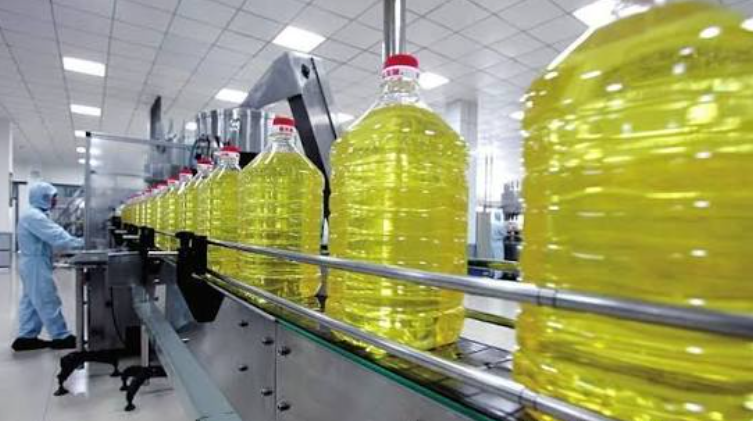
Table of Contents
- Evaluating Product Handling Capability for Bottled Oil
- Engineering a Continuous Packaging Process Integration
- Matching Production Capacity to End-of-Line Systems
- Flexibility and Scalability for Multi-SKU Production
- Assessing Application Scenarios for Cooking Oil Facilities
- Evaluating Supplier Engineering and Integration Capability
- Conclusion and Final Recommendations
1. Evaluating Product Handling Capability for Bottled Oil
Specialized bottle gripping technology is required for cooking oil handling because applying incorrect lateral pressure during high-speed transfer will dent lightweight bottles and cause micro-leaks.
The foundational metric of any bottled cooking oil packaging line is its ability to handle the product without causing physical damage. Cooking oil is frequently packaged in thin-walled PET or high-density plastic to reduce material costs. If a robotic case packer utilizes standard pneumatic side-clamps, the rapid acceleration of the robotic arm will crush the bottle walls, potentially compromising the cap seal and ruining the product before it reaches the carton.
When evaluating a system, engineers must scrutinize the end-of-arm tooling (EOAT). The optimal solution employs precision neck-gripping or custom-contoured shoulder gripping technology. This isolates the kinetic force away from the weak sidewalls, ensuring stable product positioning even at maximum operating speeds. Furthermore, the handling system must feature smooth conveyor transitions and automated diverters that prevent bottles from tipping or vibrating violently as they are grouped into their final case-packing matrix.
2. Engineering a Continuous Packaging Process Integration
A continuous workflow must mechanically and digitally synchronize bottle grouping, robotic case packing, carton sealing, and palletizing to prevent material accumulation and line stoppages.
Purchasing a collection of standalone machines—a case packer from one vendor and a labeler from another—forces the manufacturer to act as the system integrator. This fragmented approach invariably leads to mismatched Programmable Logic Controller (PLC) logic, uneven conveyor speeds, and localized bottlenecks where products pile up between stations.
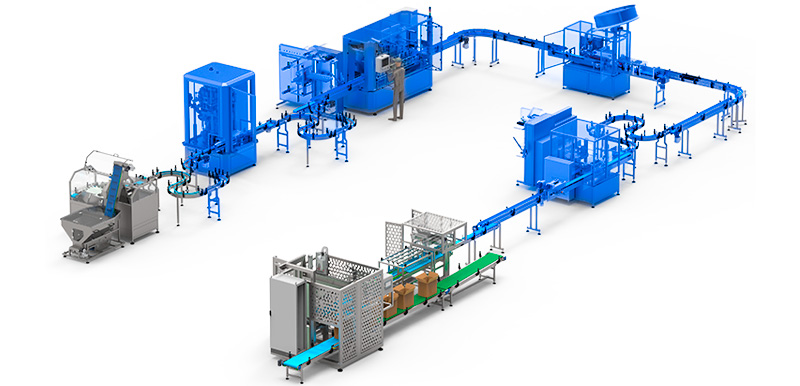
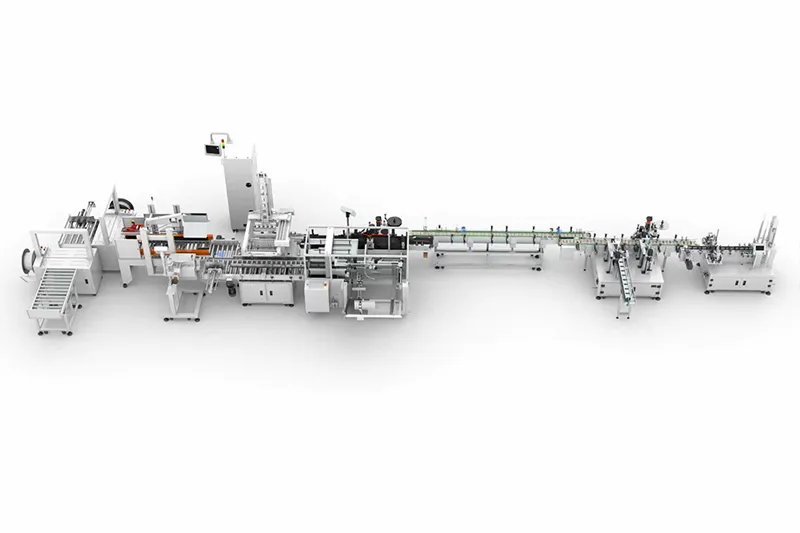
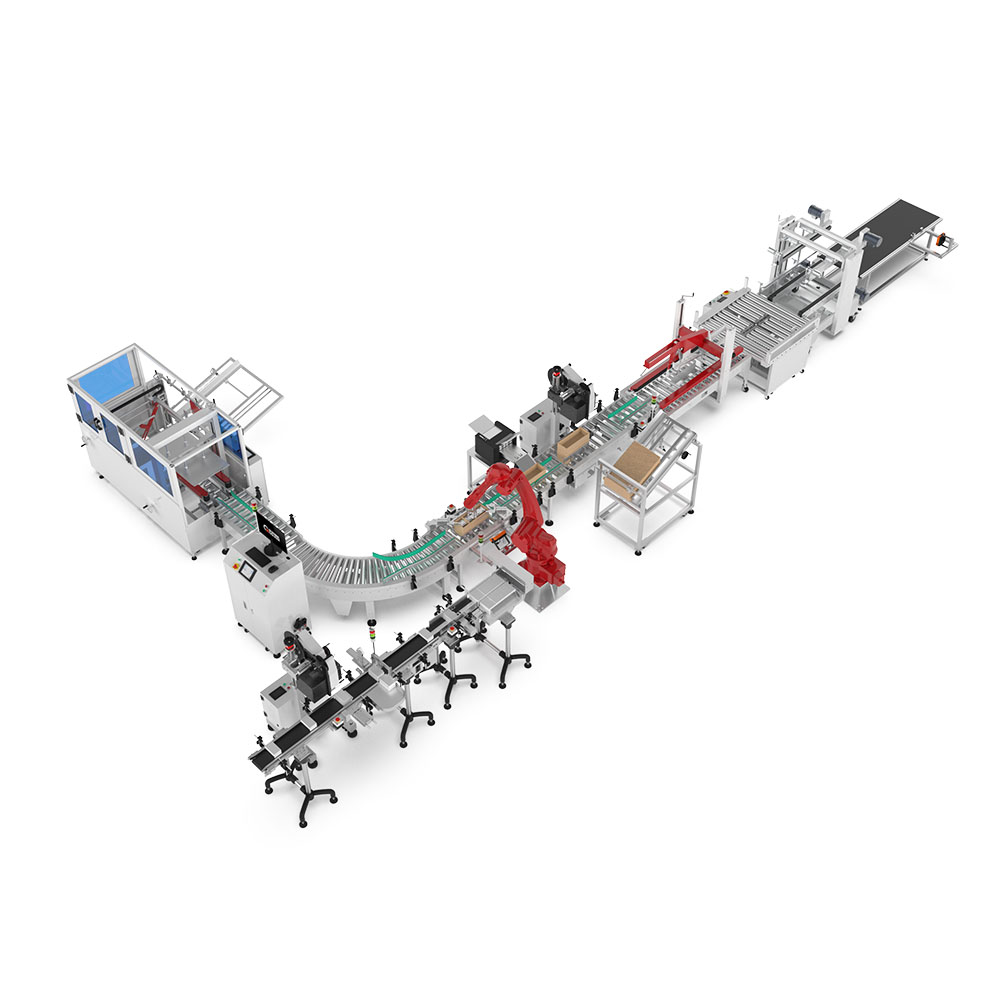
A highly efficient bottled cooking oil packaging line operates as a unified, turnkey ecosystem. The technical workflow should proceed seamlessly:
- Bottle Transfer & Grouping: The system receives bottles from upstream conveyors and groups them perfectly into pre-defined grid formats (e.g., 3×4 or 2×3).
- Automatic Case Erection & Packing: Carton blanks are erected flawlessly, and robotic arms load the grouped bottles simultaneously, eliminating drop-impacts.
- Carton Sealing: The loaded cases move through automated flap folders and tape/glue sealers to guarantee structural rigidity for warehousing.
- Labeling & Traceability: High-speed applicators attach logistics labels linked to the factory’s production database.
- Robotic Palletizing: Industrial robots construct stable, interlocking pallet patterns ready for immediate dispatch.
3. Matching Production Capacity to End-of-Line Systems
System capacity must be calculated based on continuous bottles-per-hour output and multi-shift configurations rather than evaluating machines based strictly on theoretical maximum speed.
A common procurement mistake is buying the fastest machine available without matching it to the factory’s actual upstream output. An oversized packaging system leads to excessive capital expenditure and inefficient stop-and-start operation as the EOL equipment constantly waits for bottles to arrive. Conversely, an undersized system creates severe upstream backups.
Engineers must calculate the required packaging capacity by auditing current output, accounting for planned growth, and evaluating OEE (Overall Equipment Effectiveness).
| System Sizing Scenario | Operational Impact | Equipment Cost Efficiency | Recommendation for Buyers |
| Undersized Packaging Line | Creates severe bottlenecks. Upstream equipment must be slowed down to prevent pile-ups. | High hidden costs due to lost production potential and manual labor interventions. | Unacceptable. Always engineer EOL capacity to be 10-15% faster than upstream output. |
| Oversized Packaging Line | Equipment suffers from frequent micro-stops as it starves for incoming product. | Poor capital allocation. High initial investment with extended ROI periods. | Avoid over-specifying unless major upstream expansion is contracted within 12 months. |
| Perfectly Matched System | Enables continuous, synchronized material flow with calculated buffer zones. | Maximum ROI. Capital is spent on precise automation tailored to actual throughput. | Ideal. Requires a supplier capable of customized line engineering and layout design. |
4. Flexibility and Scalability for Multi-SKU Production
Modular packaging architecture is recommended because it allows manufacturers to execute rapid recipe changeovers for multiple bottle sizes and easily integrate future capacity expansions.
Very few cooking oil manufacturers produce a single product size. A factory may need to run 1-liter PET bottles for retail and 5-liter jugs for commercial food service on the same line. If the packaging system relies on rigid, mechanical tooling that takes a maintenance crew four hours to swap out, the factory will lose thousands of dollars in downtime during every product changeover.
When selecting a turnkey cooking oil packing solution, prioritize flexibility. The system should utilize recipe-driven Human-Machine Interfaces (HMIs). With a smart system, an operator simply selects the new SKU on the touch screen, and the machinery automatically adjusts guide rails, robotic gripping coordinates, and sealing parameters. Furthermore, a modular design ensures that if factory capacity doubles in three years, additional robotic packing cells can be integrated into the existing control architecture without scrapping the original equipment.
5. Assessing Application Scenarios for Cooking Oil Facilities
Factories upgrading existing lines require automation that connects flawlessly to legacy conveyors, while export-oriented suppliers prioritize heavy-duty carton sealing and precision palletizing to survive long-distance logistics.
The operational environment of the facility dictates the specific requirements of the EOL packaging line.
- Food Manufacturing Plants with Existing Lines: These facilities face integration challenges. The new EOL automation must communicate with legacy upstream equipment without causing data faults. Precision accumulation conveyors are necessary to bridge the gap between older processing machines and high-speed robotic packers.
- Multi-SKU Cooking Oil Producers: Fast-moving consumer goods (FMCG) producers require systems with highly flexible robotic end-effectors capable of handling diverse bottle geometries (round, square, or contoured) with minimal changeover time.
- Export-Oriented Cooking Oil Suppliers: For products subject to ocean freight, load stability is paramount. The packaging line must feature advanced H-type carton sealing and tightly configured robotic palletizing to prevent carton collapse under turbulent transit conditions.
- Smart Food Factories: Greenfield projects prioritizing Industry 4.0 require native ERP integration. The packaging line must push real-time data regarding carton output, material consumption, and predictive maintenance alerts directly to the enterprise management system.
6. Evaluating Supplier Engineering and Integration Capability
Buyers must select suppliers with complete turnkey engineering capabilities to eliminate the severe project risks and communication breakdowns associated with multi-vendor coordination.
The success of an automation project relies heavily on the competence of the system integrator. If a factory buys equipment from three different manufacturers, they inherit the liability of making those machines communicate. During factory acceptance testing (FAT) or on-site commissioning, independent vendors frequently blame each other for software handshakes that fail or mechanical handoffs that drop products.
A highly capable supplier delivers a complete ecosystem. Evaluate potential partners based on their ability to provide end-to-end services: 3D facility layout design, in-house mechanical manufacturing, unified PLC programming, and comprehensive lifecycle support. A single-source provider ensures that the bottle diverter, the robotic case packer, and the palletizer are governed by one cohesive software architecture, drastically reducing installation time and ensuring immediate, stable production.
7. Conclusion and Final Recommendations
Selecting a bottled cooking oil packaging line is a strategic engineering decision that shapes a factory’s long-term profitability. Transitioning away from manual EOL operations removes arbitrary production ceilings, dramatically lowers labor dependency, and ensures retail-ready packaging consistency.
To maximize your investment, prioritize systems that offer precision robotic bottle gripping, synchronized turnkey workflows, and the modular flexibility required to handle future SKU expansions. Do not isolate machinery purchases; evaluate how the entire end-of-line system integrates with your specific throughput requirements and digital infrastructure.
For technical buyers and factory managers ready to eliminate post-processing bottlenecks and upgrade to a fully integrated, automated packaging workflow, we invite you to discuss your specific capacity requirements with our engineering experts to configure the ideal solution for your facility.
FAQs
1. What is the main cause of bottle damage during automated case packing?
Damage typically occurs when robotic tooling applies excessive lateral pressure to thin-walled PET bottles, or when bottles clash against each other due to aggressive conveyor grouping. Advanced systems utilize precision neck-gripping and servo-driven diverters to prevent this.
2. Can one automated packing line handle both round and square cooking oil bottles?
Yes, provided the system is designed with flexible automation. Advanced robotic case packers use quick-release, interchangeable end-of-arm tooling and adjustable grouping lane guides that can accommodate different bottle geometries via HMI recipe selections.
3. Why is it important to integrate carton sealing and palletizing into the same control system?
A unified control system ensures that if the palletizer needs to pause to discharge a full load, the carton sealer and case packer automatically scale back their speed or utilize accumulation buffers. This prevents crushed cartons and eliminates chaotic manual interventions.
4. How does an automated packaging line improve export logistics?
Automated lines provide superior structural consistency. Robotic carton erectors create perfectly square boxes, automated sealers apply exact tape tension, and robotic palletizers stack cartons with mathematical precision. This structural integrity prevents pallet collapse during long-distance shipping.
5. How much space is required to install a complete end-of-line packaging system?
Space requirements vary heavily based on capacity and layout configuration (e.g., linear vs. U-shaped). However, turnkey system integrators can engineer compact, unified machine frames that require significantly less footprint than stringing together multiple standalone machines.