An automated carton packing line is a connected sequence of machines—case erector, robotic case packer, sealer, and palletizer—that forms, fills, seals, and palletizes cartons with minimal human labor. For small and mid-sized manufacturers it typically replaces 6–8 manual packers per shift, reclaims cramped floor space, and pays back in roughly 12 months. This guide explains what the line does, how to automate the steps that still eat your team’s time (like carton selection), how fast it switches between products, and exactly how to calculate the ROI for your factory.
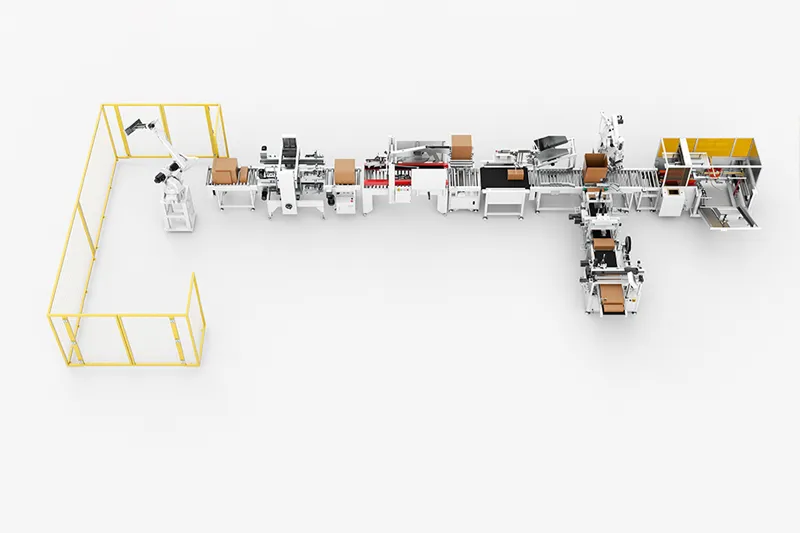
If your pack area relies on a few standalone machines tied together by hand labor, the shift to a fully automated carton packing line is one of the highest-leverage moves available to a small factory—without requiring a plant expansion.
Table of Contents
- Why Manual Packing Bleeds Profit in Small Factories
- What Is an Automated Carton Packing Line? (Definition + Workflow)
- How to Automate Manual Carton Selection
- The Industry 4.0 Layer: Predictive Maintenance & Real-Time Visibility
- Speed vs. Stability: Throughput You Can Plan Around
- Cutting the “Hidden Factory” of Rework and Errors
- How Fast Can a Line Switch Between SKUs? (Changeover Time)
- Case Study: From Standalone Stations to One Integrated Line
- How to Calculate ROI (With a Worked Example)
- What Does an Automated Carton Line Cost? (Honest Expectations)
- How to Choose the Right Configuration
- Frequently Asked Questions
- Secure Your Line with a Free Floorplan Analysis
1. Why Manual Packing Bleeds Profit in Small Factories
Many small manufacturers run “islands of automation”—a standalone case sealer here, a semi-auto strapper there—joined by manual labor. It keeps startup cost low but creates high operational variance.
The hidden cost of manual packing isn’t just wages; it’s the loss of rhythm. A manual operator often works at 80% efficiency in the morning and 60% after lunch. Add the difficulty of hiring reliable packers and the rising cost of repetitive-strain injuries, and the “cheap” manual approach evaporates fast.
2. What Is an Automated Carton Packing Line? (Definition + Workflow)
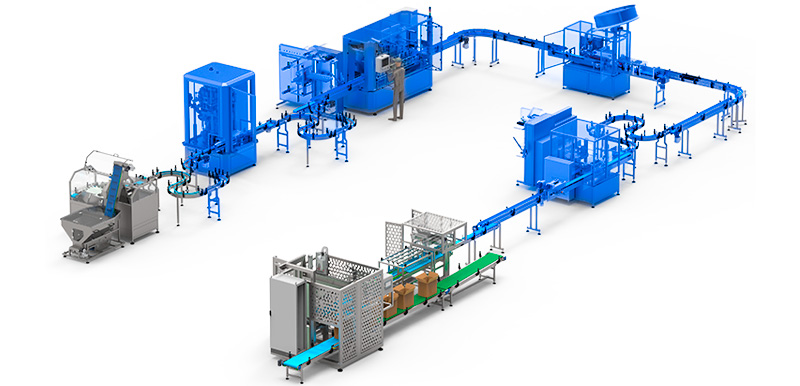
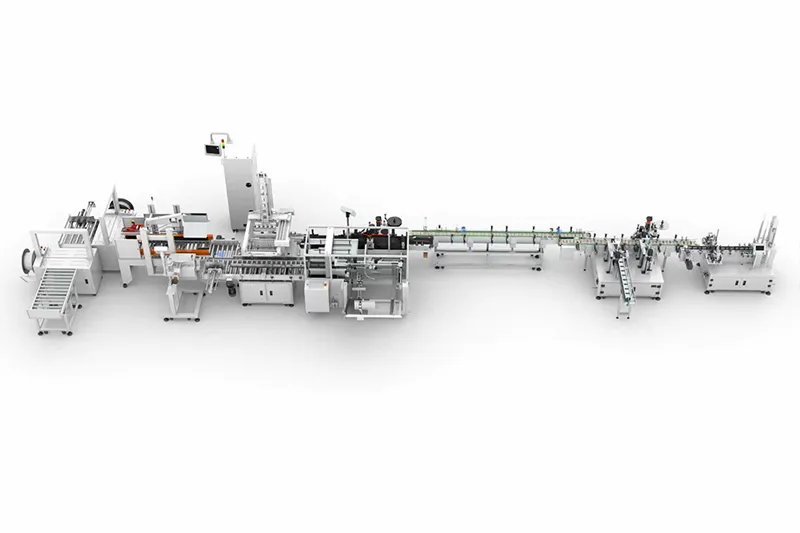
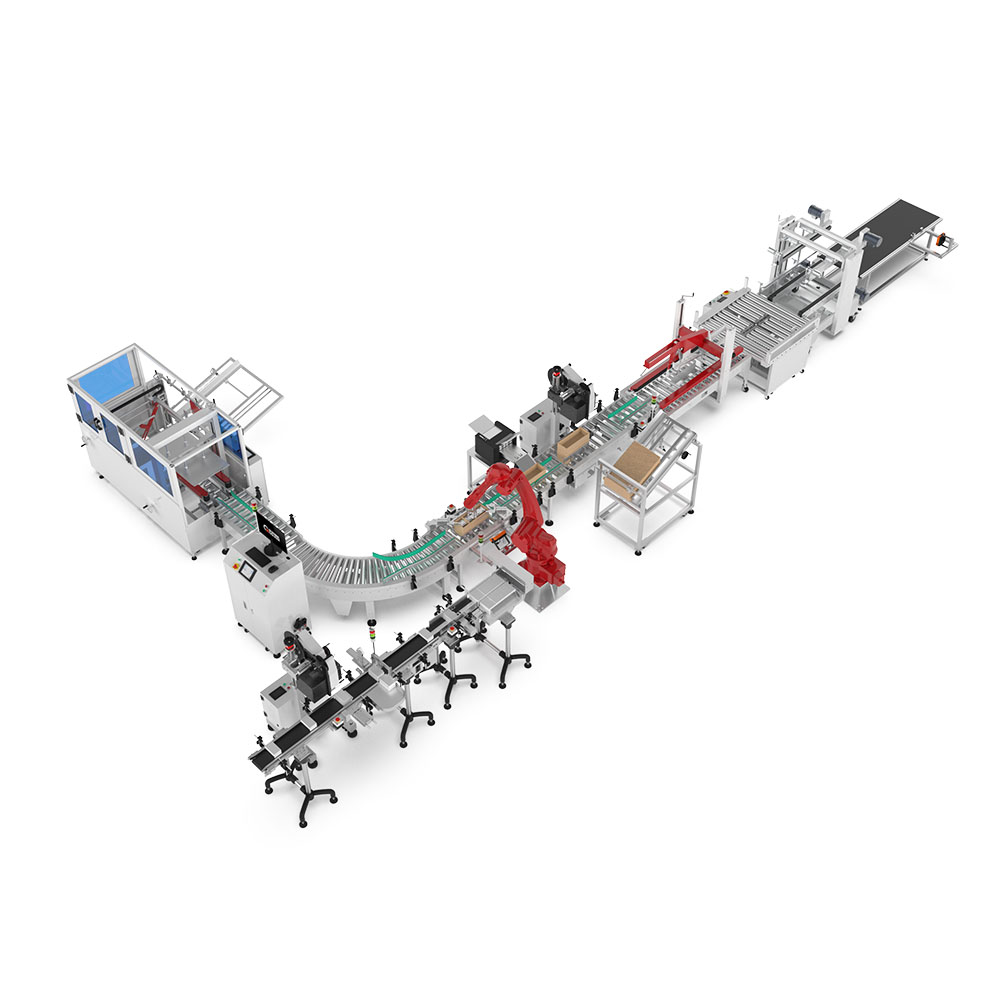
A true automated carton packing line is a continuous system that handles product from the moment it leaves production to the moment it is truck-ready. The typical sequence: Case Erector → Robotic Case Packing → Check Weighing & Vision → Sealing → Labeling → Palletizing → Stretch Wrapping.
| Stage | Manual / Semi-Auto | Fully Automated |
| Setup | Manual box folding (slow, inconsistent) | Automatic Case Erector (square boxes) |
| Loading | Hand packing (RSI risk, count errors) | Robotic Packer (precise, multi-SKU) |
| Quality | Random spot checks | Inline Check Weigher & Vision (100% inspection) |
| End-of-Line | Manual stacking, hand wrapping | Robotic Palletizer & Auto Wrapper |
By physically linking these stations, you eliminate the work-in-progress piles that accumulate between manual steps.
3. How to Automate Manual Carton Selection
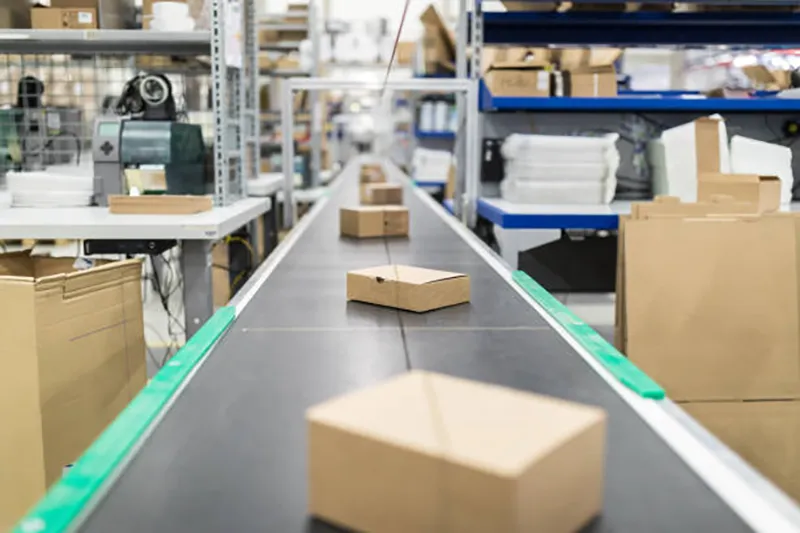
“Manual carton selection” usually means two slow, error-prone jobs: an operator physically choosing the right box for each order, and hand-placing products into it. Both are prime automation targets.
To automate carton selection, vision-guided robots identify each product and place it into the correct carton, while an auto-erector forms boxes sized to the order in real time (a “right-size” system). The result: no mismatched boxes, no mis-picks, and no operator walking the pack floor hunting for the right carton.
This is where a compact carton packing line pays off even for low-SKU operations—the robot and erector handle selection so your team moves to higher-value work.
4. The Industry 4.0 Layer: Predictive Maintenance & Real-Time Visibility
Modern lines sit on Industry 4.0 architecture—PLC networking and IoT sensors that act as the factory’s nervous system. SCADA dashboards show every station’s yield, utilization, and labor efficiency live.
More importantly, this connectivity enables predictive maintenance. By analyzing sensor data (motor vibration, temperature), the system flags degradation before failure—lowering maintenance cost up to 40% and raising OEE by 10–18%. See our deep dive on predictive maintenance in packaging lines for the full setup path.
Proactive alarms help cut unplanned stoppages by 30–50%, buying back lost production time.
5. Speed vs. Stability: Throughput You Can Plan Around
Small manufacturers often assume automation only pays at 500+ items/minute. The real value is reliability. A compact automated carton packing line holds a stable ~4,000 units/hour (about 60–70 cartons/minute).
A manual team may sprint for ten minutes then fade from fatigue. The automated line keeps a steady beat 24/7, guaranteeing predictable daily yield and outproducing manual packing by shift end.
6. Cutting the “Hidden Factory” of Rework and Errors
Rework is the silent killer of margin. Shipping a carton with a missing unit or misaligned label triggers customer penalties and return logistics.
Inline inspection and weighing reduce packaging errors and rework by 25–35% versus manual packing. If a carton is underweight (missing product) or a label is misprinted, the system rejects it automatically—without stopping the line—so 100% of pallets leaving your facility meet spec.
7. How Fast Can a Line Switch Between SKUs? (Changeover Time)
A modern automated carton line switches between SKUs in about 5–15 minutes, versus 30–60 minutes of manual reconfiguration. Changeover is driven by saved “recipes” on the HMI: an operator selects the product, and the line auto-adjusts case size, pack pattern, and label.
Quick-change tooling and vision-guided robotics mean format changes (e.g., 12-pack vs. 24-pack) no longer require wrench work or recalibration. For seasonal or multi-SKU small factories, this flexibility is what keeps the line busy year-round.
8. Case Study: From Standalone Stations to One Integrated Line
A regional food manufacturer moved from multiple standalone packing stations to a fully integrated Industry 4.0 carton packing line. The old setup needed 8 operators per shift for forming, packing, and palletizing.
The new line added an automatic carton erector, robotic case packer, vision inspection, sealing, and robotic palletizing.
- Labor: Operators dropped from 8 to 2 per shift—eliminating up to 20 manual roles across shifts and reaching full ROI in about one year.
- Flexibility: Modular design enabled fast format changeovers between SKUs via the HMI.
- Maintenance: Real-time data flagged a servo issue before failure, preventing a potential 4-hour shutdown.
- Outcome: Lower labor dependence and a stable, predictable daily output.
9. How to Calculate ROI (With a Worked Example)
Look past the sticker price. Compare Total Cost of Ownership (TCO) against the Cost of Inaction.
Worked example: a line removing 6 packing roles at $35,000 fully loaded = $210,000/year in labor savings. Add ~$20,000/year in saved film and damaged boxes. Against a ~$250,000 installed system, simple payback is about 14 months—before counting capacity gains that defer a second shift or new warehouse.
ROI factors to model: (1) labor savings (wages + benefits + turnover), (2) material savings (less film, fewer damaged boxes), (3) capacity gains (defer expansion).
10. What Does an Automated Carton Line Cost? (Honest Expectations)
There is no single price—cost scales with throughput, level of robotics, and how many stations are integrated. A semi-auto starter cell costs far less than a fully robotic, palletizing end-of-line system.
The right question isn’t “what’s the price?” but “what’s the payback?” Most small-factory deployments we size land in a range that pays back within 12–18 months through labor and material savings. Treat the quote as an investment with a modeled ROI, not a cost to minimize.
11. How to Choose the Right Configuration
- Integration level: Does the supplier deliver a true closed-loop system, or piece together third-party machines?
- Software: Is the SCADA dashboard intuitive? Can it export to your ERP?
- Flexibility: Can the robotic packer handle future products, or is it fixed to today’s design?
- Footprint: Does the layout fit your floor, or assume space you don’t have?
For the architecture behind a right-sized line, see how Industry 4.0 transforms end-of-line packaging.
12. Frequently Asked Questions
12.1 What is an automated carton packing line?
It is a connected sequence—case erector, robotic packer, sealer, palletizer—that forms, fills, seals, and palletizes cartons with minimal labor.
12.2 How do I automate manual carton selection?
Use vision-guided robots to identify and place products into the correct carton, plus an auto-erector that forms right-sized boxes on demand—eliminating hand selection and mis-picks.
12.3 How quickly can a carton packaging line switch between different product SKUs?
Typically 5–15 minutes via saved HMI recipes and quick-change tooling, versus 30–60 minutes of manual reconfiguration.
12.4 How do I calculate ROI for automating a manual packaging line?
Model labor savings (roles removed × fully-loaded cost) + material savings + capacity gains, then divide by installed cost. A 6-role line at $35k each often pays back in ~14 months.
12.5 What does an automated carton packing line cost?
It varies with throughput, robotics, and integration depth. Most small-factory systems we size pay back in 12–18 months, so evaluate by payback, not sticker price.
12.6 Can a small factory with limited space use one?
Yes. Compact, modular lines are designed for limited floorspace and connect to your existing production without a plant expansion.
12.7 Does automation suit low-volume or seasonal production?
Yes. Fast SKU changeover (5–15 min) keeps the line useful across seasons and product mixes, so you are not locked to one high-volume run.
12.8 How much labor can an automated carton line save?
A typical integrated line removes 6–8 manual packers per shift, redeploying that team to higher-value work.
13. Secure Your Line with a Free Floorplan Analysis
For small factories, the question is no longer “can we afford automation?” but “can we afford the instability of manual packing?”
JOYDA delivers right-sized, modular carton packing solutions integrated with your ERP and built on Industry 4.0 architecture—without a facility expansion.
Worried about limited space or a tight budget? Contact our engineering team for a free floorplan analysis and a customized ROI quote within 48 hours.