As commercial poultry farms continuously expand their daily production capacities, relying on manual egg packing methods or disjointed standalone machinery is no longer economically viable. Rising labor costs, stricter global food safety regulations, and the constant demand for higher throughput are forcing plant managers to rethink their end-of-line packaging strategies. Upgrading to a comprehensive, fully automated egg packing solution is the most effective way to eliminate production bottlenecks, minimize product damage, and ensure long-term operational resilience. This article provides technical guidance on selecting and implementing high-capacity turnkey packaging systems tailored for modern poultry operations.
Table of Contents
- The Shift to Turnkey Automated Egg Packing Systems
- Technical Workflow of a High-Capacity Egg Packing Line
- Engineering Gentle Handling for Fragile Products
- Application Scenarios: Matching Solutions to Farm Requirements
- Evaluating Modular Architecture and System Scalability
- Industry 4.0 Integration in Commercial Poultry Operations
- Selection Criteria for an Automation Partner
- Conclusion and Final Recommendations
1. The Shift to Turnkey Automated Egg Packing Systems
Turnkey automated egg packaging systems are essential for large poultry farms because they synchronize multiple packaging stages into one continuous workflow, eliminating the physical bottlenecks and data silos associated with fragmented machinery.
Historically, farms purchased packaging equipment in isolation—a carton erector from one vendor, a labeler from another, and manual labor to bridge the gaps. This fragmented approach requires complex third-party system integration, often resulting in mismatched Programmable Logic Controller (PLC) communication, inconsistent conveyor speeds, and frequent machine jams.
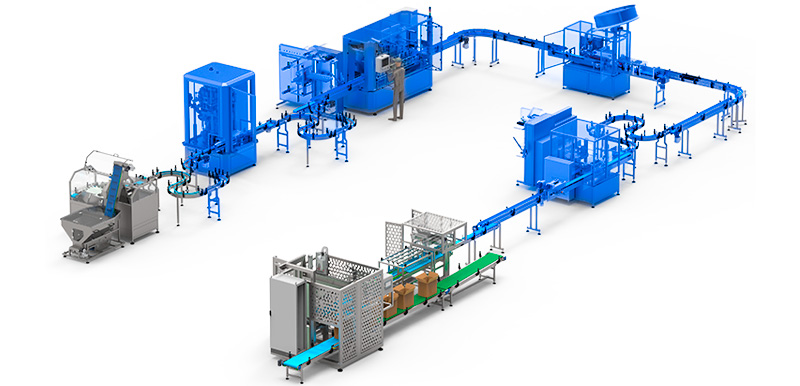
Modern commercial egg producers are shifting their procurement strategy entirely toward turnkey systems. A fully integrated automated egg packing production line connects all end-of-line processes through a unified mechanical and digital architecture. By treating the packaging line as a single cohesive organism rather than a series of disconnected workstations, farms achieve significantly higher Overall Equipment Effectiveness (OEE). This integrated approach ensures stable material flow, reduces the number of human operators required per shift, and guarantees consistent packaging quality from the first carton to the final pallet.
2. Technical Workflow of a High-Capacity Egg Packing Line
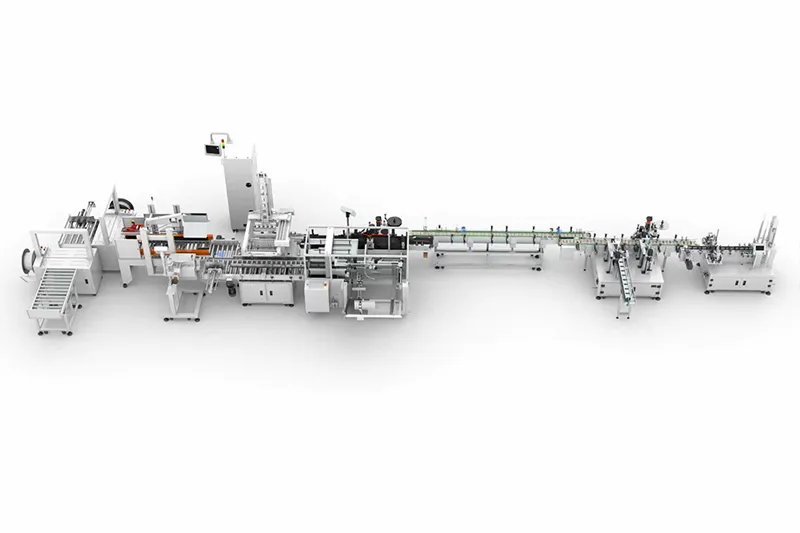
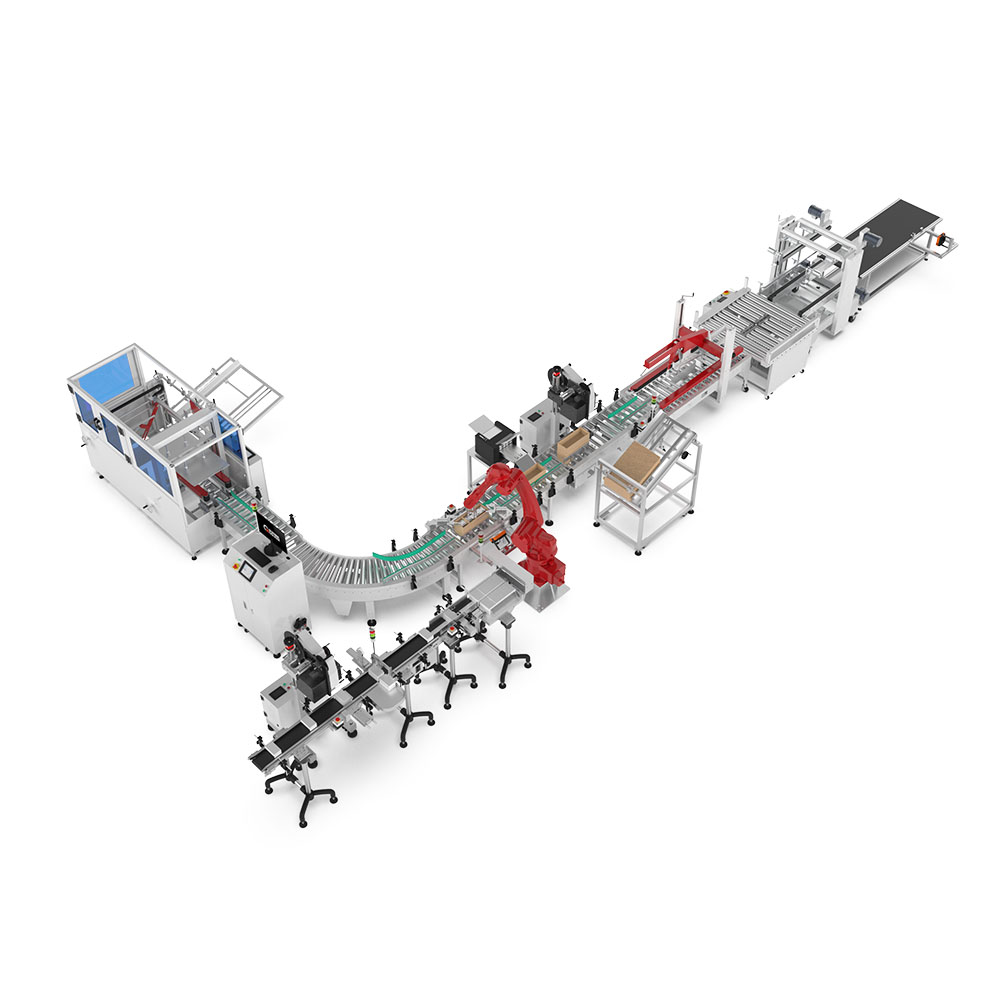
A high-capacity commercial egg packing line maximizes throughput by executing carton erection, sponge buffering, robotic loading, and palletizing as a digitally unified mechanical sequence.
To understand the value of an automated solution, engineers must evaluate the precise synchronization of its mechanical workflow. A modern system replaces manual intervention with servo-driven precision at every step.
A complete turnkey packaging workflow includes the following synchronized stages:
- Automatic Carton Erection: Denesting mechanisms rapidly separate and form empty cartons with high dimensional accuracy.
- Bottom Sponge Placement: Automated inserters place a protective buffered sponge at the base of the carton to absorb transit shocks.
- Robotic Egg Grouping and Loading: Vision-guided kinematics group graded eggs and load them gently into the carton pockets simultaneously.
- Top Sponge Placement: A secondary automated inserter places a top sponge, locking the eggs in place for transport protection.
- Flap Folding and Sealing: Mechanical plows fold the carton flaps without applying crushing force to the internal product.
- H-Type Reinforcement Sealing: For export or heavy-duty retail, systems apply an H-type tape seal to guarantee the carton’s structural integrity.
- Real-Time Printing and Labeling: Integrated printers apply batch codes, expiration dates, and RFID traceability tags at high speeds.
- Robotic Palletizing: Industrial robotic arms configure the sealed cartons into stable pallet loads ready for warehouse distribution.
3. Engineering Gentle Handling for Fragile Products
Robotic egg packing systems equipped with automated top and bottom sponge placement mechanisms are required for fragile product handling because they absorb kinetic shock, directly reducing egg breakage rates.
Egg damage is one of the most critical factors negatively impacting a poultry farm’s profitability. Manual packing introduces unpredictable kinetic forces; operators may drop eggs into cartons or crush them while closing misaligned lids.
Advanced engineering solves this through precision motion control. The robotic tooling utilized in a professional intelligent egg packing production line is designed with force-limiting sensors and custom end-effectors that perfectly match the contour of the eggs. Furthermore, the automated insertion of bottom and top sponges is a game-changer for large-scale producers. This dual-buffering technique suspends the eggs within the carton, preventing micro-vibrations during robotic palletizing and long-distance logistics from causing hairline cracks.
4. Application Scenarios: Matching Solutions to Farm Requirements
The optimal egg packing solution varies by application, with high-volume farms prioritizing continuous throughput while export-oriented producers focus on enhanced packaging protection and automated traceability.
A single packaging architecture does not fit every commercial farm. The automation solution must be tailored to the facility’s specific market demands and logistical challenges.
- Large Commercial Poultry Farms: Handling hundreds of thousands of eggs daily, these facilities require heavy-duty, high-speed lines where the primary focus is minimizing labor dependency and preventing unplanned mechanical downtime.
- Integrated Egg Production Companies: Operations that manage grading, packing, and warehousing internally benefit most from end-to-end material flow automation, ensuring that eggs move from the layer houses to the distribution trucks without manual bottlenecks.
- Export-Oriented Egg Producers: Shipping eggs internationally requires rigorous packaging integrity. These operations require automated H-type sealing and robust robotic palletizing to ensure pallets survive the dynamic loads of ocean freight or cross-border trucking.
- Poultry Farms Facing Labor Shortages: In regions where reliable manual labor is scarce, turnkey robotic automation provides operational resilience, allowing the farm to maintain maximum output regardless of workforce availability.
5. Evaluating Modular Architecture and System Scalability
Modular packaging system architecture is highly recommended for growing poultry operations because it allows for the future integration of additional robotic cells or varied carton formats without forcing a complete line replacement.
Capital investments in commercial poultry equipment must account for future business growth. Purchasing a rigid, non-scalable packaging line forces a farm into a complete operational redesign if they secure a new retail contract requiring a different carton size or a higher daily volume.
Modern automated solutions utilize a modular architecture. This means the system is built on standardized chassis and software frameworks. If a farm needs to increase throughput next year, a secondary robotic loading cell can be integrated seamlessly into the existing line.
| Feature | Rigid Standalone Machinery | Modular Turnkey Packaging System | Engineering Benefit for Poultry Farms |
| Capacity Expansion | Requires purchasing a separate, parallel line. | Additional robotic cells can be “plugged into” the existing layout. | Lowers the capital expenditure required for future growth. |
| Format Changeover | Extensive manual tooling adjustments (hours). | HMI recipe-driven automated changeovers (minutes). | Supports multiple retail carton formats (e.g., 6-pack, 30-tray) effortlessly. |
| Software Upgrades | Requires third-party PLC reprogramming. | Centralized updates deployed across all modules. | Keeps the system aligned with the latest Industry 4.0 standards. |
| Footprint Utilization | Large, inefficient spacing between machines. | Compact, shared-conveyor architecture. | Maximizes throughput per square meter of factory floor space. |
6. Industry 4.0 Integration in Commercial Poultry Operations
ERP-integrated packaging lines are vital for modern smart farms because they provide real-time production visibility, predictive maintenance alerts, and seamless data exchange with upstream grading systems.
Hardware alone cannot achieve the maximum Total Cost of Ownership (TCO) benefits. The best egg packing production lines operate as digital nodes within a broader smart factory ecosystem.
Industry 4.0 integration allows the packaging line to communicate bidirectionally with the farm’s Enterprise Resource Planning (ERP) and Manufacturing Execution Systems (MES). When the upstream grading equipment detects an influx of large-grade eggs, the integrated software automatically adjusts the robotic packaging speed to accommodate the flow. Simultaneously, the system monitors servo motor torque and pneumatic pressure, triggering predictive maintenance alerts before a mechanical failure can halt production. This digital connectivity ensures complete traceability, logging every sealed carton against specific grading batches for flawless compliance with global food safety standards.
7. Selection Criteria for an Automation Partner
Large poultry farms must select turnkey system integrators over basic equipment manufacturers because single-source providers guarantee seamless mechanical, software, and logistical synchronization across the entire project lifecycle.
The success of transitioning to an automated egg packing operation relies heavily on the capability of the supplier. Coordinating multiple vendors for layout design, machine manufacturing, and software integration introduces immense project risk and delays commissioning timelines.
When evaluating potential automation partners, commercial farms should demand:
- Complete Turnkey Capability: The partner must design, manufacture, and integrate the entire workflow (erecting, packing, sealing, labeling, and palletizing) internally.
- Proprietary Software Ownership: Select a supplier with in-house software subsidiaries. This ensures the mechanical hardware and control systems communicate natively, allowing for rapid customization and reliable ERP integration.
- Proven Lifecycle Support: The supplier must provide comprehensive layout engineering, factory acceptance testing (FAT), on-site commissioning, and long-term predictive maintenance support.
8. Conclusion and Final Recommendations
For large commercial poultry farms, transitioning to a fully automated egg packing solution is the most strategic maneuver to safeguard profitability against rising labor costs and strict quality demands. A high-performance packaging line is not just a collection of conveyors and robots; it is a meticulously engineered workflow that protects fragile products, maximizes throughput, and integrates seamlessly with enterprise data systems.
By prioritizing turnkey systems over standalone machinery, investing in gentle robotic handling, and ensuring modular scalability, plant managers can significantly lower their Total Cost of Ownership while future-proofing their facilities.
To explore how advanced robotic integration and Industry 4.0 connectivity can transform your facility’s operational efficiency, reach out to our technical engineering team to discuss a customized, turnkey packaging solution designed for your specific production volume.
FAQs
1. How does automated top and bottom sponge placement reduce total operating costs?
By suspending the eggs in a buffered environment, the automated sponge placement virtually eliminates hairline cracks and breakages caused by downstream logistics and robotic palletizing, directly increasing the yield of sellable product and preventing costly retailer rejections.
2. Can an automated line integrate with my existing egg grading equipment?
Yes. A professional turnkey system is engineered with customized transition conveyors and integrated control software that synchronizes the packaging line’s speed directly with the output data of your existing grading machinery, preventing product pile-ups.
3. What is the advantage of H-type reinforcement sealing for egg cartons?
H-type sealing applies tape to the center seam and both edges of the carton. This provides maximum structural rigidity, preventing the carton from bursting open under heavy compression loads during high-tier robotic palletizing or turbulent long-distance export shipping.
4. How quickly can a modular packing line switch between different carton sizes?
Advanced modular systems utilize recipe-driven Human-Machine Interfaces (HMIs) and quick-release robotic tooling. Operators can select a new packaging format on the touchscreen, and the system automatically adjusts guide rails and suction parameters in a matter of minutes.
5. Why is single-source turnkey integration critical for poultry farms?
A single-source integrator is solely accountable for the entire line’s performance. This eliminates the operational risks and commissioning delays caused by different equipment vendors blaming each other for software communication failures or mechanical bottlenecks during installation.