In modern manufacturing, production delays are rarely caused by a single, obvious issue. When packaging lines lose efficiency, factory managers often struggle to identify whether the root cause is a machine slowdown, a material shortage, or incorrect operator settings, leading to delayed fault reporting and reduced output. Industry 4.0 manufacturing solutions eliminate these hidden inefficiencies because they connect packaging equipment and production data into an integrated environment, allowing manufacturers to identify delays instantly and take immediate corrective actions. This guide explains how transitioning to smart manufacturing systems provides the real-time visibility needed to optimize end-of-line packaging and eliminate costly downtime.
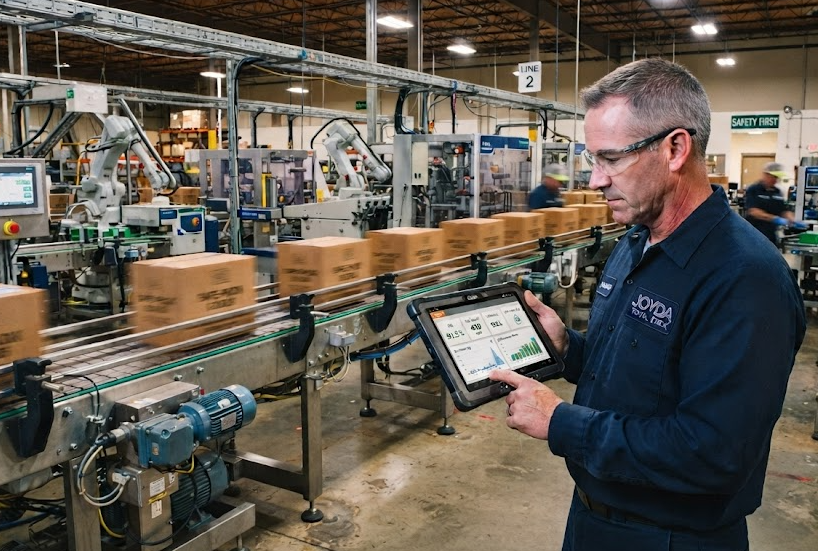
Table of Contents
- The Challenge: Hidden Inefficiencies in Traditional Packaging Lines
- Overcoming Production Blind Spots with Real-Time Monitoring
- Data-Based Root Cause Analysis: Moving from Guessing to Knowing
- Reducing Unexpected Shutdowns with Predictive Maintenance
- Connecting Isolated Equipment into a Smart Packaging Ecosystem
- Bridging the Gap: MES and ERP Integration for Smart Factories
- Industry Application Scenarios: Solving Sector-Specific Delays
- Evaluating Smart Factory Partners: Turnkey Integration vs. Standalone Machines
- Conclusion
1. The Challenge: Hidden Inefficiencies in Traditional Packaging Lines
Traditional packaging lines suffer from prolonged production delays because disconnected machines and manual reporting prevent operators from identifying the root cause of an interruption until production performance has already dropped.
For traditional end-of-line packaging operations, including case packing, labeling, bagging, and robotic palletizing, visibility is severely limited. Operators typically discover a problem only after a machine has completely stopped or a bottleneck has formed on the conveyor. In these reactive environments, factory managers often know that output is dropping and orders are delayed, but they lack the tools to pinpoint exactly which machine is causing the issue.
This lack of manufacturing data visibility means that minor anomalies—such as a slight machine slowdown, an unexpected material shortage, or an incorrect operational setting—can compound into major production losses. Without digital tracking, determining whether a delay was caused by mechanical failure or poor workflow coordination requires time-consuming manual investigation, directly affecting revenue and customer delivery timelines.
2. Overcoming Production Blind Spots with Real-Time Monitoring
Real-time production monitoring is essential for minimizing downtime because it continuously collects operational data from connected equipment, allowing factory managers to quickly locate abnormal production points without relying on manual inspections.
Industry 4.0 packaging automation transforms the factory floor by equipping machinery with intelligent sensors and IoT-enabled capabilities. Instead of waiting for an operator to notice a fault, smart packaging systems continuously track critical operational metrics.
By analyzing this data stream, production managers gain immediate visibility into the health of the line. Key data points monitored in an Industry 4.0 packaging system include:
- Machine running status: Active, idle, or faulted states across the entire line.
- Production output and cycle time: Measuring real-time throughput against target KPIs.
- Equipment alarms and downtime records: Instant logging of fault codes and stoppage durations.
- Material consumption: Tracking packaging material usage to prevent stock-out delays.
- Production efficiency indicators: Calculating Overall Equipment Effectiveness (OEE) dynamically.
When a machine slows down, the system flags the efficiency drop immediately, empowering operators to intervene before a minor issue escalates into a complete line stop.
3. Data-Based Root Cause Analysis: Moving from Guessing to Knowing
Data-based production delay analysis transitions factories from reactive troubleshooting to precise diagnostics because it identifies exactly which machine caused the interruption, when it started, and whether it stems from equipment wear or operational errors.
The most significant barrier to resolving manufacturing downtime is that traditional factories often know what happened (e.g., the palletizer stopped) but cannot quickly determine why it happened (e.g., an upstream case packer delayed the feed).
Industry 4.0 smart manufacturing systems solve this by establishing a clear timeline of events. Through deep data-based root cause analysis, manufacturers can map out exactly where the efficiency drop originated. The system evaluates:
- Which specific production unit initiated the fault.
- The exact timestamp the efficiency drop began.
- The total duration of the downtime and its cascading effect on downstream equipment.
- Whether the root cause is tied to mechanical failure, material inconsistencies, or improper parameter settings.
By identifying recurring problems mathematically rather than anecdotally, engineers can implement permanent corrective actions, optimizing the entire packaging line performance and stabilizing high-volume output.
4. Reducing Unexpected Shutdowns with Predictive Maintenance
Predictive maintenance in manufacturing reduces unexpected equipment shutdowns because smart packaging systems use continuous condition monitoring to detect early warning signals before a catastrophic mechanical failure occurs.
Unexpected equipment failure is one of the leading causes of production delays and revenue loss. In a traditional setup, maintenance is either reactive (fixing a broken machine) or preventative (replacing parts on a strict schedule, regardless of actual wear). Both approaches are inefficient and costly.
IoT-enabled packaging lines introduce predictive maintenance, which analyzes real-time mechanical data—such as motor vibration, temperature spikes, or servo torque resistance—to predict failures. When a component begins to degrade, the system triggers an alert, allowing maintenance teams to schedule repairs during planned changeovers rather than suffering mid-shift breakdowns.
At JOYDA TECH, our Industry 4.0 solutions emphasize these predictive systems, ensuring that potential anomalies are neutralized before they affect production performance. This approach improves equipment availability, extends machine lifecycles, and drastically reduces emergency maintenance costs.
5. Connecting Isolated Equipment into a Smart Packaging Ecosystem
Connecting isolated packaging equipment into a unified smart ecosystem eliminates inter-machine bottlenecks because case erectors, packers, labelers, and palletizers communicate seamlessly to regulate material flow.
Many existing packaging lines have become difficult to manage because they consist of isolated machines purchased from different vendors over time. When machines do not communicate, an upstream case erector might overproduce while a downstream labeling machine is jammed, creating chaotic backups and unnecessary wear.
A turnkey Industry 4.0 packaging line connects these disparate units into a coordinated automation system. In this smart ecosystem, the operational speed of the case packer is automatically synchronized with the output of the case erector and the intake capacity of the robotic palletizer. This dynamic speed adjustment prevents material collisions, reduces the risk of localized jams, and ensures that the entire line operates smoothly as a single intelligent entity.
6. Bridging the Gap: MES and ERP Integration for Smart Factories
MES integration for smart factories eliminates administrative delays because it bridges business management systems with shop-floor execution, aligning production planning directly with real-time machine operation data.
For manufacturers operating large-scale production facilities, delays are not always mechanical; they often stem from poor coordination between the planning department and the shop floor. When production schedules are distributed manually, changeovers are delayed, and incorrect packaging formats are frequently used.
Integrating the packaging line with Manufacturing Execution Systems (MES) and Enterprise Resource Planning (ERP) software creates a closed-loop data architecture. This integration facilitates:
- Automated Production Planning: Orders from the ERP are sent directly to the packaging line’s master control, automatically adjusting machine recipes for upcoming batches.
- Production Tracking and Traceability: Every carton packed and palletized is logged in the central database, essential for compliance and quality control.
- Manufacturing Execution: Real-time completion rates are fed back to management, allowing for precise logistics scheduling without waiting for end-of-shift manual reports.
7. Industry Application Scenarios: Solving Sector-Specific Delays
Industry 4.0 manufacturing solutions are highly adaptable to sector-specific requirements because they provide tailored data visibility to solve challenges like high-speed bottlenecks, frequent changeovers, and strict traceability mandates.
Different manufacturing sectors face unique challenges that cause production delays. Evaluating how Industry 4.0 addresses these specific pain points helps clarify the practical value of smart factory solutions for manufacturing.
| Manufacturing Industry | Common Production Problems | Industry 4.0 Solution Value | Selection Recommendation |
| Food & Beverage | High-speed interruptions, seasonal demand spikes, untracked line losses. | Real-time bottleneck identification ensures continuous flow; prevents product spoilage due to stoppages. | Recommended when maximizing throughput and minimizing micro-stops is the primary goal. |
| FMCG / Consumer Goods | Multiple product formats, frequent and lengthy physical changeovers. | Connected automation analyzes efficiency and digitizes parameter adjustments for faster SKU changes. | Highly suitable for facilities with high product mix and tight delivery windows. |
| Pharmaceuticals | Strict quality requirements, high cost of packaging errors, lack of traceability. | Digital monitoring and automated data collection ensure every package is tracked, preventing compliance failures. | Strictly required for environments where data integrity and recall readiness are mandatory. |
| Electronics | Complex schedules, small batch runs, need for highly flexible packaging. | Smart systems allow rapid adjustment to real-time data, maintaining line OEE during small-batch transitions. | Recommended for agile manufacturing environments prioritizing precision and flexibility. |
8. Evaluating Smart Factory Partners: Turnkey Integration vs. Standalone Machines
Partnering with a turnkey Industry 4.0 packaging solution provider is strongly recommended over purchasing standalone machines because comprehensive factory integration ensures seamless hardware compatibility, centralized data management, and long-term production optimization.
When production managers recognize that downtime is directly affecting revenue, the next step is procurement. However, buyers often make the mistake of purchasing another isolated machine to solve a localized problem, which only fragments factory data further. Manufacturers need a complete Industry 4.0 partner, not just a machine supplier.
When evaluating how to upgrade your packaging line, consider these decision rules:
- Standalone equipment is suitable when upgrading a single manual station in a low-volume environment where data tracking is not required.
- Turnkey smart factory integration is recommended when existing packaging lines are becoming difficult to manage, data is too scattered to analyze, and the factory requires complete automation system integration—from mechanical design to software connectivity.
A true integration partner provides automation solution design, software connection, robust data management, and ongoing predictive maintenance support.
9. Conclusion
Production delays are a symptom of disconnected operations and hidden inefficiencies. By implementing Industry 4.0 manufacturing solutions, factories can transition from guessing the causes of downtime to actively monitoring, diagnosing, and preventing them. Real-time production monitoring, data-driven root cause analysis, predictive maintenance, and deep MES integration provide production managers with the exact visibility needed to optimize workflows. To truly eliminate packaging line delays, manufacturers must move beyond isolated equipment and embrace complete, intelligently connected turnkey ecosystems.
Ready to eliminate production blind spots in your packaging line?
As a complete Industry 4.0 partner, JOYDA TECH specializes in turnkey packaging solutions, smart factory integration, and automation system connectivity. Stop guessing where your efficiency is dropping. Contact our engineering team today to discuss how our integrated case packing, labeling, and palletizing systems can provide the real-time data visibility you need to optimize your production performance.
Frequently Asked Questions (FAQs)
1. How does Industry 4.0 help identify the root cause of production delays?
Industry 4.0 systems continuously monitor all connected machinery. Instead of manually inspecting the line after a failure, the system’s data-based root cause analysis pinpoints exactly which machine caused the interruption and at what time, providing clear diagnostics.
2. What is real-time production monitoring in a packaging line?
It is the continuous, automated collection of operational data—such as cycle times, machine status, alarm logs, and material consumption—allowing managers to view the exact performance of the packaging line on a live digital dashboard.
3. How does predictive maintenance differ from traditional maintenance?
Traditional maintenance relies on fixing broken parts or replacing them on a rigid schedule. Predictive maintenance uses real-time sensor data (like vibration or temperature) to detect early warning signs of wear, allowing repairs to be scheduled before an unexpected shutdown occurs.
4. Why is MES integration important for end-of-line packaging?
Integrating the packaging line with a Manufacturing Execution System (MES) aligns shop-floor operations with top-floor business planning. It automates recipe changeovers, ensures accurate production tracking, and prevents delays caused by manual scheduling errors.
5. Can Industry 4.0 solutions be applied to existing packaging lines?
Yes. While turnkey systems offer the highest level of integration, existing lines can be upgraded with IoT-enabled sensors, connected PLCs, and centralized data management software to create a bridge toward a smart factory environment.
6. Why should we choose a turnkey integration partner instead of buying individual smart machines?
A turnkey partner like JOYDA TECH ensures that all mechanical equipment, software, and data management systems communicate flawlessly. Buying individual machines from different vendors often leads to software incompatibility and fragmented data, defeating the purpose of Industry 4.0 visibility.