Designing an efficient egg packing line layout is not merely about fitting machinery into an available building space; it is a critical engineering decision that dictates operational throughput, product safety, and labor utilization. Poor facility design leads to material handling bottlenecks, higher egg breakage rates, and restricted production scalability. As egg producers transition toward automated manufacturing, layout planning must be executed as an integral part of the automation project, ensuring every process from carton feeding to final palletizing operates flawlessly.
This article provides a comprehensive technical framework for engineering an optimized packaging plant layout, helping operations directors and automation engineers evaluate spatial requirements, eliminate production risks, and implement scalable turnkey solutions.
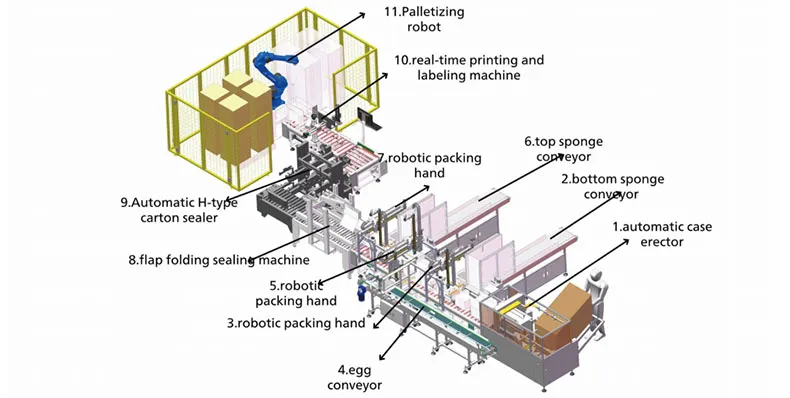
Table of Contents
- The Impact of Facility Layout on Egg Packaging Efficiency
- Core Engineering Principles for Egg Packing Line Layout Design
- Synchronizing the Integrated Egg Packing Workflow
- Technical Comparison: Modular vs. Integrated Layout Configurations
- Overcoming System Integration Challenges in Egg Plant Layouts
- Adapting Layouts to Specific Egg Manufacturing Scenarios
- Scalability and Industry 4.0 Readiness in Layout Planning
- Selection Criteria for a Turnkey Layout Engineering Partner
- Conclusion and Final Recommendations
1. The Impact of Facility Layout on Egg Packaging Efficiency
An optimized egg packing line layout directly dictates overall equipment effectiveness (OEE) by minimizing unnecessary product movement, eliminating material bottlenecks, and establishing a continuous, synchronized flow from carton erection to robotic palletizing.
In high-volume egg production, the physical arrangement of equipment dictates the stability of the entire operation. Traditional facilities often treat packaging as a series of isolated workstations. This fragmented approach requires excessive manual transfer between machines, increasing the risk of dropping fragile products and creating localized bottlenecks where one fast machine is constantly forced to wait for a slower downstream process.
Modern smart factories approach layout design fundamentally differently. An integrated layout views the entire end-of-line process as a single, cohesive organism. By designing the layout to minimize travel distance and eliminate cross-traffic between raw materials (empty cartons, sponges) and finished goods (sealed and palletized eggs), manufacturers can drastically lower labor overhead. Furthermore, a highly optimized layout minimizes the kinetic stress placed on the eggs. Smooth, linear transitions between conveyors and robotic cells ensure that the packaging materials and the eggs remain stable, directly reducing the scrap rate and protecting the manufacturer’s profit margins.
2. Core Engineering Principles for Egg Packing Line Layout Design
Effective egg packaging line design relies on linear product flow, balanced workstation capacity, dedicated material paths, strict robotic safety zones, and pre-planned floor space for future modular expansion.
To achieve a seamless automated workflow, plant engineers must adhere to strict spatial and mechanical principles during the initial CAD design phase. Ignoring these principles often results in retrofitting costs that exceed the initial equipment investment.
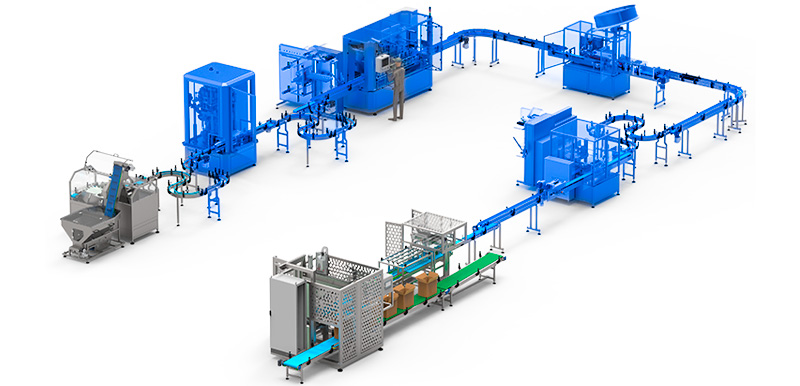
- Linear Product Flow: The layout should follow a straight-line or U-shaped progression. Complex zig-zag patterns require additional transfer conveyors, diverters, and 90-degree turns. Every transfer point introduces a micro-vibration that can misalign an open egg carton or damage the product. Linear flow ensures smooth, high-speed transit.
- Dedicated Material Flow Paths: Forklifts delivering empty pallets or raw packaging materials must never intersect with the path of finished goods moving to the warehouse. A professional layout dedicates the back end of the line strictly to material infeed and the front end strictly to automated outfeed, preventing logistical gridlock.
- Robotic Operating Zones: Industrial and collaborative robots require specific kinematic clearance. Layouts must provide sufficient footprint for safety fencing, light curtains, and emergency maintenance access without encroaching on adjacent production lines or pedestrian walkways.
- Workstation Capacity Balancing: Space must be allocated for accumulation buffers. If the automatic labeler requires a micro-stop to swap a label roll, a properly designed accumulation conveyor allows the upstream robotic loader to continue running for several minutes, preventing a complete line shutdown.
3. Synchronizing the Integrated Egg Packing Workflow
A continuous production workflow physically connects carton erection, bottom and top sponge placement, robotic egg loading, sealing, and labeling into a unified material handling process, drastically reducing handling-related damage.
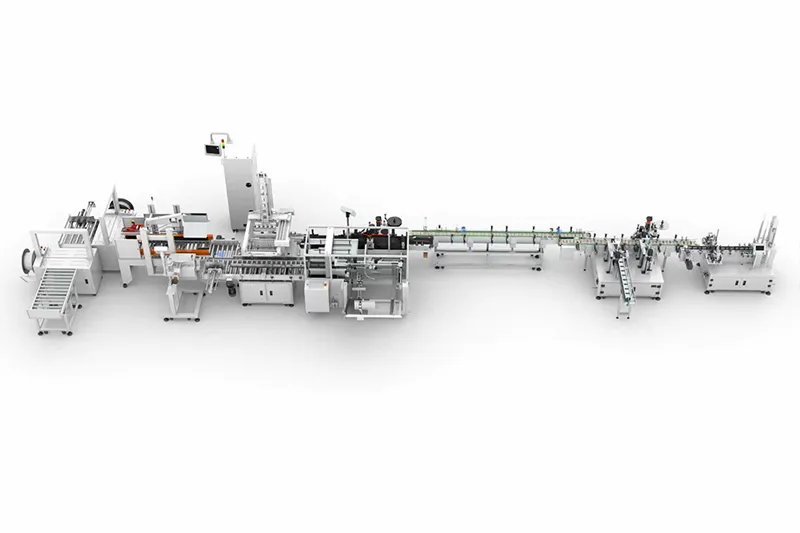
When planning the footprint for an advanced automated egg packing production line, the sequence of operations must be physically grouped to share centralized control systems and power distribution.
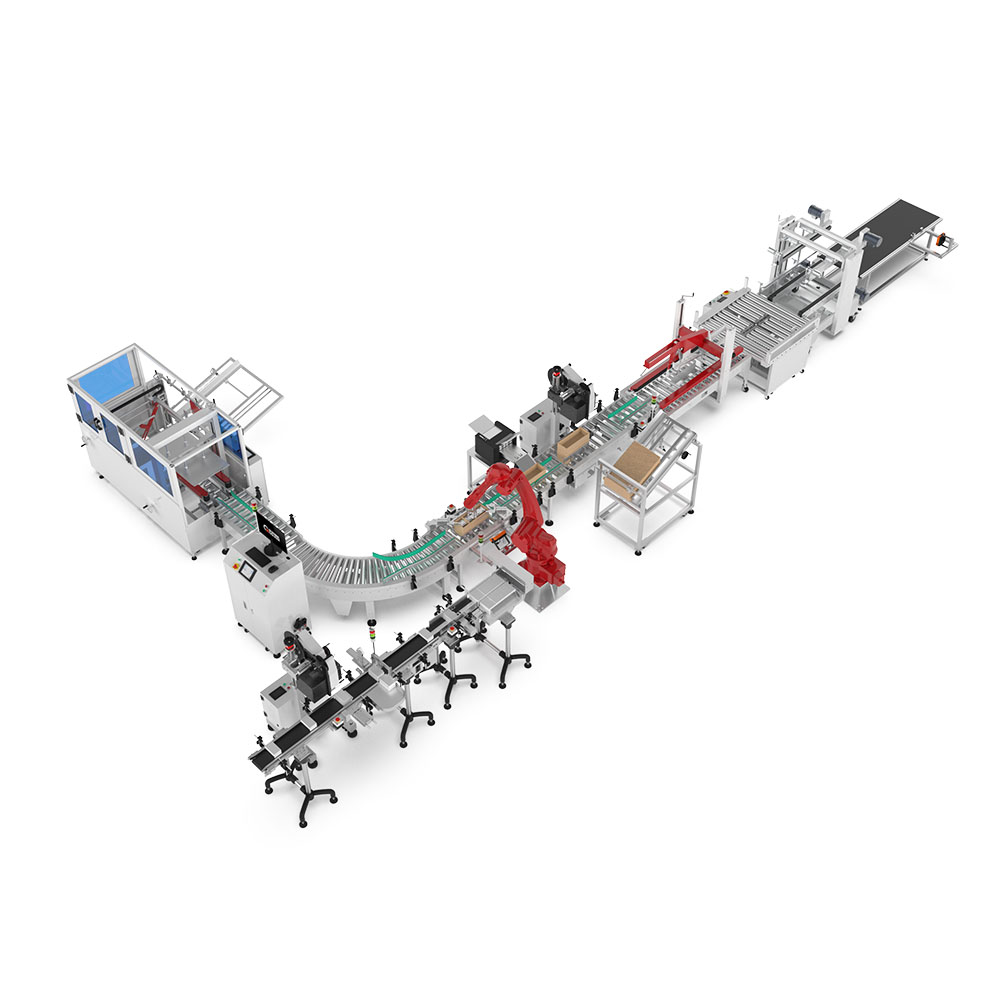
A high-performance layout sequences equipment tightly to limit the time a carton remains open and vulnerable. The workflow begins with the automatic carton erector, which feeds directly into the bottom sponge placement station. Immediately following this, the carton enters the robotic loading zone. By keeping the loading zone adjacent to the sponge insertion, the layout minimizes the chance of the lightweight sponge blowing out of the carton due to factory drafts.
After robotic loading, the layout must seamlessly route the filled carton to the top sponge placement and automatic sealing stations. In JOYDA’s integrated philosophy, these mechanical steps are grouped into a compact, unified automation cell. This reduces the overall footprint of the line while ensuring that the carton is immediately sealed and stabilized. Finally, the layout routes the sealed cartons through dynamic checkweighers and labelers before entering the robotic palletizing cell, creating a continuous, hands-free journey from empty paper to a ready-to-ship pallet.
4. Technical Comparison: Modular vs. Integrated Layout Configurations
Compared to traditional fragmented configurations, a fully integrated end-of-line packaging layout reduces required floor space, standardizes communication protocols, and eliminates manual transfer zones that often lead to product damage.
When evaluating how to configure their factory floor, decision-makers typically choose between piecing together individual modular machines from different vendors or adopting a fully integrated layout designed by a single system integrator. The integrated approach offers profound advantages in both spatial efficiency and operational control.
| Layout Evaluation Metric | Fragmented / Modular Layout | Fully Integrated Turnkey Layout | Engineering Impact / Decision Value |
| Floor Space Efficiency | Low. Requires extensive connecting conveyors and manual buffer zones. | High. Machinery is compactly designed to share chassis and transfer mechanisms. | Integrated layouts are critical for factories with restricted square footage. |
| Product Breakage Risk | High. Manual transfers or mismatched conveyor speeds cause collisions. | Minimal. Servo-driven synchronization ensures gentle, continuous handling. | Fragile products demand integrated layouts to protect profit margins. |
| Control Architecture | Complex. Multiple PLC brands and isolated HMI screens. | Unified. Single master PLC controls the entire synchronized line. | Integrated systems simplify operator training and fault diagnosis. |
| Throughput Stability | Variable. Bottlenecks frequently occur between unmatched machine capacities. | Highly Stable. Line is engineered with calculated accumulation zones. | Integrated layouts guarantee the required OEE and daily production targets. |
| Installation & Commissioning | Lengthy. High risk of mechanical and software conflicts on-site. | Fast. The entire layout is pre-assembled and FAT tested by one supplier. | Single-source layout design drastically reduces project downtime. |
5. Overcoming System Integration Challenges in Egg Plant Layouts
Successful egg packing plant layouts must physically and digitally synchronize with upstream egg grading machines, downstream warehouse logistics, and overarching MES/ERP systems without causing spatial or data bottlenecks.
The most critical point of failure in any layout is the integration zone where two different systems meet. An automated packaging line does not exist in a vacuum; it must consume eggs at the exact rate the upstream grading machine produces them.
If the egg packing line layout does not account for the grading machine’s outfeed height, pitch, and speed, the transition will cause massive product accumulation and crushing. To overcome this, the layout must incorporate customized transition conveyors and servo-driven diverters that phase the eggs perfectly into the packaging robotic cells.
Similarly, downstream integration requires careful spatial planning. Once the robot palletizes the cartons, the layout must facilitate the smooth exit of the full pallet. Integrating an intelligent egg packaging solution requires planning for automated guided vehicles (AGVs) or pallet conveyors that transport the goods to the stretch wrapper without interrupting the robotic palletizer’s continuous operation.
6. Adapting Layouts to Specific Egg Manufacturing Scenarios
Layout requirements vary heavily by facility type; commercial farms require continuous high-speed linear configurations, while export-oriented centers prioritize extensive robotic palletizing and robust logistics integration zones.
A standardized layout does not fit every business model. The physical configuration of the equipment must reflect the facility’s specific operational goals and market demands.
- Large Commercial Egg Farms: These facilities pump out massive volumes with little product variation. Their layouts emphasize straight, linear, high-speed lines with redundant robotic loaders to ensure that if one robot requires maintenance, the line continues to process the farm’s daily yield without stopping.
- Egg Grading & Packaging Centers: Handling mixed inputs from various farms, these layouts require high flexibility. The design must incorporate multiple parallel packaging lanes, allowing different carton formats (e.g., 6-pack, 12-pack, 30-tray) to run simultaneously from a central sorting hub.
- Factory Automation Upgrades: When automating an existing manual plant, space is usually the primary constraint. Layout engineers must utilize vertical space, implementing overhead empty carton delivery systems or compact robotic palletizing cells to increase throughput without expanding the building’s footprint.
- Export-Oriented Facilities: Export layouts allocate significantly more floor space to the end of the line. Because international shipping requires extreme load stability, the layout must integrate heavy-duty strapping machines, corner board applicators, and comprehensive wrapping stations after the palletizing cell.
7. Scalability and Industry 4.0 Readiness in Layout Planning
Forward-looking egg packing line layouts reserve physical floor space for capacity expansion while integrating advanced sensor networks and MES connectivity to enable predictive maintenance and real-time production tracking.
A static layout is an obsolete layout. Manufacturers must design their factory floors with a 5-to-10-year growth horizon. If a plant currently requires a processing speed of 60,000 eggs per hour but expects to reach 120,000 in three years, the initial layout must reserve physical bays where secondary robotic packing cells can be dropped in without moving the primary infrastructure.
Beyond physical space, Industry 4.0 readiness requires an “invisible layout” of data infrastructure. A modern smart factory layout ensures all machinery is hardwired into a central industrial network. This allows every sensor—from the carton erector’s vacuum pressure gauge to the palletizer’s servo drives—to feed real-time data into a Manufacturing Execution System (MES). Designing a comprehensive egg packing production line with this digital architecture from day one enables intelligent scheduling, comprehensive traceability, and predictive maintenance, ensuring long-term global competitiveness.
8. Selection Criteria for a Turnkey Layout Engineering Partner
Manufacturers should select an automation partner capable of delivering single-source turnkey layout engineering, ensuring that equipment integration, floor plan design, and software architecture are managed as a single cohesive project.
Purchasing individual machines and attempting to integrate the layout internally is a high-risk strategy that often leads to budget overruns and operational failures. Professional buyers evaluate automation partners based on their ability to deliver a holistic solution.
When selecting a supplier, mandate that they provide comprehensive 3D layout simulations prior to purchase. These simulations prove that the equipment fits the facility, that robots have safe operating envelopes, and that material flow paths are logically sound. Furthermore, prioritize partners who possess deep mechanical and software expertise under one roof. A supplier capable of providing the carton erectors, the robotic loaders, the palletizers, and the centralized software architecture ensures that every module in the layout communicates seamlessly, drastically reducing installation time and eliminating the “blame game” between different equipment vendors during commissioning.
9. Conclusion and Final Recommendations
Designing an efficient egg packing line layout is the foundation of a highly profitable, automated production facility. A superior layout eliminates material handling chaos, protects fragile products from unnecessary transfers, and maximizes the return on investment for robotic automation systems.
By strictly adhering to principles of linear workflow, balancing machine capacities, and planning for seamless upstream grading and downstream logistics integration, production managers can create a smart factory environment capable of extreme efficiency. Do not treat layout design as an afterthought. Engage with integration experts early in the facility planning process to ensure your spatial design supports your production goals and future scalability.
For facility managers and automation engineers ready to transition to a fully integrated, high-speed end-of-line packaging system, we invite you to request a technical layout consultation to see how our engineering team can optimize your specific factory footprint.
FAQs
1. What is the most common cause of bottlenecks in an egg packing line layout?
Bottlenecks typically occur due to unmatched machine capacities—such as a carton erector that feeds slower than the robotic loader operates—or inadequate accumulation conveyors that fail to absorb minor machine stoppages, forcing the entire line to halt.
2. How much floor space is required for a robotic egg palletizing cell?
While exact dimensions vary, a standard robotic palletizing cell requires enough footprint to house the robotic arm’s maximum reach envelope, safety fencing, pallet dispensers, outfeed conveyors, and safe forklift access points, typically requiring at least a 4×5 meter dedicated zone.
3. Why is it necessary to separate raw material and finished goods flow paths?
Intersecting material paths cause logistical traffic jams on the factory floor and increase the risk of forklift accidents. Separating the infeed of empty cartons from the outfeed of heavy, palletized eggs ensures continuous, uninterrupted production operations.
4. Can an automated packaging layout be integrated into an existing, space-constrained factory?
Yes. Expert system integrators can design compact, U-shaped layouts or utilize overhead delivery systems for lightweight materials like empty cartons to maximize vertical space and fit advanced automation into tight facility footprints.
5. What is the role of an accumulation buffer in layout design?
Accumulation buffers are specialized conveyor zones that temporarily hold products if a downstream machine (like a labeler or sealer) pauses for maintenance or a consumable change. This allows the upstream robotic loaders to continue packing without interruption, protecting line efficiency.