For bottled cooking oil manufacturers, scaling production capacity often reveals severe limitations at the end of the manufacturing process. While upstream liquid filling and capping operate at high speeds, relying on manual labor for the final packaging stages creates immediate bottlenecks, causing product accumulation and threatening delivery schedules. The right time to invest in automation is not simply when a factory reaches its absolute maximum capacity, but when packaging inefficiencies begin to restrict overall operational stability. This article provides a technical framework for evaluating current production constraints and determining the optimal threshold for deploying integrated end-of-line packaging automation.
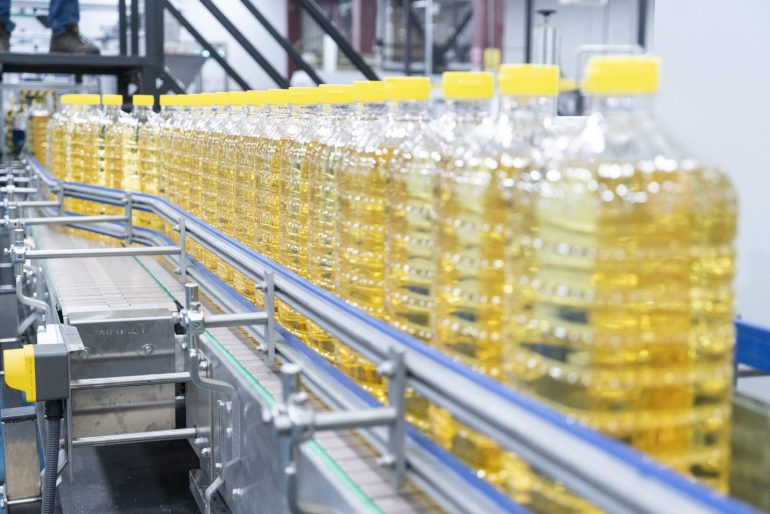
Table of Contents
- Identifying When Packaging Becomes the Production Bottleneck
- Evaluating the Complete Scope of End-of-Line Automation
- Assessing Labor Dependency and Workforce Stability Factors
- Integrating Automation with Existing Upstream Filling Lines
- Planning for Future Production Growth and Scalability
- Factory Integration and Industry 4.0 Readiness
- Selection Criteria for a Turnkey Automation Partner
- Conclusion and Final Recommendations
1. Identifying When Packaging Becomes the Production Bottleneck
Bottled oil packaging automation becomes a necessary investment when the manual end-of-line packing speed can no longer match the upstream filling output, resulting in constant product accumulation and delayed shipments.
Many factories do not immediately realize they need automation because they are still able to physically push products out the door, albeit with excessive overtime. However, in continuous fluid manufacturing, any process that forces the upstream equipment to slow down or halt is a critical bottleneck.
When high-speed filling lines discharge capped cooking oil bottles faster than human operators can fold cartons, group bottles, and manually pack them, the system requires accumulation tables. Once these buffers overflow, the entire filling line must be stopped. These micro-stops degrade Overall Equipment Effectiveness (OEE) and increase the wear and tear on processing machinery. If your facility is experiencing routine upstream downtime strictly because the packing personnel cannot keep up with the volume, transitioning to an automated system is no longer an optional upgrade; it is a strategic requirement to unlock your factory’s true output potential.
2. Evaluating the Complete Scope of End-of-Line Automation
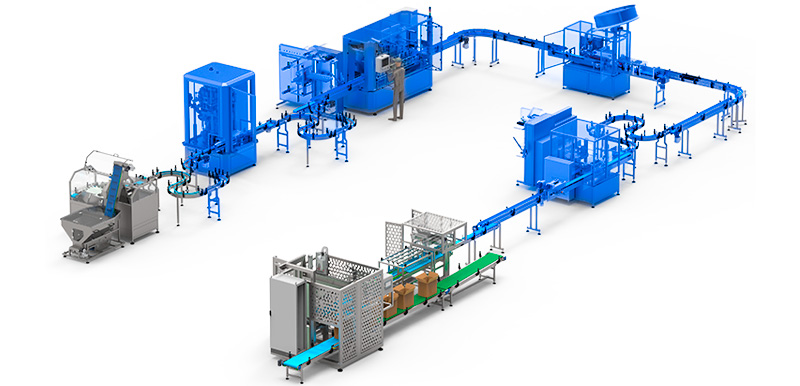
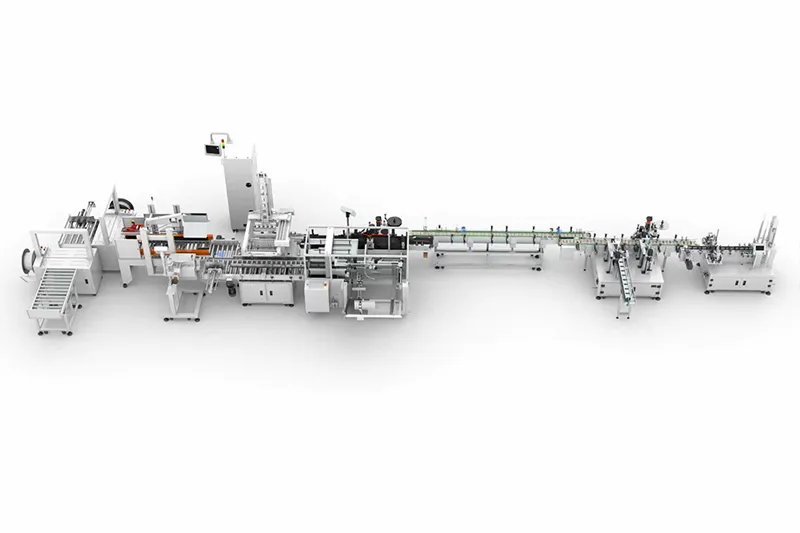
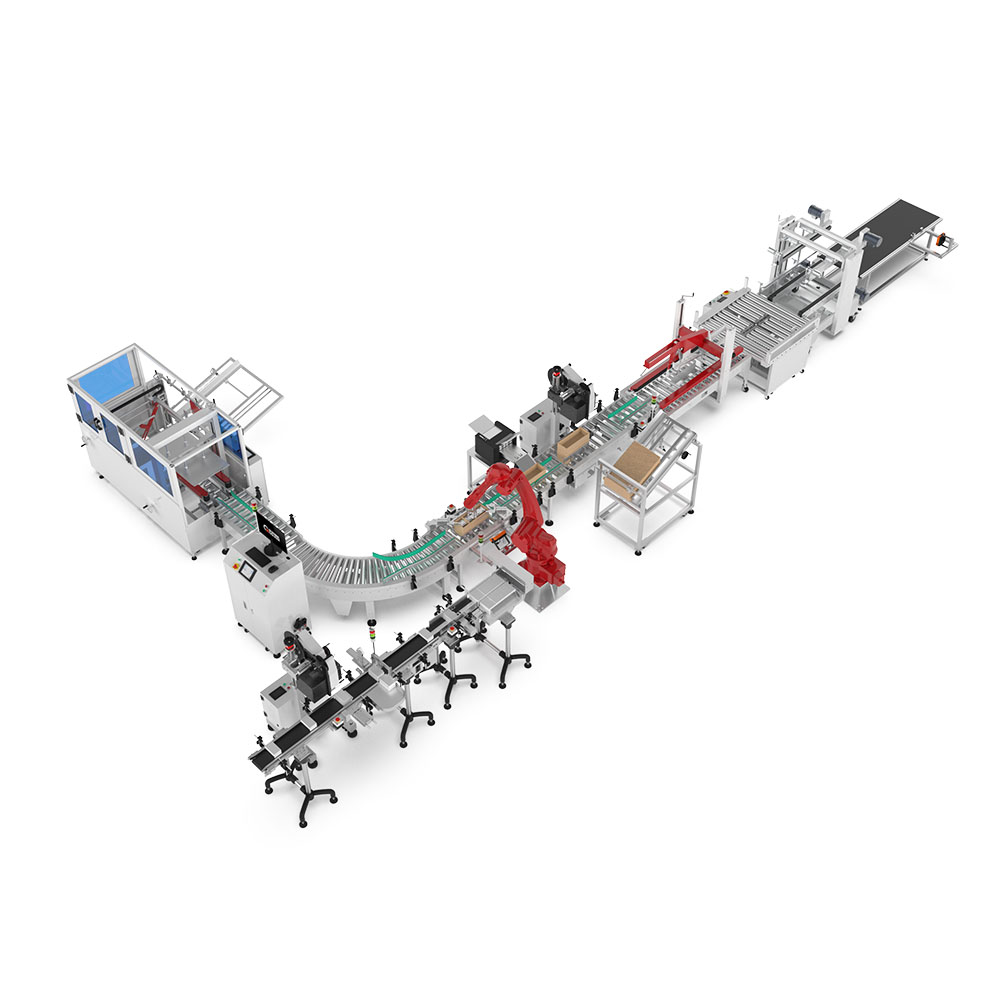
A comprehensive bottled oil packaging automation system encompasses bottle conveying, grouping, robotic case packing, carton sealing, real-time labeling, and robotic palletizing operating as one synchronized workflow.
When assessing the timing for investment, engineers must look beyond replacing a single task and evaluate the entire end-of-line (EOL) sequence. Automating just one step—such as installing a standalone carton taper while still manually loading bottles—often just shifts the bottleneck three meters down the line.
A fully integrated bottled oil packing production line connects the entire EOL process through a continuous mechanical and digital architecture. The technical workflow includes:
- Bottle Conveying and Grouping: Automatically transferring filled bottles from upstream conveyors and stabilizing them into precise matrix formations without tipping.
- Robotic Case Packing: Utilizing specialized bottle gripping technology to safely pick and place heavy oil bottles into erected cartons without squeezing or deforming the plastic containers.
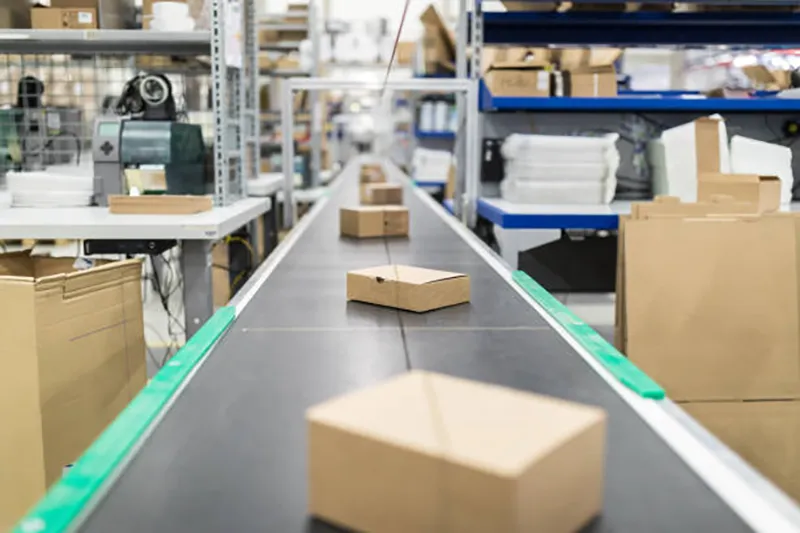
- Carton Sealing: Automatically folding and sealing flaps with consistent tape or hot-melt glue application to ensure structural rigidity.
- Labeling: Applying high-speed logistics and traceability labels synced to production runs.
- Robotic Palletizing: Arranging sealed cartons into stable warehouse-ready pallets, entirely eliminating repetitive heavy lifting.
3. Assessing Labor Dependency and Workforce Stability Factors
Investing in automated packaging is strategically required when repetitive manual operations, labor shortages, and high turnover rates disrupt continuous delivery schedules and inflate factory operating costs.
Labor availability is currently one of the strongest drivers for food packaging automation. Manual case packing and palletizing for bottled cooking oil is highly labor-intensive, physically demanding work. A standard carton containing four 5-liter oil bottles is heavy and cumbersome. Relying on human operators to repeatedly lift, pack, and stack these loads leads to rapid physical fatigue, inconsistent packing speeds throughout a shift, and higher risks of workplace ergonomic injuries.
When a factory struggles to hire or retain reliable packaging workers, production continuity is fundamentally threatened. An automated packaging system stabilizes output by running at a predictable, programmed speed regardless of shift changes, labor shortages, or holiday schedules. This allows plant managers to reallocate existing personnel to supervisory, quality control, or technical maintenance roles, vastly improving overall labor utilization.
4. Integrating Automation with Existing Upstream Filling Lines
Factories should invest in packaging automation when they have already automated their liquid filling and labeling stages, creating a high-ROI opportunity to upgrade the end-of-line section without overhauling the entire factory.
Many food manufacturers find themselves in a hybrid automation state: their liquid processing and filling are highly automated, but their end-of-line operations are manual. This operational imbalance creates the perfect timing for an automation upgrade.
Because the upstream infrastructure (fillers, cappers, primary labelers) is already in place, integrating an automated cooking oil packing line yields an exceptionally fast Return on Investment (ROI). The engineering challenge lies in seamless connectivity. The new packaging system must utilize variable frequency drives (VFDs) and smart sensors to electronically handshake with the legacy filling equipment. By matching conveyor speeds and establishing digital communication between PLCs, the automated packaging line smoothly absorbs the continuous flow of bottles, unifying the factory into a complete automated ecosystem.
5. Planning for Future Production Growth and Scalability
Manufacturers must invest in modular packaging automation prior to reaching maximum manual capacity to safely handle increasing order volumes, new bottle sizes, and expanded distribution channels.
The optimal time to invest in automation is before a surge in demand completely breaks your current manual processes. Waiting until the factory is in crisis mode leads to rushed procurement decisions, poor installation planning, and extended downtime.
A forward-thinking production strategy evaluates future requirements. If the factory plans to introduce a new bottle SKU (e.g., expanding from commercial 5L jugs to retail 1L PET bottles), scaling manually requires hiring and training entirely new packing lines.
| Scalability Factor | Manual Packaging Operations | Modular Automated Packaging System |
| Capacity Expansion | Requires hiring more shifts, increasing HR overhead and footprint. | Requires increasing machine speed parameters or operating hours with zero added labor. |
| Product Format Changeovers | Requires physical workstation reconfiguration and staff retraining. | HMI recipe-driven changeovers allow robotic tooling to adapt in minutes. |
| Throughput Consistency | Degrades over time due to operator fatigue and shift changes. | Mathematically constant output, perfectly aligned with upstream filling speeds. |
| Packaging Quality (Sealing/Stacking) | Highly variable, leading to potential transport damage or rejected pallets. | Servo-driven precision ensures every carton is perfectly squared, sealed, and palletized. |
6. Factory Integration and Industry 4.0 Readiness
The transition to smart packaging automation is justified when a facility requires ERP and MES integration to enable real-time production monitoring, automated data collection, and traceable logistics operations.
In modern food manufacturing, data is just as critical as the physical product. Manual packaging operations create massive data silos; carton counts, scrap rates, and pallet logs are recorded on paper, leading to delayed reporting and traceability errors.
If your facility is pursuing an Industry 4.0 strategy, manual end-of-line operations will block your progress. Investing in intelligent packaging automation ensures that every robotic cycle, carton seal, and completed pallet is digitally logged. This equipment interfaces directly with the factory’s Enterprise Resource Planning (ERP) and Manufacturing Execution Systems (MES). Plant managers gain real-time visibility into packaging efficiency, allowing for predictive maintenance scheduling, precise inventory control, and total compliance with stringent global food safety traceability standards.
7. Selection Criteria for a Turnkey Automation Partner
Large food factories should select a turnkey industrial packaging automation system integrator rather than purchasing standalone machines to ensure seamless mechanical, electrical, and software integration across the entire line.
Once the decision to automate is made, the execution strategy is critical. A common pitfall is attempting to build an EOL system by purchasing separate machines from different vendors. This forces the manufacturer to act as the system integrator, leading to communication failures between different equipment PLCs, mismatched physical transfer points, and ambiguous vendor liability when the line fails to perform.
Buyers must prioritize a single-source automation partner. A specialized turnkey cooking oil packaging system provider delivers end-to-end engineering. This includes designing the factory layout, engineering the robotic integration, manufacturing the conveyors, and writing the unified software code that governs the entire operation. This holistic approach drastically reduces installation risks, shortens the commissioning timeline, and guarantees that the system achieves the specified throughput immediately upon startup.
8. Conclusion and Final Recommendations
The right time to invest in bottled oil packaging automation is precisely when manual end-of-line processes begin limiting your upstream filling efficiency, threatening workforce stability, or blocking future scalability. Packaging should never act as a production bottleneck; it must be a seamless, high-speed conduit that prepares your product for global distribution.
By moving away from fragmented, labor-heavy packing stations and adopting a fully integrated robotic EOL system, bottled oil manufacturers can secure long-term operational value. Automation ensures perfectly consistent packaging quality, eliminates repetitive manual lifting, and establishes the data connectivity required for intelligent factory management.
If your current packaging operations are preventing your facility from reaching its full output potential, we invite you to connect with our engineering specialists to evaluate your production data and design a customized automation roadmap tailored to your specific facility.
FAQs
1. How do I know if my manual packaging process is restricting my filling line?
If your upstream filling equipment is frequently forced to pause, slow down, or divert bottles to an accumulation buffer because the operators at the end of the line cannot pack or palletize fast enough, your packaging process has become the primary factory bottleneck.
2. Can packaging automation handle both glass and PET cooking oil bottles?
Yes, but it requires highly flexible robotic integration. Advanced systems utilize programmable gripping pressure and specialized end-of-arm tooling to ensure that delicate glass bottles are not shattered and lightweight PET bottles are not squeezed or dented during robotic case packing.
3. Is it possible to automate only the palletizing step if I still want to pack cases manually?
Yes. Many facilities phase their investments, starting with robotic palletizers to eliminate the most physically dangerous and strenuous heavy-lifting tasks. However, to maximize ROI and factory throughput, integrating the entire EOL process (packing, sealing, and palletizing) is recommended.
4. How does packaging automation improve delivery scheduling?
Automated lines operate at a fixed, mathematically predictable cycle time. Unlike manual labor, which fluctuates due to fatigue or breaks, an automated line allows logistics managers to know exactly how many pallets will be ready for the loading dock at any given hour, eliminating shipment delays.
5. What is the biggest hidden cost of delaying packaging automation?
The biggest hidden costs are lost production capacity and labor turnover. Every hour your high-speed filler is slowed down to accommodate manual packing represents lost revenue. Additionally, the constant costs of recruiting, training, and replacing workers for strenuous packing jobs drain operational budgets annually.