Every time you switch carton sizes, the line stops. Ten minutes here, twenty there—across a week of mixed-SKU orders, those stops quietly eat hours you could have spent shipping. If changing box sizes feels slow, you are not alone, and it is almost never the operator’s fault. It is the setup. This guide lists the seven reasons changeovers drag, shows how to measure what they really cost you, and how quick-changeover design turns a half-hour stop into a few minutes.
Switching carton sizes is a normal part of any automatic carton packing production line. The question is how long it takes. We will also walk through a simple loss calculation, the SMED method behind fast changeovers, and a real before-and-after so you can see the payoff.
What you will read
- The hidden cost of a size change
- The 7 reasons carton changeovers waste hours
- How to measure your own changeover loss
- How quick-changeover design cuts this to minutes
- The SMED method, in plain terms
- Manual vs semi-auto vs auto changeover
- Changeover mistakes that cost hours
- A before-and-after example
- What to check before you buy
- Frequently asked questions
1. The hidden cost of a size change
A changeover looks like a few minutes of work. Add it up: if a line changes sizes six times a day at fifteen minutes each, that is ninety minutes of stopped output daily—close to eight hours a week. Multiply by loaded labor cost and lost throughput, and slow changeovers are one of the most expensive “normal” things on the floor.
The cost stays hidden because no one invoices it. It just shows up as lower daily output and missed ship dates. A carton line that keeps jamming has the same pattern: small stops that nobody totals until they do. Track both for a week and the number is usually larger than expected.
2. The 7 reasons carton changeovers waste hours
Most slow changeovers come from the same seven issues. If any of these sound familiar, the fix is design, not effort.
- Screws and hand tools to move guides. Every width change means finding a tool and loosening bolts—slow and easy to miss.
- Manual guide adjustment by eye. Without scales, operators guess, then fine-tune after a bad carton appears.
- Trial-and-error to hit the size. Run, check, adjust, run again. Each loop costs cartons and time.
- Re-fitting grippers or tooling. Swapping physical parts for a new carton adds steps most lines could avoid.
- Re-entering parameters from scratch. If settings are not saved per size, every change starts at zero.
- Operator training on each change. When the process is fiddly, only a few people can do it fast.
- Lost setup records. No saved recipe means every change is a fresh puzzle, even for a size you ran last week.
3. How to measure your own changeover loss
You cannot fix what you do not count. For one week, log every size change with three numbers: clock time stopped, people involved, and cartons scrapped while tuning. Then:
- Total stop time = sum of all changeover minutes that week.
- Labor cost = stop time × people × loaded hourly rate.
- Lost output = stop time × your line’s carts-per-minute (the cartons you could have shipped).
- Scrap cost = tuning cartons × unit cost.
Add the three and divide by your changeover count to get cost per change. Most teams find each size swap costs more than they thought—and that cutting it from 18 minutes to 4 pays for better tooling within a year.
4. How quick-changeover design cuts this to minutes
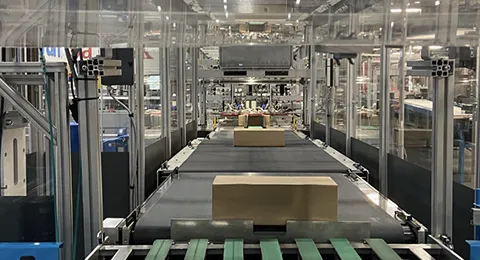
Quick-changeover design removes the seven slow steps by making size changes a selection, not a rebuild. The practical features:
- Hand-levers or crank adjusters with printed scales, so no tools and no guessing.
- Saved recipes per carton size—pick the size, the line sets its own guides and parameters.
- Tool-free format parts that click in place instead of bolting on.
- Visual guides that any operator can follow without long training.
- Auto-recipe recall that moves grippers, belts, and sealer pressure together in one step.
With these, a change that took twenty minutes drops to a couple. Sealing setup is part of the same story: see how a tape vs glue sealing choice affects changeover speed when you run many box types.
5. The SMED method, in plain terms
SMED (Single-Minute Exchange of Die) is the classic way plants shrink changeovers. The idea splits the work into two buckets:
- External tasks—done while the line is still running the old size: pre-set guides, stage format parts, load the recipe on screen.
- Internal tasks—only what must happen during the stop: the actual size switch and a first-carton check.
Move everything you can to external, and the stop shrinks. On a carton line this means staging the next box’s format parts and recipe before the run ends, so the operator only performs the swap and verifies one good carton. That is exactly what saved recipes and click-in parts enable.
6. Manual vs semi-auto vs auto changeover
Not every line needs full automation. Match the level to how often you change sizes:
| Level | Typical time | Best for | Cost |
|---|---|---|---|
| Manual (tools + eye) | 15–30 min | Few changes per week | Low |
| Semi-auto (levers + scales) | 5–10 min | Several changes per day | Medium |
| Auto (recipes + click-in) | 2–5 min | Many sizes, mixed-SKU | Higher, fast payback |
7. Changeover mistakes that cost hours
- Not saving the recipe. Re-entering from scratch every time is the biggest single time sink.
- Loosening the wrong guide. Without scales, operators move extra parts and create new misalignments.
- Skipping the first-carton check. Running before verifying wastes a whole loop of cartons.
- One expert only. If only one person can do it fast, every change waits on that person.
- Forgetting to re-align the sealer. A bumped sealer after a size change causes crushing and weak seals on the new size.
8. A before-and-after example
A contract packer running 8 sizes a day logged 22 minutes per change—about 3 hours of stopped output daily. After adding lever adjusters with scales, saved recipes, and click-in format parts, the same change took 4 minutes. That recovered roughly 2.5 hours a day, let them accept smaller mixed-SKU orders, and paid back the upgrade in under nine months through recovered throughput alone—before counting the scrap they stopped making during tuning.
9. What to check before you buy
If slow changeovers are pushing you to automate, ask suppliers two things directly: how long is a size change on their line, and is it tool-free with saved recipes? Those answers matter more than top speed, because you live at changeover, not at peak.
Changeover speed also protects product: a line that handles sizes smoothly is less likely to mishandle cartons, which is why it pairs with reading why cartons get crushed on the packing line. And at the far end, pairing quick changeover with checkweighing vs manual counting keeps every size accurate, not just the first one.
10. Frequently asked questions
How fast should a carton changeover be?
A well-designed line changes size in two to five minutes with one operator and no tools. If yours takes fifteen or more, it is a setup problem worth fixing.
Do saved recipes really help?
Yes. Saving guide positions and parameters per size removes trial-and-error and lost records. The operator picks a size and the line self-sets, which is the single biggest time saver.
Is tool-free changeover worth paying for?
For any line that changes sizes daily, yes. Hand-levers and click-in parts cut the change from a mechanic’s job to an operator’s step, and they remove the “missing bolt” class of errors.
Can one line handle many carton sizes?
Most modern lines handle a wide range of sizes through adjustable formats. The limit is usually carton height and flap style, not count of sizes. Confirm the range with your real boxes.
Will faster changeover pay back?
Almost always. Recovering even thirty minutes a day is two or more extra shipping hours a week. On a busy line, that alone often covers the upgrade within a year.
What is the fastest win if I cannot buy new equipment?
Start saving recipes and staging format parts before the run ends (external tasks). Even on a manual line, that alone often cuts changeover time by a third with no new hardware.
Want a line that changes carton sizes in minutes instead of halts? Reach out to the JOYDA team with your carton range, daily change count, and current changeover time, and we will size a quick-changeover setup for you—plus send a one-page changeover log template you can use this week to measure your own loss. You can also review our automatic carton packing production line options.