
In many manufacturing facilities, the production floor operates like a highly tuned digital orchestra right up until the final step: packaging. Too often, the end-of-line packaging process remains an isolated mechanical island. Operators rely on printed work orders, production output is recorded manually on clipboards at the end of a shift, and warehouse inventory updates are delayed by hours. This disconnect creates a massive data blind spot, leading to overproduction, delayed shipments, and inaccurate inventory forecasting.
To survive in a fast-paced supply chain, modern packaging operations can no longer function as standalone mechanical systems. They must act as data-driven execution nodes. Achieving this requires Industry 4.0 packaging line ERP MES integration, a transformative approach that connects physical machinery directly to enterprise-level software.
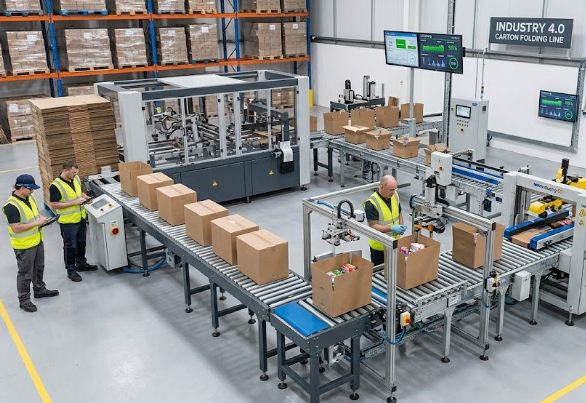
This comprehensive guide explains how bridging the gap between your Enterprise Resource Planning (ERP), Manufacturing Execution System (MES), and automated packaging equipment fundamentally solves the problem of data fragmentation, turning your packaging floor into a highly responsive, digital execution layer.
Table of Contents
- What is the Role of ERP, MES, and Packaging in a Smart Factory?
- How Does Data Flow Between the Enterprise and the Shop Floor?
- Which Packaging Modules Connect to the Digital Ecosystem?
- How Does Integration Solve the Cost and Inefficiency Problem?
- What is the Measurable Impact of an Integrated Architecture?
- How Have Real-World Factories Achieved Digital Packaging Integration?
- How Can You Build a Connected Packaging Node for Your Facility?
- Frequently Asked Questions (FAQ)
1. What is the Role of ERP, MES, and Packaging in a Smart Factory?
To understand how a smart factory packaging line functions, it is essential to define the hierarchy of the systems involved. An integrated architecture divides responsibilities into planning, translation, and physical execution.
- ERP (The Brain): Enterprise Resource Planning software operates at the highest level of the business. It defines the “what” and the “when.” The ERP manages customer orders, supply chain logistics, inventory planning, and overall shipment schedules. However, an ERP system is not designed to control machinery.
- MES (The Nervous System): The Manufacturing Execution System bridges the gap between the office and the factory floor. It translates the broad production orders from the ERP into real-time, step-by-step execution logic. It dictates exactly how a specific product should be made and packed on a specific shift.
- The Packaging Line (The Muscle): In an Industry 4.0 setup, the packaging line serves as the physical execution layer. It receives the digital commands from the MES, performs the mechanical actions (folding, packing, sealing), and continuously feeds real-time status data back up the chain.
By synchronizing these three layers, manufacturers eliminate manual order-to-execution translation, ensuring that the shop floor is always perfectly aligned with enterprise demand.
2. How Does Data Flow Between the Enterprise and the Shop Floor?
The true value of ERP MES packaging system integration lies in the bidirectional flow of data. It is a continuous, automated conversation between software and hardware.
When a new order is received, the ERP pushes the production requirement to the MES. The MES then communicates directly with the Programmable Logic Controllers (PLCs) on the packaging line. Using industrial communication standards like OPC UA packaging equipment integration, the system ensures flawless, secure data exchange across different machine brands and software platforms.
As the physical packaging begins, the data flow reverses. The packaging line continuously transmits performance metrics—such as cycle times, throughput, motor temperatures, and defect rates—back to the MES. The MES aggregates this real-time packaging data system feed, calculates Overall Equipment Effectiveness (OEE), and logs downtime classifications. Finally, the MES updates the ERP, confirming exactly how many units have been packed, allowing the ERP to adjust warehouse inventory and trigger shipping logistics instantly.
This loop completely eliminates the need for manual production reporting.
3. Which Packaging Modules Connect to the Digital Ecosystem?
An automated end-of-line packaging system is not a single machine, but a synchronized workflow of intelligent modules. JOYDA Totalpack designs its Industry 4.0 carton folding line so that every single stage of the packaging process acts as an active data-generating node.
Within a fully integrated system, the following modules communicate continuously with the MES:
- Automatic Carton Forming and Folding: Erects the exact box size required for the specific SKU dictated by the ERP order.
- Robotic Product Loading: Delta or 6-axis robots receive speed and placement coordinates from the central control system, ensuring the right product goes into the right box.
- Inline Weighing and Inspection: Digital scales and vision systems verify product weight and integrity. If a defect is found, the system rejects it and instantly logs the quality error in the MES.
- Barcode Verification and Labeling: Automated print-and-apply systems generate labels dynamically based on live ERP data, ensuring perfect traceability.
- Sealing and Strapping: Secures the carton while monitoring consumable usage (like tape or glue) to alert purchasing when supplies run low.
- Palletizing Systems: Robotic arms stack boxes into optimized patterns dictated by the warehouse management software, preparing them for automated guided vehicles (AGVs).
4. How Does Integration Solve the Cost and Inefficiency Problem?
Relying on human intervention to transfer information between business systems and packaging machines creates expensive delays and errors. When the ERP, MES, and physical packaging equipment are unified, the operational improvements are immediate and profound.
First, this integration enables ERP-driven production execution. There is no waiting for a supervisor to print out a batch order and hand it to a machine operator. The moment an order is approved in the ERP, the packaging line adjusts its parameters and begins execution.
Second, the system ensures full batch-level traceability. Because every box is scanned, weighed, and verified against the digital order, human error is virtually eliminated. This barcode-based product tracking is vital for industries requiring strict compliance, such as pharmaceuticals, food, and high-value electronics.
Finally, an IoT enabled packaging production line allows for real-time fault detection. If a motor begins to overheat, the MES detects the anomaly and signals for predictive maintenance before a catastrophic failure occurs, shifting the factory from reactive firefighting to proactive optimization.
5. What is the Measurable Impact of an Integrated Architecture?
Transitioning your packaging lines from standalone equipment into fully networked digital manufacturing execution nodes yields hard, measurable ROI. Industry data highlights the transformative impact of tying physical automation to enterprise software.
Traditional Packaging vs. Integrated Industry 4.0 Packaging
| Performance Metric | Isolated Packaging Line | ERP/MES Integrated Packaging Line | Direct Business Impact |
| Data Collection | Manual clipboards / End of shift | Real-time automated synchronization | Eliminates data latency and manual reporting errors. |
| Labor Dependency | High (Operators, data clerks, quality control) | Up to 30% reduction in labor costs | Automates both physical handling and data processing. |
| Operational Efficiency | Reactive to upstream bottlenecks | Over 40% improvement | Synchronized machine coordination optimizes throughput. |
| Unplanned Downtime | High (Run-to-failure model) | Reduced by up to 75% | MES feedback loops enable predictive maintenance. |
| Quality & Traceability | Sample-based manual checks | 100% batch-level automated tracking | Automated rejection systems ensure perfect shipment accuracy. |
| Scalability | Rigid, difficult to upgrade | Modular architecture ready for WMS/AGV | Adapts easily to future smart factory expansions. |
6. How Have Real-World Factories Achieved Digital Packaging Integration?
To understand how this architecture operates in practice, it is helpful to look at how different industries utilize these connected systems to solve specific operational bottlenecks.
Case 1: Multi-Line FMCG Factory ERP Integration
A Fast-Moving Consumer Goods (FMCG) manufacturer operated multiple packaging lines but struggled with delayed production reporting and inconsistent output tracking. Management had no real-time visibility across the lines. By integrating an Industry 4.0 packaging system directly connected to their MES, ERP orders were automatically pushed to the packaging floor. Execution data returned in real time, enabling live production monitoring, automated scheduling adjustments on the fly, and vastly improved order fulfillment accuracy.
Case 2: E-commerce Fulfillment Digital Transformation
A massive e-commerce fulfillment center handled extreme SKU variability. They urgently required tighter synchronization between their warehouse ERP and packaging systems. After implementing an integrated packaging line, SKU-based carton selection was automatically triggered by ERP orders. The MES tracked packaging performance per order batch, and labeling was fully digitized. This seamless communication reduced manual intervention and significantly improved fulfillment speed during peak holiday demand periods.
Case 3: Smart Factory MES Deployment in Electronics Manufacturing
An electronics manufacturer transitioning to an Industry 4.0 standard implemented MES-connected packaging lines to achieve absolute quality control. The system enabled real-time production visibility, synchronized robotic palletizing, and automated quality control feedback loops. By aggregating centralized production data, the packaging line evolved from an isolated end-of-line station into a fully connected execution node within the factory’s broader digital ecosystem.
7. How Can You Build a Connected Packaging Node for Your Facility?
The future of manufacturing belongs to facilities that can seamlessly translate customer demand into physical execution without delay. A disconnected packaging line acts as a dam, holding back the flow of data and product. By embracing an architecture where the ERP plans, the MES translates, and the packaging line executes, you can eliminate manual errors, slash labor dependency, and gain absolute visibility over your throughput.
At JOYDA Totalpack, we design intelligent, modular automated packaging systems engineered from the ground up for digital integration. Our systems speak the language of your smart factory, seamlessly connecting with leading ERP and MES platforms to ensure your end-of-line operations are as intelligent as the rest of your facility.
Ready to eliminate your packaging data blind spots? Contact the integration engineers at JOYDA Totalpack today to discuss how we can transform your packaging line into a fully networked, data-driven execution node.
8. Frequently Asked Questions (FAQ)
1. Do we need to have an MES in place to use an Industry 4.0 packaging line?
While an MES unlocks the highest level of real-time control and data aggregation, it is not strictly mandatory on day one. Modern intelligent packaging lines can operate via their local PLC and HMI systems, and can be easily connected to an MES or ERP later when your facility’s software infrastructure is ready.
2. What is OPC UA, and why is it important for packaging integration?
OPC Unified Architecture (OPC UA) is a universal, secure industrial communication protocol. It acts as a universal translator, allowing machines from different manufacturers (like a carton erector from one brand and a robotic arm from another) to share data seamlessly with your central MES and ERP systems.
3. Will integrating our packaging line with our ERP cause network latency issues?
No. In a properly architected system, the ERP does not directly control the millisecond-to-millisecond movements of the machines. The ERP sends broad orders to the MES (or edge controllers), which then handle the high-speed, localized machine logic. This prevents network latency from slowing down physical production.
4. How does the system handle an order change in the middle of a shift?
Because the system is integrated in real time, if an order is updated or canceled in the ERP, the MES instantly receives the update. The MES then commands the packaging line to finish the current carton, safely halt, or automatically switch to the new carton recipe required for the updated order, completely eliminating manual miscommunication.
5. Can legacy packaging machines be integrated into an MES?
In many cases, yes. While it is easier to install native Industry 4.0 equipment, legacy machines can often be retrofitted with external IoT sensors, edge gateways, and updated PLCs that capture machine status and output data, bringing them into your smart factory network.
6. How does integration improve batch-level traceability?
As the packaging line operates, barcode scanners and vision systems read every product and carton. The MES links these specific barcode scans to the exact time, date, machine parameters, and ERP order number. If a recall is ever necessary, you can instantly trace exactly which products went into which boxes and where they were shipped.