Relying on manual packaging exposes manufacturers to a 5–8% annual increase in labor costs and high error rates that erode margins. While manual setups have lower initial costs, they lack scalability. An Industry 4.0 packaging line delivers superior long-term savings by reducing unplanned downtime by 30–50% and cutting maintenance costs by 40% through predictive maintenance, effectively transforming the end-of-line process into a high-yield, predictable asset.
In the world of industrial engineering, we often say that “cheap is expensive.” Choosing a manual process might save capital today, but it invites a “hidden tax” of fatigue-related errors and throughput volatility. This analysis breaks down the total cost of ownership (TCO) from a technical perspective to help you decide when to make the leap to automation.
Table of Contents
- The Hidden Inflation of Manual Labor Dependency
- Defining the Industry 4.0 Packaging Line Ecosystem
- Predictive Maintenance: Slashing Costs by 40%
- Stabilizing Throughput: 120 CPM vs. Manual Fatigue
- Reducing the “Rework Tax” with Automated Inspection
- Case Study: Transitioning to Integrated Automation
- Strategic Decision: Calculating the 5-Year ROI
- Conclusion
1. The Hidden Inflation of Manual Labor Dependency
Many procurement managers view labor as a flexible, variable cost. However, the current economic landscape has turned manual labor into a high-risk liability for high-volume packaging.
Manual packaging suffers from inconsistent quality control and fatigue-related errors that directly impact the bottom line. With global manufacturing labor costs rising by an average of 5% to 8% annually, an Industry 4.0 packaging line acts as a hedge against inflation by replacing variable human costs with fixed, predictable machine performance that does not fluctuate across shifts.
The Reality of “Hidden” Labor Costs
- Recruitment & Training: In high-turnover environments, the cost of constantly training new operators for end-of-line tasks is significant.
- Safety & Liability: Manual palletizing involves repetitive heavy lifting, which carries a high risk of workplace injury claims and insurance premiums.
- Throughput Variance: A manual team’s speed at 4:00 PM is rarely the same as at 8:00 AM, leading to upstream bottlenecks.
2. Defining the Industry 4.0 Packaging Line Ecosystem
To understand the savings, we must move beyond the idea of “robots replacing hands.” We are looking at a digital nervous system for your factory.
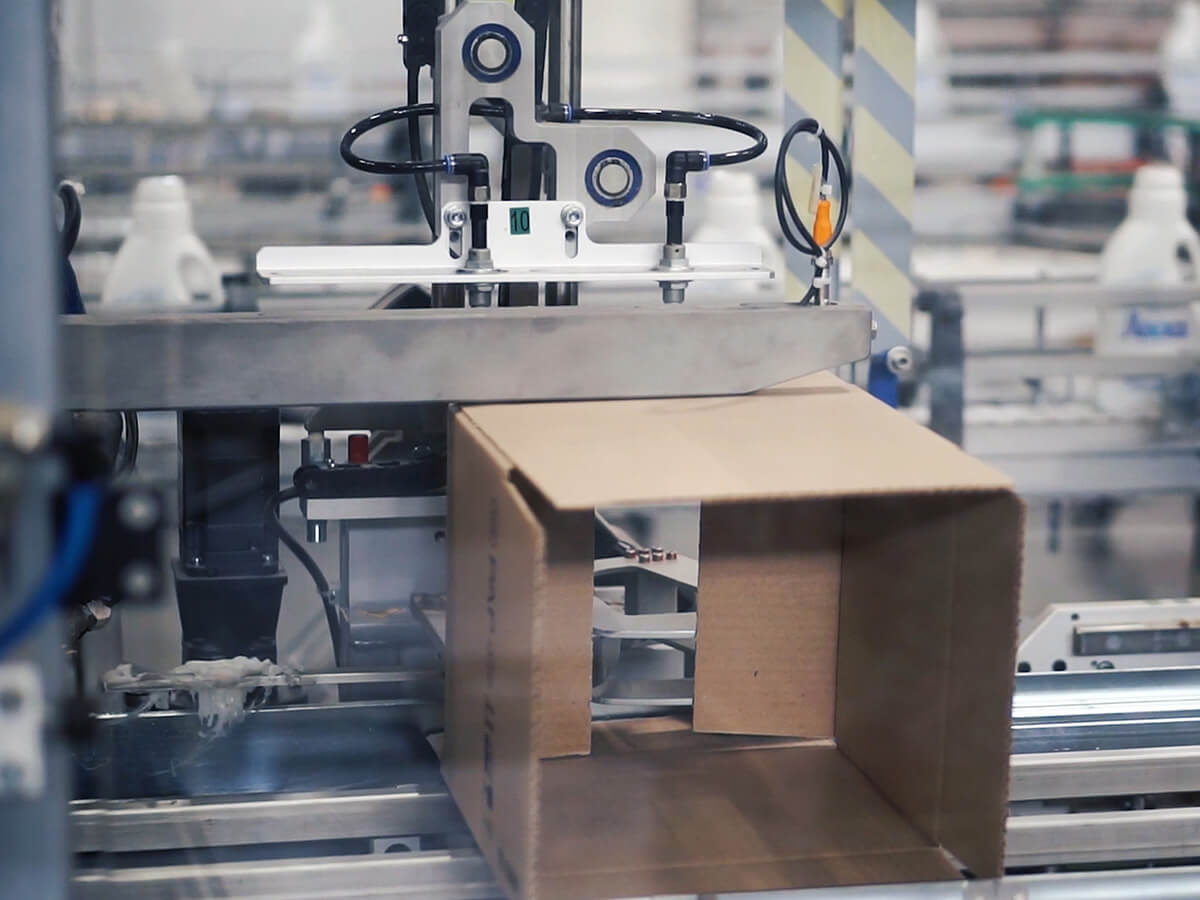
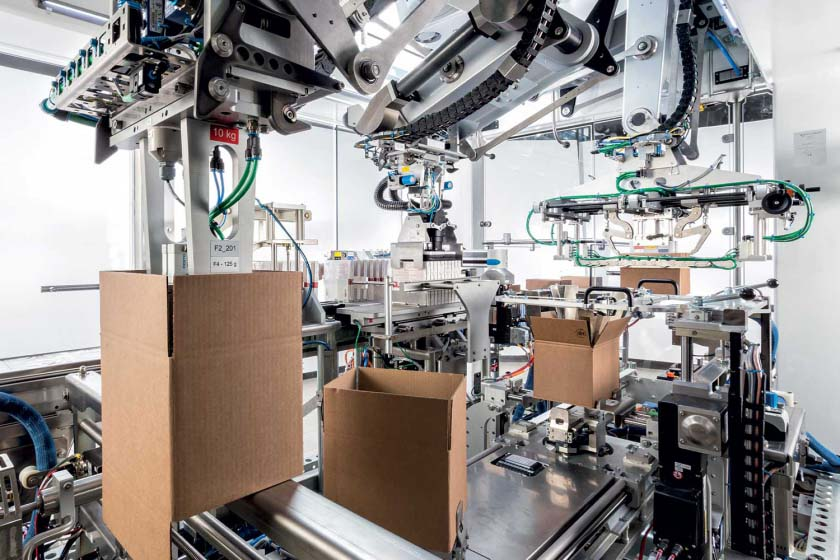
An Industry 4.0 packaging line integrates automation, IoT, robotics, and smart software to create intelligent end-of-line solutions. By utilizing PLC networking and centralized SCADA dashboards, these systems provide real-time visibility of every station—ensuring that carton forming, robotic loading, and palletizing function as a single, synchronized, and transparent workflow.
The Pillars of a Connected Line
- IoT Sensors: These monitor critical metrics such as vacuum pressure in robotic grippers or motor vibration.
- Smart Software: Production managers can track yield and scrap rates from a tablet, allowing for instant adjustments without stopping the line.
- Workflow Continuity: Integrated systems eliminate the “stop-and-go” manual handling that results in damaged goods and wasted floor space.
3. Predictive Maintenance: Slashing Costs by 40%
One of the most profound differences between manual and smart systems is how they fail. Manual lines are reactive; Industry 4.0 lines are proactive.
Industry 4.0 packaging lines can reduce unplanned downtime by 30–50% through predictive maintenance and real-time monitoring. By identifying mechanical wear before it leads to a breakdown, these architectures can lower overall maintenance costs by up to 40% while increasing Overall Equipment Effectiveness (OEE) by 10–18% compared to traditional processes.
Maintenance Efficiency Comparison
| Metric | Manual/Legacy Systems | Industry 4.0 Packaging Line |
| Maintenance Strategy | Reactive (Fix when broken) | Predictive (Fix before failure) |
| Annual Maintenance Cost | 100% (Baseline) | 60% (40% Savings) |
| OEE Range | 65% – 75% | 85% – 93% |
| Unplanned Downtime | High (Frequent micro-stops) | Reduced by 30–50% |
4. Stabilizing Throughput: 120 CPM vs. Manual Fatigue
Speed is secondary to stability. A line that runs at 100 cartons per minute (CPM) consistently is more profitable than a team that sprints at 150 but stops for breaks every two hours.
Steady throughput from automated lines, typically achieving 80–120 CPM, significantly outperforms fluctuating manual performance across multiple shifts. This predictable cycle time allows for tighter logistics planning and ensures that peak demand periods do not require the hiring of temporary, unskilled labor, which often leads to production errors.
High-Speed vs. High-Stability
While high-speed configurations can achieve 200–300 CPM, even a standard 80 CPM line delivers a “rhythm” that manual labor cannot match. This consistency eliminates the “wave effect” in manufacturing, where one slow station causes a backlog for the entire facility.
5. Reducing the “Rework Tax” with Automated Inspection
The cost of a shipping error—a missing item or a misaligned label—goes far beyond the cost of the box. It includes return shipping, customer penalties, and lost brand trust.
Automated inspection and weighing modules reduce packaging errors and rework by 25–35%. By integrating check-weighers and vision sensors directly into the Industry 4.0 packaging line, manufacturers ensure 100% outbound quality that is independent of operator fatigue or distraction, providing a level of reliability manual inspection cannot reach.
Quality Metrics at the End-of-Line
- Weight Verification: Detects a single missing component in a multi-pack instantly.
- Vision Inspection: Verifies barcode readability and label orientation at full line speed.
- Automated Reject: Non-conforming cartons are diverted to a rework station without pausing the main production flow.
6. Case Study: Transitioning to Integrated Automation
To illustrate the long-term impact, let’s look at a regional food manufacturer that recently upgraded their facility.
A regional food manufacturer transitioned from standalone manual stations to a full Industry 4.0 carton packing line. Key results included reducing labor from 8 manual operators to 2 supervisory roles and achieving consistent daily output with a much lower labor dependency. This illustrates how end-to-end automation transforms packaging from an unpredictable bottleneck into a controlled, high-yield asset.
The “Maintenance Win”
During the first six months of operation, a sensor alert flagged an overheating servo motor on the case packer. The maintenance team was able to replace the component during a scheduled 15-minute break, preventing a projected 4-hour unscheduled shutdown. This single event preserved an entire shift’s productivity, validating the investment in a smart system.
7. Strategic Decision: Calculating the 5-Year ROI
When evaluating the cost-effectiveness of an Industry 4.0 packaging line, the calculation must extend beyond the first year.
The strategic value of Industry 4.0 lies not just in raw speed, but in digital connectivity. When you aggregate the 40% reduction in maintenance costs, the 30% reduction in downtime, and the elimination of 25%+ of rework costs, the automated line typically achieves a full ROI within 18–30 months, becoming significantly cheaper to operate than manual labor for the remainder of its 15-year lifespan.
TCO Comparison (5-Year View)
- Manual Setup: Low initial CapEx → Rising OpEx (wages + errors + downtime).
- Industry 4.0 Line: High initial CapEx → Flat/Declining OpEx (efficiency + predictive care).
8. Conclusion
While manual packaging might seem like the “safe” financial choice for a budget-conscious manufacturer, the long-term data tells a different story. In an era of rising labor costs and demands for 100% quality, an Industry 4.0 packaging line is the only way to stabilize profit margins. By integrating IoT, robotics, and smart software, you aren’t just buying a machine; you are buying the ability to predict, control, and scale your production.
Frequently Asked Questions (FAQ)
1. Is an Industry 4.0 line too complex for our existing maintenance team?
Not necessarily. While the technology is advanced, the interfaces (HMI) are designed for intuitive operation. Most systems include remote diagnostic capabilities, allowing the manufacturer (like Joyda) to troubleshoot software issues or sensor calibrations via the cloud, supporting your team in real-time.
2. How does an automated line handle frequent SKU changeovers?
Unlike manual stations that require physical reconfiguration, an Industry 4.0 line uses “digital recipes.” You select the SKU on the HMI screen, and servo motors automatically adjust the guide rails and robot pick-points. This can reduce changeover time from 45 minutes to under 10 minutes.
3. What is the typical footprint of a fully integrated line?
Surprisingly, an integrated line often takes up less space than multiple manual stations. By eliminating the need for “walk-around” space for 8+ people and removing work-in-progress (WIP) storage areas, the layout is much more compact.
4. Can we automate in stages, or do we need to do it all at once?
Industry 4.0 lines are modular. You can start with an automated case erector and packer, then add robotic palletizing and IoT monitoring layers as your production volume and budget grow.
5. How does the system improve sustainability metrics?
Automation reduces material waste (shrink film, tape, and cardboard) by 10–15% through precision application. Additionally, modern servo-driven systems consume up to 20% less energy than older pneumatic systems.
6. What happens if the network or internet goes down?
The line will continue to operate. The PLC (Programmable Logic Controller) handles the physical machine movements locally. The Industry 4.0 “Cloud” layer is primarily for data tracking and remote diagnostics; the physical line does not require an internet connection to perform its core functions.
7. Can the system integrate with our existing ERP?
Yes. A key feature of Industry 4.0 is connectivity. The system can feed production data (yield, scrap, OEE) directly into your ERP (like SAP or Oracle) to ensure your inventory and sales data are accurate in real-time.