
A juice bottle packaging production line is a highly connected system where any inefficiency—such as bottle congestion, inconsistent manual packing, or unexpected machine downtime—directly limits a factory’s overall capacity and profitability. As beverage manufacturers expand production to handle more product variations and tighter delivery schedules, traditional operations often suffer from critical bottlenecks. Automation solves these problems by integrating conveyors, automatic case packers, checkweighers, and robotic palletizers into a synchronized, Industry 4.0-ready workflow that eliminates manual errors, stabilizes output speed, and reduces long-term operating costs. This comprehensive guide breaks down the top 15 most common packaging problems and explains how upgrading to a complete automated beverage packaging solution can optimize your factory’s performance.
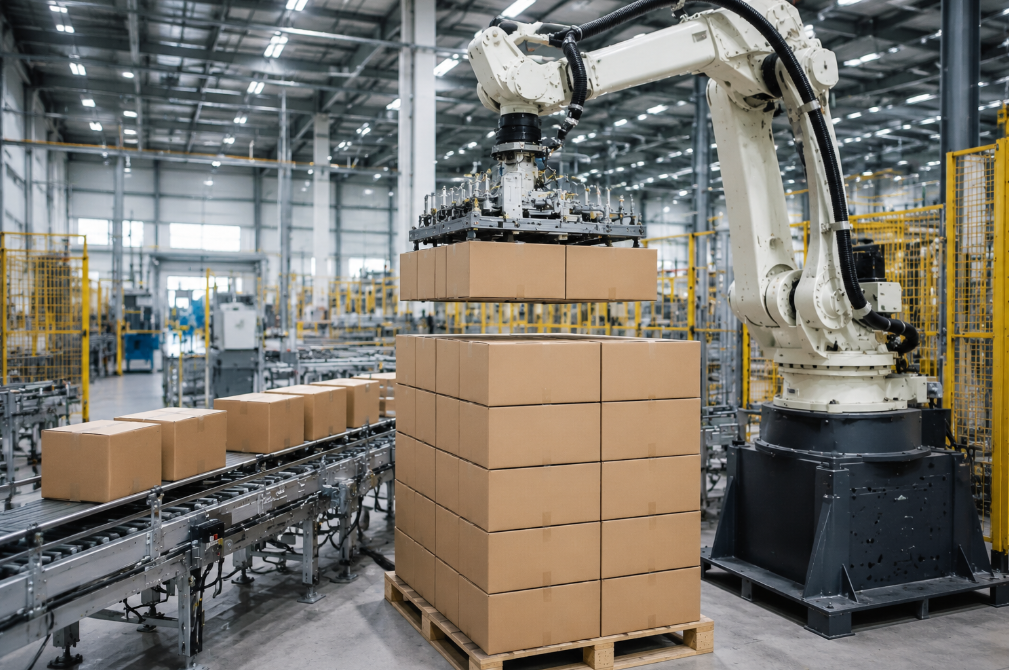
Table of Contents
- The True Cost of Inefficiency in Beverage Packaging
- Solving Downtime and Equipment Synchronization Problems
- Overcoming Conveyor Congestion and Material Flow Interruptions
- Eliminating Manual Packing Inconsistencies and Labor Bottlenecks
- Ensuring Quality Control: Missing Bottles and Incorrect Weights
- Scaling Capacity and Managing Multi-SKU Flexibility
- Gaining Production Visibility and Transitioning to Predictive Maintenance
- Industry Application Scenarios: Beverage Sector Solutions
- Turnkey Solutions vs. Standalone Machines: A Decision Guide
- Conclusion
1. The True Cost of Inefficiency in Beverage Packaging
Traditional beverage packaging lines lose efficiency because disconnected machines, high labor dependency, and poor material flow synchronization cause frequent production bottlenecks that directly affect output and cost.
The beverage industry is facing increasing pressure to achieve higher production efficiency while maintaining consistent packaging quality. A juice bottle packaging production line is not a single machine but a complex, connected system involving multiple sequential processes: bottle conveying, accumulation, carton forming, case packing, weight inspection, carton sealing, robotic palletizing, and stretch wrapping.
Any inefficiency in one stage cascades through the entire line. For many beverage factory owners, the primary purchase trigger for automation is the realization that their packaging line is consistently losing production time. Automation is not merely about replacing workers; the real objective is to create a highly reliable, synchronized packaging operation with better equipment coordination and lower long-term operating costs.
2. Solving Downtime and Equipment Synchronization Problems
Automation solves equipment synchronization problems by utilizing centralized control systems that harmonize machine speeds, drastically reducing unexpected downtime across the entire packaging line.
When one section of the packaging line stops, downstream processes are immediately starved, and upstream processes are forced to halt.
Problem 1: Unexpected Equipment Failures
Unexpected downtime is one of the most severe issues affecting beverage factory efficiency. When an isolated machine breaks down, the entire line halts. Modern automation solves this by utilizing connected equipment with real-time monitoring, allowing operators to identify abnormal conditions and execute rapid interventions before a complete breakdown occurs.
Problem 2: Poor Synchronization Between Machines
In traditional setups, a case packer might operate faster than a carton sealer, leading to micro-stops and mechanical wear. An automated juice bottle packing system links all PLCs, ensuring that the speed of the sealer perfectly matches the output of the packer, creating a balanced, uninterrupted workflow.
Expert Decision Logic:
- Independent machine controls are acceptable when operating a low-speed line where minor delays do not affect the shift’s total output target.
- Synchronized line automation is strictly required when running high-speed beverage production where even a two-minute micro-stop results in hundreds of lost units.
3. Overcoming Conveyor Congestion and Material Flow Interruptions
Automated conveyor systems overcome congestion by utilizing controlled accumulation zones that regulate bottle movement, ensuring smooth and continuous material flow before case packing.
High-speed beverage lines are particularly vulnerable to material handling issues during the transition from filling to packaging.
Problem 3: Material Flow Interruptions
Interruptions often occur when the transfer between equipment is poorly designed. A smart packaging system for beverage factories integrates dedicated bottle conveying and storage areas, absorbing upstream delays and maintaining a continuous feed to the packer.
Problem 4: Bottle Congestion on Conveyors
Without automated regulation, bottles jam at chokepoints, leading to scuffed labels and crushed containers. Automated conveyors use intelligent sensors to detect backpressure, slowing down upstream flow to prevent congestion.
Problem 5: Unstable Feeding and Uneven Product Flow
Uneven product flow causes the case packing machine to pause while waiting for sufficient bottles. Installing controlled accumulation areas ensures a steady, even flow of bottles is always queued, maximizing the case packer’s efficiency.
4. Eliminating Manual Packing Inconsistencies and Labor Bottlenecks
Replacing manual labor with an automatic juice bottle packing system eliminates inconsistent packing speeds and fatigue-related errors, guaranteeing stable output for high-volume beverage factories.
As labor costs rise and skilled workers become harder to find, relying on manual end-of-line operations creates massive production vulnerabilities.
Problem 6: Inconsistent Packing Speed Due to Manual Operations
Human operators naturally slow down over an eight-hour shift. An automated line uses a double-station case packer to improve bottle loading efficiency, maintaining a highly stable and rapid packing cycle from the first minute of the shift to the last.
Problem 7: Fatigue-Related Packaging Errors
Physically demanding packaging tasks lead to increased fatigue-related errors, such as misaligned bottles or dropped products. Automated case packing machines eliminate these physical limitations, operating continuously with robotic precision.
Problem 8: High Labor Dependency at End-of-Line Operations
Manual carton handling and palletizing are incredibly labor-intensive. By deploying robotic palletizing for beverage production and automatic stretch wrapping, factories drastically reduce their manual handling requirements while improving workplace safety and pallet stability.
5. Ensuring Quality Control: Missing Bottles and Incorrect Weights
Integrated inspection systems and automatic sealing machines ensure quality control by automatically detecting incorrect carton weights, rejecting missing bottles, and applying uniform seals.
In the food and beverage industry, packaging errors lead directly to customer complaints, product returns, and costly secondary inspections.
Problem 9: Missing Bottles in Cartons
A carton shipped with a missing juice bottle destroys brand trust. Automated lines solve this by utilizing advanced checkweighers with integrated rejection functions, ensuring that any carton falling below the precise target weight is automatically pushed off the line.
Problem 10: Incorrect Carton Weight
Overpacking or underpacking due to manual errors severely impacts profitability and compliance. Automated packing and inline weight inspection guarantee that every case perfectly matches the required specification before palletizing.
Problem 11: Inconsistent Carton Sealing Quality
Manual sealing processes often create uneven taping, leading to packaging damage during transit. Automatic flap folding and carton sealing machines provide consistent, perfectly aligned sealing performance, improving shipping reliability and package appearance.
Expert Decision Logic:
- Manual quality checks are suitable when production volumes are extremely low and visually inspecting every case is feasible.
- Automated inline checkweighing with rejection is mandatory when operating a high-speed beverage packaging automation line where human visual inspection is impossible without stopping the flow.
6. Scaling Capacity and Managing Multi-SKU Flexibility
Flexible beverage packaging automation scales factory capacity without adding labor by utilizing modular designs that enable rapid changeovers for different bottle sizes and packaging formats.
When sales volumes grow, simply adding more manual workers increases overhead costs without solving fundamental capacity limits.
Problem 12: Inability to Meet Increasing Order Volumes
Growing beverage demand creates pressure for shorter delivery schedules. Automated packaging systems optimize product handling, sealing, and palletizing, significantly increasing throughput and allowing factories to scale capacity without expanding labor requirements.
Problem 13: Difficulty Handling Different Bottle Sizes and Formats
Beverage manufacturers frequently switch between different bottle sizes (e.g., 250ml vs. 1L) and seasonal packaging formats. A customized beverage factory packaging solution uses modular designs and servo-driven adjustments, allowing for faster changeovers and reduced downtime during product switching.
7. Gaining Production Visibility and Transitioning to Predictive Maintenance
Smart packaging systems provide digital visibility and enable predictive maintenance, significantly reducing the high repair costs associated with reactive maintenance strategies.
Without data, plant managers are forced to guess why efficiency is dropping.
Problem 14: Lack of Real-Time Production Visibility
Traditional factories often do not know where delays happen or which machine affects output. Industry 4.0 packaging systems provide real-time production monitoring, equipment status tracking, and performance analysis, giving managers the digital visibility needed to make immediate, data-driven decisions.
Problem 15: High Repair Costs from Reactive Maintenance
Reactive maintenance results in unexpected downtime and higher repair costs. Smart monitoring enables predictive maintenance by tracking equipment conditions (such as motor vibration or temperature). Manufacturers can detect abnormal operations and schedule maintenance earlier, preventing catastrophic failures.
8. Industry Application Scenarios: Beverage Sector Solutions
Juice bottle packing line solutions are highly customized to solve sector-specific challenges, providing high-volume continuity for juice manufacturers and strict export-quality consistency for global brands.
Understanding how automation applies to specific beverage sectors helps manufacturers select the right system configuration.
| Beverage Sector | Common Manufacturing Problems | Automation Application & Solution | Key Benefit |
| Juice Manufacturers | High-volume production requirements; continuous packaging demand; severe labor pressure. | Complete integration of conveyors, case packing, checkweighing, sealing, and robotic palletizing. | Achieves continuous, uninterrupted end-of-line automation with minimal labor. |
| Beverage Bottling Companies | Multiple product categories; diverse bottle specifications; fast production cycles. | Flexible packaging automation with rapid, modular changeover capabilities. | Maintains high OEE while easily adapting to different packaging formats. |
| Food & Beverage Export | Strict packaging requirements; need for perfectly stable shipment quality. | Automated inline inspection, precision sealing, and highly stable robotic palletizing. | Guarantees packaging consistency and compliance for export-oriented production. |
| Large Beverage Plants | Complex workflow management; need for digital monitoring across multiple lines. | Industry 4.0-ready packaging systems connecting equipment controls and production data. | Provides centralized digital visibility and proactive line management. |
9. Turnkey Solutions vs. Standalone Machines: A Decision Guide
Partnering with a turnkey supplier for a complete juice bottle packaging production line is highly recommended over purchasing standalone machines because it eliminates integration risks and ensures perfectly synchronized operation.
A critical B2B purchase trigger is the realization that buying individual machines creates more problems than it solves. Large beverage companies need a complete packaging line, not just an isolated case packer or a standalone robotic arm.
When evaluating an upgrade, procurement managers must recognize that purchasing from multiple vendors leads to software incompatibility and difficult maintenance. A reliable turnkey provider designs the entire line, handles all equipment integration, develops unified automation controls, and provides comprehensive long-term support.
Expert Decision Logic:
- Purchasing a standalone machine is recommended when you are simply replacing a single, identical broken unit on an existing, fully manual line.
- Investing in a complete turnkey packaging line is strictly required when you need to increase overall factory throughput, reduce end-of-line labor dependencies, and require a synchronized system that guarantees high-speed stability.
10. Conclusion
Solving the top 15 common problems in beverage manufacturing requires moving away from fragmented, labor-intensive processes. By upgrading to a fully automated juice bottle packaging production line, factories can eliminate conveyor congestion, eradicate manual packing errors, and significantly reduce unexpected downtime. The integration of advanced case packers, checkweighers, and robotic palletizing systems ensures strict quality control and provides the scalability needed to meet increasing order volumes. For beverage manufacturers looking to reduce long-term operating costs and gain true production visibility, partnering with a turnkey automation expert is the most effective strategy to optimize end-of-line performance.
Is your beverage packaging line losing valuable production time?
As a professional manufacturer and turnkey automation solution provider, JOYDA TECH specializes in designing and integrating complete juice bottle packing production lines. We help beverage factories transition from unstable manual processes to highly reliable, Industry 4.0 automated workflows. Contact our engineering team today to discuss your packaging bottlenecks and receive a customized end-of-line automation proposal.
Frequently Asked Questions (FAQs)
1. Why is our juice bottle packing line experiencing so much unexpected downtime?
Unexpected downtime in traditional lines is usually caused by poor synchronization between independent machines and reactive maintenance. Automation solves this by linking all machines via a centralized control system that harmonizes speeds and uses smart sensors to predict maintenance needs before failures occur.
2. How does an automated case packing machine improve upon manual packing?
An automated case packer completely eliminates the inconsistent speeds and fatigue-related errors inherent in manual labor. Using a double-station case packer, the system continuously loads bottles into cartons with perfect accuracy and stability, regardless of the shift duration.
3. Can an automated packaging line handle different juice bottle sizes?
Yes. Modern flexible packaging systems are designed with modular components and digital recipe management. This allows operators to perform fast, servo-driven changeovers between different bottle sizes and packaging formats, minimizing downtime during product switching.
4. How do we prevent cartons with missing bottles from being shipped?
By integrating automatic checkweighers with rejection functions directly into the packaging line. The system automatically weighs every sealed carton; if the weight is too low (indicating a missing bottle), the carton is automatically pushed off the conveyor before it reaches the palletizer.
5. What is the main benefit of robotic palletizing for beverage production?
Robotic palletizing eliminates the physically demanding and labor-intensive task of manually stacking heavy beverage cases. It ensures perfectly stable, uniform pallets ready for stretch wrapping, which improves workplace safety and insulates your factory from labor shortages.
6. Why should we purchase a complete packaging line instead of individual machines?
Purchasing a complete, turnkey system ensures that the conveyors, packers, sealers, and robots are mechanically and digitally synchronized by a single supplier. Buying individual machines from different vendors often leads to software incompatibility, material flow bottlenecks, and unclear supplier responsibility.