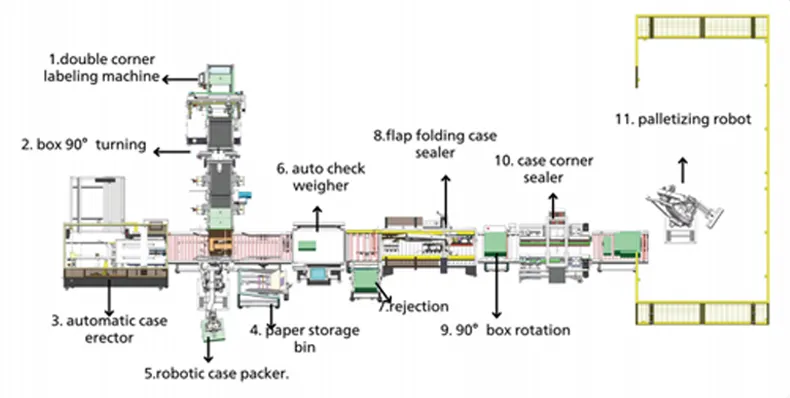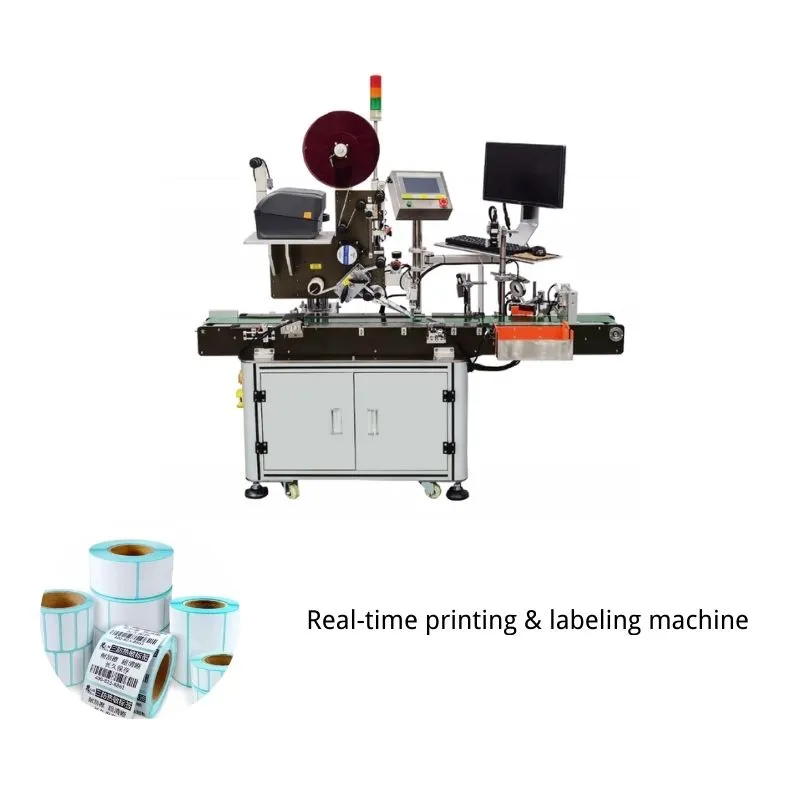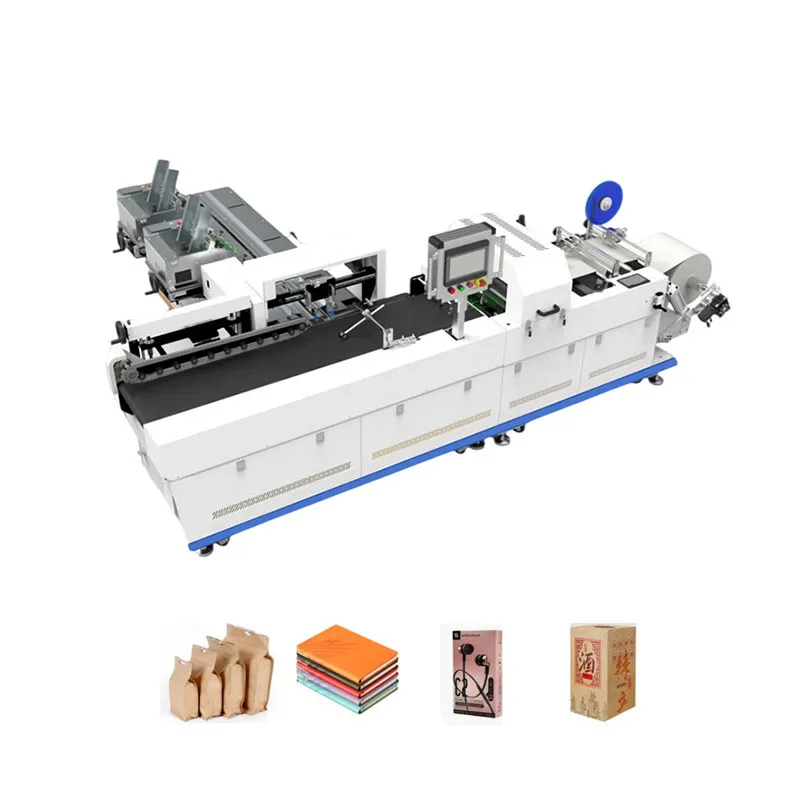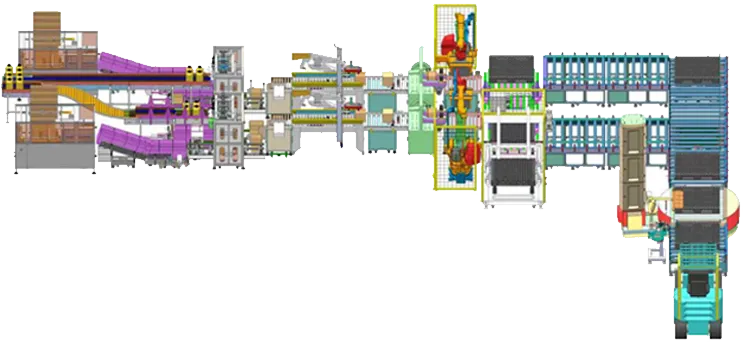
Packing automation ROI is often calculated for the robot that takes the part out of the mould. That is a different investment. This article covers only the stage after take-out and before the pallet: conveying, counting, bagging, labelling, case packing and palletising. A plastic parts packing production line starts where the moulding cell ends, so its payback must be calculated on packing labour, packing errors and packing downtime, not on moulding cycle time.
Where this shows up in real plants. ROI guides for packaging automation are written for industrial end-of-line operations, and several publishers split their advice by industry because payback depends on labour rates, shift patterns and product mix. Published implementation examples cover palletizing, case packing and robotic handling. In an injection molding shop the investment sits downstream of take-out: parts leave the machine, then need conveying, counting, bagging, labeling, cartoning and palletizing before a pallet can ship. One counting line can serve one machine or four, and that choice changes the payback more than the robot price does.
Table of Contents
- What Is the Payback of Automating the Packing Stage?
- Draw the Boundary After Take-Out, Before the Pallet
- Count the Four Cost Buckets
- Build the Payback Formula
- Phase 1: Conveying and Buffering
- Phase 2: Vision Counting and Bagging
- Phase 3: Case Packing and Palletising
- One Machine or Four Machines Sharing One Line
- Run Sensitivity on Wages, Shifts and SKU Count
- Get Capital Approval With Phased Payment and Phased Acceptance
- Request a Packing Automation ROI Calculator
1. What Is the Payback of Automating the Packing Stage?
Payback is the number of months until the accumulated savings equal the investment. For a packing stage, the savings come from fewer packers, fewer wrong counts, fewer damaged parts and less downtime between bags and cartons.
Most published ROI guides already give a formula, a worksheet and a worked example. They usually cover the whole packaging line or the moulding cell. The missing piece is the boundary: if the take-out robot is included, the payback looks faster but the packing problems remain.
What this means for plastic parts: use the same cost buckets in the five-year TCO table and in the ROI model. One set of numbers, two views.
2. Draw the Boundary After Take-Out, Before the Pallet
Write down the first and last station of the investment. First: the conveyor that receives parts after take-out. Last: the pallet ready for stretch wrap.
Exclude the moulding machine, the take-out robot and any mould changes. State who owns each excluded item in the approval document.
What this means for plastic parts: a clear boundary stops double counting. If the plant already has a take-out robot, its cost cannot appear as a new saving.
3. Count the Four Cost Buckets
Bucket one is packing labour: operators who count, bag, label and box by hand, including indirect time for supervision and rework. Bucket two is quality: wrong counts, mixed parts, scratched parts and customer returns. Bucket three is downtime: waiting for bags, labels, cartons or a pallet change. Bucket four is the cost of peak-season overtime and temporary staff.
Use your own wage rate, part value and contribution per bag, not an industry average.
Add a fifth gain next to the four cost buckets: throughput improvement. Published ROI frameworks treat labour reduction, throughput gain and error or waste reduction as three separate returns, and material usage optimisation, injury and safety costs, and consistency gains as further ones. Counting the first alone understates the case.
What this means for plastic parts: mixed parts are the most expensive quality item, because one sealed bag can trigger a customer line stop. Price the full event, as shown in our guide to counting and mix-up errors.
4. Build the Payback Formula
Monthly saving = packing labour saved + quality loss avoided + downtime avoided − extra running cost. Payback months = total investment ÷ monthly saving.
Extra running cost includes power, air, consumables, planned maintenance and the operator who now supervises the line. Do not set it to zero.
State what the framework does not include. A payback formula built on wage rates and bag counts will not capture a customer audit requirement, a traceability mandate or a seasonal peak. List those exclusions in the capital request so the number is not read as a guarantee.
What this means for plastic parts: put the same formula and the same assumptions into the packing line RFQ so supplier quotes can be compared on accepted bags per shift, not on nameplate speed.
5. Phase 1: Conveying and Buffering
The first phase moves parts from the moulding cell to a controlled buffer and removes manual carrying. It is the smallest investment and often pays for the later phases by making output steady.
Measure the saving in walking time, waiting time and parts dropped or mixed between machines.
What this means for plastic parts: buffer design depends on whether parts arrive in a steady stream or in bursts. Confirm the feeding method before sizing the buffer, because a bowl feeder and a robot cell need different infeed behaviour.
6. Phase 2: Vision Counting and Bagging
The second phase replaces hand counting with a counting station, a checkweigher and a bagging module. This is where most labour and most count errors disappear.
Measure the saving in packers per shift, wrong-count credits and rework hours.
What this means for plastic parts: ask for a sustained trial on transparent, shiny and soft parts. Accepted bags per hour after rejects is the output figure that belongs in the payback model.
7. Phase 3: Case Packing and Palletising
The third phase automates carton erecting, case packing, labelling and palletising. It removes the heaviest manual work and the end-of-line bottleneck.
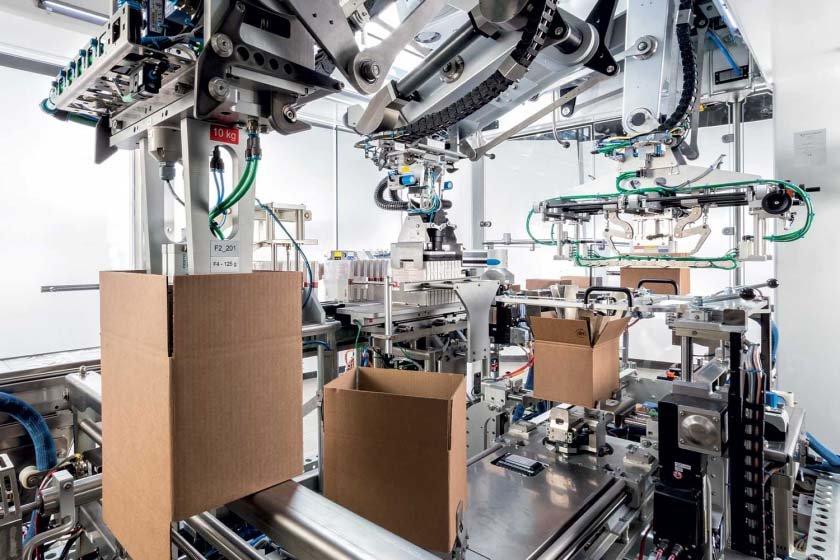
What this means for plastic parts: this phase changes the floor plan most, because palletising needs buffer space and a clear aisle. Include the building work in the investment figure.
8. One Machine or Four Machines Sharing One Line
Four moulding machines can share one counting and packing line if their output fits the line and their parts can be kept apart. Sharing raises utilisation and shortens payback, but it adds changeovers and traceability requirements.
Compare one dedicated line per machine with one shared line on utilisation, changeovers and batch separation.
Check whether semi-automation is the better fit. If one machine runs a single part family on two shifts, a full robotic line may never recover its cost; conveying and vision counting alone can remove the manual count without buying a palletizer.
What this means for plastic parts: a shared line must prove that two similar parts from two machines cannot enter the same bag. Use a measured changeover baseline, not an assumed one.
9. Run Sensitivity on Wages, Shifts and SKU Count
Change one assumption at a time. The result should show which variable moves payback the most.
| Assumption | Low case | Base case | High case | Payback months |
|---|---|---|---|---|
| Fully loaded wage rate | ||||
| Shifts per day | ||||
| Accepted bags per shift | ||||
| SKUs sharing the line | ||||
| Quality loss per incident |
Four mistakes commonly delay payback: assuming nameplate speed from day one, ignoring ramp-up output, omitting changeover downtime, and undercounting the labour needed to supervise exceptions. Run the sensitivity with a conservative ramp curve as well as the steady state.
What this means for plastic parts: SKU count usually moves payback more than wage rate, because each extra SKU adds changeover time and tooling. Ask for the accepted-output figure from a FAT/SAT sustained run rather than a catalogue speed.
10. Get Capital Approval With Phased Payment and Phased Acceptance
Tie each phase to its own acceptance test and its own payment. Phase 1 is accepted on steady conveying, phase 2 on count accuracy, phase 3 on cartons per shift.
This reduces the risk of paying for a full line before the counting station has been proven on your parts. It also gives the finance team three smaller decisions instead of one large one.
Frame the capital request around a phased implementation that can be witnessed at each stage. Published implementation examples show that a staged scope is easier to approve than a single large request, because each phase has its own acceptance record.
What this means for plastic parts: write the acceptance criteria for each phase before the order, using your real parts, and keep the evidence pack from each phase.
11. Request a Packing Automation ROI Calculator
A packing automation ROI calculator asks for moulding machine count, shifts, wage rate, part value, current scrap and complaint cost, SKU count and target bags per shift. It should return a payback period range, not a single number.
JOYDA configures and integrates conveying, counting, bagging, labelling and palletising equipment as one packaging solution. Send your machine count and shift pattern to sales01@joydatech.com, or message +86 137 1326 8688 on WhatsApp, and request the packing stage calculator and a phased investment proposal.
FAQ 1. What does packing-stage ROI include?
For injection molding downstream automation, only the stations after take-out and before the pallet count: conveying, counting, bagging, labelling, case packing and palletising. It excludes the moulding machine and the take-out robot.
FAQ 2. How is payback calculated?
Divide the total investment by the monthly saving. Monthly saving is packing labour saved, plus quality losses avoided, plus downtime avoided, minus extra running costs.
FAQ 3. Is a shared line for four moulding machines a good idea?
It can be, if output fits and parts from different machines are kept apart. Compare utilisation gains against changeover time and traceability controls.
FAQ 4. Which assumption changes payback the most?
Usually accepted bags per shift and the number of SKUs sharing the line. Wage rate matters, but changeover time often matters more.
FAQ 5. Why approve the investment in phases?
Each phase has its own acceptance test. You prove the counting station on your parts before paying for case packing and palletising.