Scoping a fastener packaging machine hardware screws bolts nuts packing line is fundamentally harder than buying a single-part bagger because mixed hardware kits combine conflicting part geometries, weights, and oil coatings inside a single pouch. When screws, hex nuts, and flat washers run on generic packaging equipment, plants lose $50,000 to $180,000 per line each year to count giveaways, pierced polybags, feeder jams, and excessive changeover labor. Every one of these ten commercial packing challenges has a specific mechanical and control configuration that eliminates the loss, building directly on the station architecture covered in our complete flat washer packing production line guide.
Table of Contents
- Why Mixed Fastener Kits Are the Hardest Thing to Pack
- The Top 10 Fastener Kit Packing Challenges
- Challenge-to-Solution Configuration Matrix
- A Real Kit Line Configuration Example Anchored on Flat Washers
- Turnkey Line vs. Self-Built: Cost, Lead Time, and Risk Comparison
- Six Capabilities to Verify Before You Sign With a Supplier
- Conclusion
1. Why Mixed Fastener Kits Are the Hardest Thing to Pack
Single-SKU bulk bagging only requires calibrating a feeder track and optical sensor for one mass and one silhouette. Mixed fastener packaging forces a single system to feed, count, stage, and seal long threaded bolts, dense hex nuts, and thin oil-coated flat washers simultaneously at 30 to 60 bags per minute.
First, mixed hardware kits create extreme mechanical bridging and feeding conflicts. Coarse-thread wood screws interlock head-to-shank along linear vibratory tracks, while flat washers coated in rust-preventative stamping oil shingle together like wet coins. A vibratory amplitude high enough to drive heavy M10 hex bolts forward will bounce lightweight M6 nylon locknuts out of the track entirely, requiring independent multi-bowl frequency control and physical separation gates on every lane.
Second, size and mass disparities break standard quality verification. When a 50-piece assembly kit combines heavy 22-gram hex bolts with 1.4-gram flat washers, the natural manufacturing weight tolerance of the bolts (+/- 2%) is heavier than an entire flat washer. A generic end-of-line checkweigher cannot tell if a washer is missing, meaning counting errors go straight to your customer unless upstream optical sensors and intermediate load cells isolate each component stream prior to bagging.
Third, unsynchronized multi-lane discharge causes count interference and seal-jaw crashes. When 4 to 8 feeder bowls dump parts of different aerodynamic drag into a central bucket conveyor or vertical forming tube without staggered timing, light washers float behind heavy bolts and get crushed inside the horizontal heat-sealing jaws. Only a master PLC (programmable logic controller, the industrial computer coordinating all feeder lanes and bagger motions) with dual-stage memory buckets can synchronize high-speed screw nut washer bagging without starving the Vertical Form Fill Seal (VFFS) machine.

2. The Top 10 Fastener Kit Packing Challenges
Every failure mode on a hardware kit packing line translates directly into scrap film, fastener giveaway, overtime wages, or customer chargebacks. Below are the ten costliest mixed-kit packing challenges, their exact financial impact, and the machine configuration required to fix them.
2.1 Oil-Induced Flat Washer Shingling and Double Counting
Stamping oils and corrosion inhibitors create high surface tension between flat washers, causing two stuck washers to slide down the feeder track and pass through a basic single-beam photo-eye as a single piece.
On a high-volume line running 12 million kits annually, a 1.8% count giveaway caused by shingled washers wastes $58,000 per year in raw fastener giveaway and forces unscheduled hopper refills.
Configure the washer lane with a stepped vibratory bowl featuring a dimpled polyurethane lining to break vacuum adhesion, dual 0.5 MPa angled air-knife jets to blow off top-riding washers, a hardened tool-steel wiper gate set to 1.5x part thickness, and area-scan vision inspection for fastener counting accuracy to achieve +/- 0 piece kit accuracy and divert double-stacked parts before they enter the bucket conveyor.
2.2 Long Screw and Bolt Bridging in Feeder Tracks
Threaded fasteners with length-to-diameter ratios above 3:1 (such as M8x30 hex bolts or drywall screws) cross threads and bridge across bowl exit transitions, stalling part flow on that lane while the remaining bowls wait idle.
Four 90-second bridging stops per hour cut effective line availability by 10%, losing 3,600 kits per 8-hour shift and burning $42,000 per year in unproductive operator labor (calculated at a fully burdened wage of $22/hour across two shifts).
Install V-groove linear orienting tracks paired with overhead counter-rotating nylon brush wheels and piezoelectric high-frequency track controllers. The counter-rotating brush sweeps bridged bolts back into the bowl reservoir before they lock inside the confinement rail, maintaining continuous discharge at 300 to 600 parts per minute.
2.3 Multi-Bowl Synchronization Lag and Bagger Starvation
In a 6-bowl kit configuration where one BOM calls for 24 flat washers, 12 hex nuts, and 4 bolts, the single washer bowl takes three times longer to count its batch than the bolt bowl, forcing the VFFS bagger to wait and slashing overall cycle speed.
Dropping line speed from 45 bags per minute to 24 bags per minute forces a plant to add a second 8-hour shift to meet monthly delivery targets, adding $48,000 per year in direct labor per operator.
Equip each vibratory feeder with twin-stage pneumatic memory buckets (pre-counting the next batch while the previous batch drops) and program master PLC bowl-pairing logic. Splitting high-count washers across two synchronized bowls operating at 800 parts per minute each keeps the central flighted bucket conveyor running continuously at 45 to 55 bags per minute.
2.4 Sharp Thread and Stamped Edge Film Punctures
When 150 grams to 500 grams of sharp-threaded bolts and stamped washers free-fall 800 mm down a vertical stainless forming tube, kinetic impact slices open standard packaging film at the bottom seal seam.
A 1.6% punctured-bag rate on a 30,000-bag daily run produces 480 defective kits per shift that must be manually sliced open and re-bagged, costing $31,200 per year in scrap film and rework labor.
Configure a 45-degree inclined heavy-duty flat washer counting and bagging machine equipped with internal urethane drop-cushioning flaps, pneumatic under-bag bottom support plates that absorb impact kinetic energy prior to jaw opening, and 80- to 120-micron co-extruded LDPE (low-density polyethylene) film.
2.5 Trailing Parts Crushed in Horizontal Sealing Jaws
Because flat washers and small nylon spacers have higher air resistance than heavy steel bolts, they fall slower through the forming tube and arrive in the sealing zone just as the horizontal jaws clamp shut.
One steel fastener crushed between heated sealing bars destroys the serrated knife and damages PTFE-coated heater jaws ($680 in replacement hardware), causing 45 minutes of downtime and producing pin-hole leaky seals that trigger $8,000 to $15,000 retail lot rejections.
Specify servo-driven anti-pinch jaw torque detection, cross-beam optical throat sensors mounted 40 mm above the sealing line, and staggered bucket-dump timing that releases lightweight washers 120 milliseconds ahead of heavy bolts so all items land in one tight cluster.
2.6 Rapid Bowl Abrasion and Excessive Shop-Floor Noise
Running hardened carbon-steel screws and nuts across bare stainless steel vibratory bowls at 600 to 1,200 parts per minute erodes feeder tracks, generates metallic dust that blinds optical sensors, and pushes plant noise above 92 dBA.
Replacing worn bare-metal bowls every 14 to 18 months on an 8-bowl line costs $18,000 in hardware and re-tuning downtime, while sensor-blinding dust causes 0.8% false rejects ($19,000 per year in unnecessary rework).
Line all feeder bowls and exit chutes with 3 mm hot-cast wear-resistant PU (polyurethane) elastomers and enclose each bowl inside a hinged acoustic safety shroud. PU coating extends bowl service life beyond 5 years, prevents damage to zinc-plated fastener threads, and drops operating noise below 76 dBA.
2.7 Slow Mechanical Changeovers Across Multi-SKU Kit Runs
Contract packagers and hardware OEMs switching between M5, M6, M8, and M10 kit recipes often spend 35 to 45 minutes per changeover manually recalibrating wiper blades, rail widths, and bag lengths with hex wrenches.
Five 40-minute changeovers per day eliminate 3.3 hours of machine uptime every shift—costing $72,000 per year in lost billing capacity on a line valued at $90 per operating hour.
Deploy an 8-bowl station where dedicated bowls stay tuned to core fastener sizes (reducing active rail adjustments to 5 to 15 minutes per bowl using tool-less digital micrometer handwheels) combined with one-touch HMI recipe recall that automatically sets VFFS bag length, film pull speed, and checkweigher limits.
2.8 Cross-Contamination and Rogue Fastener Mix-Ups
During high-tempo shift handovers, operators frequently dump a box of M8 coarse-thread nuts into an M8 fine-thread feeder hopper, or leave residual parts inside a bowl channel during recipe switches.
A single cross-contaminated batch of 15,000 assembly kits shipped to an appliance or furniture manufacturer triggers a mandatory supplier sort and line-stop penalty averaging $14,000 to $32,000 per incident.
Fit every bulk hopper lid with an electromagnetic interlock controlled by a handheld barcode scanner (the lid only unlocks when the scanned raw-material tote matches the active HMI BOM) and build quick-dump pneumatic cleanout gates into the bottom of every vibratory bowl for 60-second total purging.
2.9 Uncaught Missing Washers Masked by Heavy Bolt Tolerances
When a 50-piece hardware kit weighs 420 grams total, the +/- 1.5% weight variation of the heavy hex bolts (+/- 6.3 grams) completely masks a missing 1.8-gram M8 flat washer on an end-of-line checkweigher.
Shipping incomplete assembly kits causes customer installation failures and warranty replacement dispatches averaging $45 per claim—costing $36,000 per year if just 800 short kits slip through inspection.
Pair upstream optical fiber or vision counting (+/- 0 pieces) on every small-part bowl with intermediate high-resolution strain-gauge weigh buckets under the washer and nut lanes. The system verifies the exact sub-weight of light parts before combining them with heavy bolts in the main conveyor bucket, while the final inline dynamic checkweigher catches gross bolt errors.
2.10 Barcode and Lot Code Smudging on Oily Polybags
Oily vapor and surface residue transferring from stamped bolts and nuts onto polybag exteriors prevent standard ink-jet or basic wax-ribbon barcodes from curing, causing codes to rub off inside master cartons.
Distribution centers charge $2.50 to $4.00 per bag for manual barcode relabeling; a single 10,000-bag rejected shipment costs $28,000 in chargebacks and freight delays.
Mount a digital TTO (thermal transfer overprinting) unit using resin-formulated oil-resistant ribbons inside the enclosed clean film unwind cabinet before the film enters the forming collar, or integrate a 355 nm UV laser marker that permanently alters the polymer pigment without consumable inks.
3. Challenge-to-Solution Configuration Matrix
Use the engineering matrix below during technical specification reviews to verify that your quoted fastener turnkey line addresses all ten failure points before you release a purchase order.
| Packing Challenge | Annual Commercial Risk | Required Machine Configuration | FAT Verification Method |
|---|---|---|---|
| 1. Oil-induced washer shingling | $58,000/yr in 1.8% part giveaway | Dimpled PU bowl lining + 0.5 MPa air-knife + vision counter | Run 5,000 heavily oiled washers; verify zero double-counts |
| 2. Long bolt track bridging | $42,000/yr in micro-stop labor loss | V-groove linear rail + rotary brush kicker + piezo drive | Continuous 60-minute run with longest L/D ratio bolt in BOM |
| 3. Multi-bowl speed starvation | $48,000/yr in added shift labor | Dual-stage pre-count memory buckets + paired washer bowls | Time 500 consecutive mixed kits at target 45+ bags/min |
| 4. Sharp thread film punctures | $31,200/yr in film and rework | 45-degree inclined VFFS + bottom bag clamp + 100-micron LDPE | Drop-test 200 max-weight kits; inspect seams under tension |
| 5. Parts crushed in seal jaws | $8,000 to $15,000 per lot rejection | Servo torque jaw protection + optical throat sensor + staggered dump | Inject delayed test washer into drop stream; verify jaw auto-retract |
| 6. Bowl wear and 92 dBA noise | $37,000/yr in replacement and false rejects | 3 mm hot-cast PU bowl coating + acoustic safety enclosures | Decibel meter check (<76 dBA at 1 meter) and coating shore-hardness cert |
| 7. Slow mechanical changeovers | $72,000/yr in lost machine uptime | Tool-less micrometer rail adjusters + HMI 100-recipe memory | Perform timed switch from M6 kit to M10 kit (target under 15 min) |
| 8. Hopper cross-contamination | $14,000 to $32,000 OEM sort penalty | Barcode-interlocked hopper lids + pneumatic bowl purge gates | Scan wrong part barcode during trial; verify hopper lock holds |
| 9. Masked missing light washers | $36,000/yr in warranty field claims | Optical/vision counting + intermediate sub-weigher before main conveyor | Remove 1 washer from batch manually; verify reject gate diverts pack |
| 10. Oily bag barcode smudging | $28,000 per rejected retail shipment | Clean-zone resin-ribbon TTO or UV laser coder prior to forming tube | Rub printed QR code 20 times with oil-soaked cloth; verify Grade A scan |
4. A Real Kit Line Configuration Example Anchored on Flat Washers
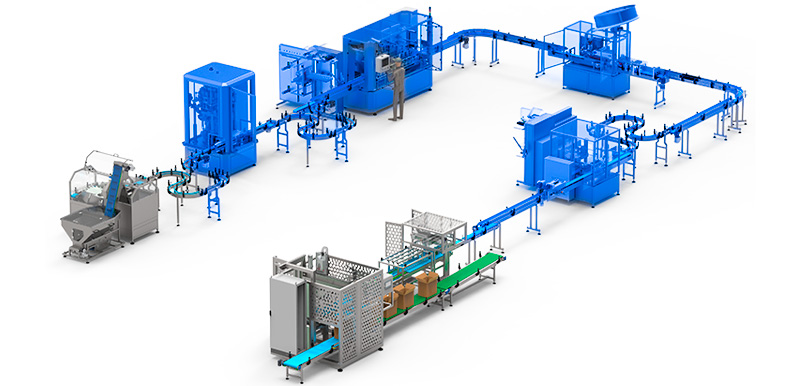
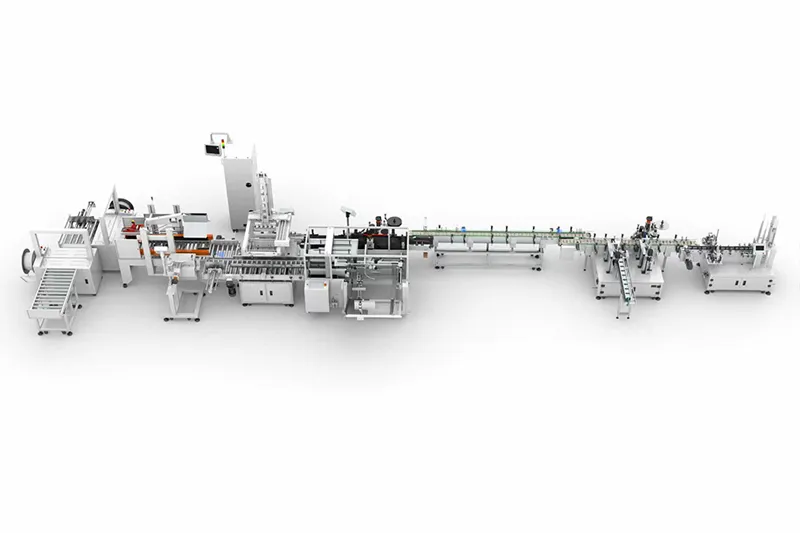
To see how a commercial mixed fastener packaging system operates on the plant floor, consider a realistic 50-piece structural assembly kit containing 15 pieces of M8x30 hex bolts, 20 pieces of M8 flat washers, and 15 pieces of M8 hex nuts, running at a guaranteed net output of 40 bags per minute inside a 12 m x 4.5 m footprint. Because flat washers represent 40% of the total piece count and carry the highest shingling risk, the line is anchored around the feeder and optical counting engineering of our turnkey flat washer packing production line.
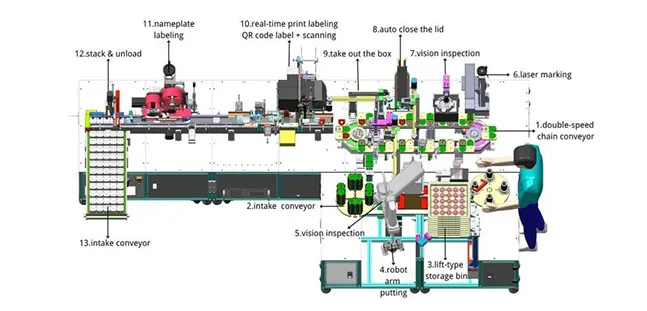
- Stations 1 & 2: 6-Lane Bulk Elevating and PU-Coated Vibratory Feeding: Two bowls are dedicated to M8x30 hex bolts (300 parts/min per bowl), two bowls are dedicated to M8 flat washers (450 parts/min per bowl with dimpled PU tracks and dual air-knives), and two bowls handle M8 hex nuts (350 parts/min per bowl). Splitting the 20 washers across two bowls cuts washer count time to 1.3 seconds per bag. Skipping the second washer bowl would cap line speed at 22 bags per minute, costing $44,000 annually in lost throughput.
- Station 3: Vision Counting and Twin-Stage Memory Buckets: High-speed optical vision sensors verify every falling part at +/- 0 piece accuracy, while pneumatic memory buckets hold one completed sub-count waiting above the flighted chain conveyor. Omitting memory buckets adds 0.8 seconds of dead time per cycle, dropping output by 32%.
- Station 4: Flighted Synchronization Conveyor with Reject Gate: A servo-indexed bucket conveyor collects the bolt, nut, and washer drops in sequence. If any bowl registers an accidental over-count (such as an extra washer dropping before the pneumatic gate closes), the master PLC tracks that specific bucket and dumps the defective batch into a segregated rework bin before it ever reaches the bagging film—saving $24,000 per year in packaging film waste.
- Station 5: 45-Degree Inclined VFFS Bagger with Resin TTO: The synchronized 50-piece charge slides down a 45-degree Teflon-lined forming tube into a 100-micron LDPE pillow bag pre-printed with a lot QR code, cushioned by a pneumatic bottom support plate. Using a standard vertical bagger here instead of an inclined unit results in a 2.5% pierced-bag rate on M8x30 bolts.
- Stations 6 to 10: Z-Conveyor, Dynamic Checkweigher, and Case Packing: Sealed bags elevate to a strain-gauge checkweigher (+/- 0.3 g resolution) with a high-speed air-blast reject pusher, accumulate on a buffering conveyor, and load automatically into RSC corrugated master cartons (25 bags per box) before automatic taping, PP strapping, and palletizing.
5. Turnkey Line vs. Self-Built: Cost, Lead Time, and Risk Comparison
Procurement managers often consider buying vibratory bowls from one vendor, a VFFS bagger from a second vendor, and a checkweigher and cartoner from a third to shave 10% to 15% off initial equipment price. In practice, multi-vendor self-built lines achieve only 55% to 65% OEE due to PLC handshaking clashes and uncoordinated bucket timing, whereas a fully integrated turnkey line operates at 80% to 88% OEE.
| Comparison Factor | Turnkey Line via One Packaging Partner | Self-Built Multi-Vendor Line (3 to 5 Suppliers) | Commercial Impact for Buyer |
|---|---|---|---|
| Total Capital Cost | Predictable fixed-price turnkey contract | 10% lower machine invoice, plus $25,000 to $45,000 in hidden PLC wiring and mechanical bridging costs | Turnkey eliminates mid-project budget overruns |
| Project Lead Time | 55 to 75 days (fully pre-integrated and tested) | 110 to 160 days (staggered deliveries and on-site debugging) | Turnkey starts generating labor savings 2 to 3 months earlier |
| Production OEE & Speed | 80% to 88% OEE at 30 to 60 bags/min | 55% to 65% OEE due to signal delays and dump starvation | 20%+ higher daily output on the exact same floor space |
| Pre-Shipment FAT | Full 10-station line tested together with your oily parts | Individual machines tested in isolation without upstream/downstream loads | Turnkey catches synchronization bottlenecks before shipping |
| Spare Parts & Warranty | Single wear-parts kit and one point of warranty accountability | Finger-pointing between feeder vendor and bagger vendor when counts drift | Single-partner accountability prevents multi-day line shutdowns |
Working with a single solutions integrator eliminates the engineering gap between counting and sealing. Before committing capital, model your current operator wages ($37,000 to $58,000 per year per operator at $18 to $28/hour fully burdened) and 1% to 2% manual packing giveaway against automated <0.1% giveaway using our manual vs. automatic flat washer packing ROI calculator.
6. Six Capabilities to Verify Before You Sign With a Supplier
Before issuing a deposit on a fastener packaging machine hardware screws bolts nuts packing line, require your prospective supplier to prove these six operational capabilities in writing:
- Pre-Shipment Commissioning With Your Worst Production Parts: Never let a supplier test your line with clean, dry commercial samples. Ship 100 kg of your oiliest, thinnest washers and longest threaded bolts, and require a continuous 2-hour video-recorded run demonstrating target bags per minute and zero unrejected count errors.
- Guaranteed Wear-Parts Inventory and Lead Time: Verify that critical consumables—including serrated cutoff knives, PTFE jaw tape, TTO printheads, optical fiber sensors, and conveyor buckets—are stocked for immediate 48-hour dispatch, and confirm that an initial 12-month spare parts kit is bundled into the initial shipment.
- Remote PLC Diagnostics and 4-Hour Technical Response: Confirm that the master control cabinet includes an industrial IoT gateway (VPN router) allowing controls engineers to log into the PLC and vision cameras remotely within 4 hours of a support ticket to adjust timing parameters without waiting for a flight.
- Documented Multi-Station FAT Protocol: Demand a quantitative Factory Acceptance Test scorecard requiring 500 consecutive mixed kits weighed individually to verify +/- 0 piece kit accuracy, a timed 15-minute SKU changeover demonstration, and deliberate fault-injection tests (such as dropping a double washer or blocking the jaw throat).
- Verified Fastener Kit Case References: Ask for production videos and layout drawings of previously commissioned 4- to 8-bowl lines running comparable hardware mixes (similar bolt length-to-diameter ratios and washer thicknesses) rather than generic snack-food or plastic-part baggers.
- Unified Single-Screen HMI and Upstream/Downstream Handshaking: Verify that all feeder bowls, vision counters, the VFFS bagger, checkweigher, and case erector are controlled through one centralized recipe selection screen using standardized Ethernet/IP or Profinet protocols, preventing pile-ups when a downstream box sealer pauses for tape reloading.
7. Conclusion
Fixing the ten profit leaks in mixed fastener kit packaging requires engineering every station around the real physics of oily washers, bridging bolts, and high-impact bag drops. By combining PU-lined multi-bowl feeders, vision-verified counting with twin-stage memory buckets, and a 45-degree inclined VFFS bagger under unified PLC control, you eliminate the $58,000 annual giveaway penalty and hit 80% to 88% OEE from week one.
As your dedicated one packaging partner and end-of-line solutions integrator, JOYDA configures, integrates, commissions, and supports complete hardware kit packing lines built around your exact BOM and floor constraints. Send us your kit BOM (fastener dimensions, piece counts per bag, target bags per minute, and carton specs) today, and our engineering team will deliver a customized turnkey line configuration, floor layout, and guaranteed lead time within 48 hours.
FAQ
How many vibratory feeder bowls do I need for a mixed fastener kit line?
Match the number of bowls to the maximum number of distinct SKUs in your most complex kit, plus 1 or 2 auxiliary bowls for high-count items like flat washers. Most commercial hardware kit lines configure 4, 6, or 8 bowls; when a kit contains 20+ washers alongside 4 bolts and 4 nuts, pairing two bowls on the washer SKU doubles cycle speed from 25 bags per minute to 45+ bags per minute.
Can one packing line handle both small retail hardware kits and 5 kg bulk fastener bags?
A single counting and bagging line can efficiently span small 10-piece kits up to 1.5 kg bags by using quick-change VFFS forming collars and switching the feeder logic from single-piece optical counting to multi-dump accumulation. However, if you run 5 kg to 25 kg bulk bags alongside small polybag kits at high volume, integrating a multi-head combination weigher lane (+/ 1 to 3 g accuracy) alongside your multi-bowl counter is far more cost-effective.
How do you prevent a missing 1-gram flat washer when packing it with heavy 20-gram bolts?
Never rely on the final end-of-line checkweigher alone to catch a missing washer in a heavy bolt kit, because normal bolt weight variance masks the washer weight. Instead, use high-speed optical vision counting (+/- 0 pieces) combined with an intermediate load-cell weigh bucket directly beneath the washer bowl to verify exact washer count before the parts merge with the bolts in the main bucket conveyor.
What is the realistic changeover time when switching from an M6 kit to an M10 kit?
On a properly configured 6- to 8-bowl line equipped with tool-less digital micrometer track adjusters, pneumatic bowl purge gates, and HMI recipe memory, switching from an M6 assembly kit to an M10 kit takes 5 to 15 minutes per active bowl. If you only change the piece count recipe using fastener sizes already loaded in the bowls, changeover takes less than 60 seconds at the touchscreen.
What bag film specification prevents sharp screw threads from puncturing the package?
Specify 80-micron to 120-micron co-extruded LDPE (low-density polyethylene) film rather than brittle BOPP film, which tears easily once nicked by a thread crest. Combine this film with a 45-degree inclined forming tube and pneumatic bottom-support plates under the sealing zone to cut drop impact forces by more than 50%.
How much floor space is required for an automatic screw, nut, and washer kit packing line?
A 6-bowl counting and inclined VFFS bagging cell with a discharge conveyor and dynamic checkweigher fits inside an L-shaped or linear footprint of 7.5 m x 3.2 m with a ceiling clearance of 2.8 meters. A complete 10-station turnkey line adding automatic case erecting, bag-in-box loading, carton strapping, and palletizing requires approximately 12 m x 4.5 m.
What is the typical ROI payback period when upgrading from manual kit packing to an automated turnkey line?
Most fastener distributors and hardware OEMs achieve full capital payback in 9 to 16 months when operating across 1.5 to 2 shifts. Replacing 5 manual kit packers ($37,000 to $58,000 per year each in fully burdened wages) with 1 line tender saves $148,000 to $232,000 annually in direct labor alone, before adding the $30,000 to $58,000 saved by cutting count giveaway from 1.8% to under 0.1%.
What technical details do I need to submit to get an accurate 48-hour turnkey line quotation?
Provide five core inputs: (1) your kit BOM matrix listing every screw, bolt, nut, and washer dimension (ID, OD, length, thickness, and unit weight) plus surface oil condition, (2) piece counts per bag across your top 10 SKUs, (3) required bag widths, lengths, and film thickness, (4) target throughput in bags per minute, and (5) master carton dimensions if secondary box packing is required.