You pack the same product in the same carton every day, yet some boxes leave the line tight and clean while others are loose, skewed, or short a unit. A retailer scanning your shipment doesn’t see “mostly fine.” They see inconsistency, and inconsistency is what triggers complaints, chargebacks, and the quiet decision to source elsewhere. Variable carton quality is rarely one big failure. It is a dozen small variables drifting out of control. This article shows what it looks like, how to find the variable that’s drifting, and how to make every carton come off the line the same.
If your quality depends on who is on shift, the line isn’t consistent by design. The fix is to move the variables into the machine, where they stay put. A well-set automatic carton line packs the 10,000th box exactly like the first.
What You’ll Learn
- What inconsistent packing looks like
- The root causes of variable quality
- How to find the variable that’s drifting
- Why it costs more than it seems
- Fixes that don’t need new machines
- How automation delivers uniform packs
- How to measure your consistency
- How JOYDA holds quality
- Frequently asked questions
- Get a consistency review
1. What Inconsistent Packing Looks Like
Variable quality shows up in small, cumulative ways:
1.1 Seal tightness varies
Some cartons are taped tight, others barely stuck. That is the hallmark of hand sealing, where pressure and placement drift through a shift. The tape-vs-glue decision matters less than applying either one consistently.
1.2 Boxes skewed or misaligned
Erected cartons that sit slightly off, or products that land off-center, produce packs that look wrong and stack poorly. Minor feeding problems often sit upstream of this.
1.3 Count and fill errors
An occasional short count or wrong item slips through when counting is manual. A checkweigher at the end is what makes the count uniform instead of luck.
1.4 Damage that comes and goes
Crushed or scuffed cartons appear in batches, not steadily. Another sign the cause is a drifting variable, not the product.
2. The Root Causes of Variable Quality
| Cause | How it varies quality | Control |
| Operator difference | Each person seals and packs differently | Automate the step |
| Machine drift | Pressure, tension, timing slip over a shift | Closed-loop sensing |
| Material variance | Board stiffness and tape batches differ | Recipe per material |
| Environment | Humidity changes board behavior and glue cure | Climate-stable settings |
| Training gap | New staff miss the standard | Built-in repeatability |
Every one of these is a variable that a human, or a loosely tuned machine, lets wander. The theme is simple: consistency is engineered, not supervised.
3. How to Find the Variable That’s Drifting
Before you spend anything, spend an afternoon. Take one week of defect data and sort it two ways: by shift and by defect type. A defect that tracks the shift points to people or handoff. A defect that appears in batches regardless of shift points to material lots or machine drift. That single sort usually cuts the suspect list in half.
Then run a five-why on your worst defect. Example: boxes skewed in a batch. Why? The blank fed late. Why? Vacuum pressure was low. Why? The filter was half-clogged. Why? It was changed on calendar time, not condition. Why? No one owns the check. The fix there costs the price of a filter and a checklist item, and it removes a whole defect class.
Change one variable at a time when you test. Lines that “fix” three things at once never learn which one worked, and the problem usually returns.
4. Why It Costs More Than It Seems
Inconsistent packs drive three costs most teams undercount:
4.1 Returns and chargebacks
Retailers penalize short counts and damaged cartons. One bad batch can erase a month of margin on that SKU.
4.2 Brand trust
Customers remember the sloppy box. Inconsistent packing reads as “they don’t care,” and that perception outlasts the shipment.
4.3 Wasted material
Over-taping “to be safe” and repacking rejects doubles the tape and board waste on every off-spec box.
5. Fixes That Don’t Need New Machines
If a capital request isn’t in the cards this quarter, three disciplines still move the needle:
5.1 Write the standard down, with photos
A good/bad sample board at the bench plus a one-page standard with photos beats verbal training. New hires copy what they see, and inspectors check against the same pictures instead of opinion.
5.2 Sample on a fixed plan
Check a fixed number of cartons every hour (say 5) against the standard, and log the result. Fixed-plan sampling catches drift within an hour instead of at the customer’s dock. Borrow the AQL idea from your QC team; you don’t need the full statistics to benefit.
5.3 Add a shift-handover checklist
Many “operator difference” defects are actually handover defects: the incoming crew inherits a half-adjusted machine and nobody says so. A two-minute checklist (seal length, pressure, tape roll, carton stock) at every handover removes that whole category.
6. How Automation Delivers Uniform Packs
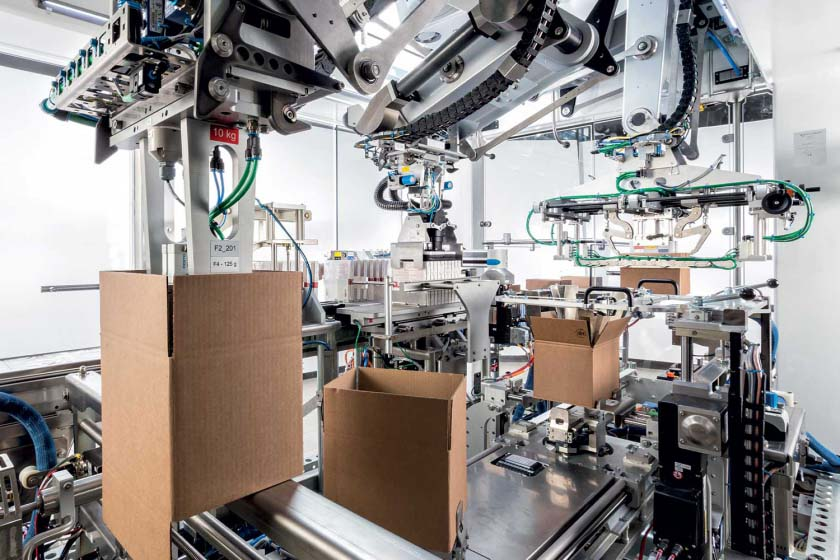
Automation removes the wandering variables. Sealing pressure, case-erect position, fill count, and reject criteria are set once and held by the controller, shift after shift. Closed-loop sensors catch drift and correct it before a bad carton is made. Where the defect matters most, add a vision check over the sealer or at the pack-out: the camera flags a skewed label or an open flap instantly, and the carton is pulled before it ships. The result is a pack that looks the same at 8 a.m. and 8 p.m., Monday and Friday, which is exactly what a retailer’s incoming inspection expects.
7. How to Measure Your Consistency
Track three rates per shift: seal-defect rate, misalignment rate, and short-count rate. Plot them. If they swing with shift or operator, the line is variable. If they sit flat near zero, it’s controlled. This is the same discipline behind a good buying decision: buy for consistency, not just speed.
8. How JOYDA Holds Quality
A JOYDA carton line sets every packing parameter in software and holds it with closed-loop control: metered sealing, positioned erection, counted fill, and inline checkweighing with automatic reject. The line logs each parameter so you can prove consistency to a retailer instead of just claiming it. Tell us your acceptable defect rate and we’ll show how the line stays under it.
9. Frequently Asked Questions
9.1 Can automation really match hand skill?
It does better: it removes the variation between skilled and tired hands. Automation is repeatable where people are not.
9.2 Does material variance still cause defects?
It can, which is why the line stores a recipe per carton and tape batch. Switch material, select the recipe, and settings follow. No drift from guesswork.
9.3 How do I prove consistency to a retailer?
Use the shift defect log. A flat near-zero line across shifts is the evidence buyers accept.
9.4 Will consistent packing slow the line?
No. Holding parameters steady usually raises effective throughput because there are fewer rejects and jams to recover from.
9.5 Is this worth it for low-volume lines?
If a single chargeback costs more than the consistency upgrade, yes. Many low-volume lines protect a high-value brand where one bad box matters.
9.6 Where does vision inspection make sense?
At the two points where defects escape to customers most often: over the sealer (open or short flaps) and at pack-out (wrong or missing items, skewed labels). One camera at either point usually pays for itself the first time it catches a batch a human would have missed at hour nine of a shift.
9.7 Can JOYDA audit my current consistency?
Yes. Share a shift of defect data and we’ll show where the variables are drifting and what it costs you.
10. Get a Consistency Review
If your carton quality swings with the shift, send JOYDA a week of your defect counts by type and shift. We’ll map where the variables drift, size a consistent carton line, and show the return-and-rework saving. Contact our packing engineers here for a no-obligation review.