Procuring disjointed packaging machines creates severe data silos, incompatible software, and uncontrollable downtime during factory automation upgrades. To ensure a successful transition, buyers must choose an Industry 4.0 turnkey carton packing system integrator capable of delivering a fully unified, data-driven end-of-line production capacity system. Failure to do so risks massive production bottlenecks and financial losses.
Table of Contents
- The Shift from Machine Purchasing to System-Level Automation Capacity
- Why Single-Source Turnkey Responsibility is the Safest Procurement Standard
- Industry 4.0 Control Architecture: The Great Divide in Supplier Capabilities
- Evaluating Full-Line System Structure and Continuous Closed-Loop Operations
- Benchmarking Throughput, Labor Reduction, and Automation ROI
- Custom Engineering for Complex Application Workflows
- Ensuring High-Load Stability for Continuous 24/7 Production
1. The Shift from Machine Purchasing to System-Level Automation Capacity
For decades, upgrading a facility’s packaging capabilities meant issuing purchase orders for individual pieces of equipment. A procurement team would source a case erector from one vendor, a carton sealer from another, and a labeling machine from a third. In the era of modern smart manufacturing, this fragmented approach is fundamentally broken.
Modern factory automation requires upgrading from buying isolated case erectors and carton sealers to investing in comprehensive system-level automation capacity, where the entire carton packing production line operates as a single, synchronized entity.
As an engineering consultant with over 20 years of experience in end-of-line integration, I constantly advise plant managers that they are no longer just buying machines—they are buying guaranteed production capacity systems. When you purchase individual units, you inherit the monumental task of mechanical and electrical integration. If the robotic packer pushes cartons slightly off-center, the downstream labeling machine will misapply barcodes, causing massive rework loops. The core procurement logic must shift entirely toward evaluating a supplier’s ability to engineer an automated, seamless flow of materials from raw inventory to dispatch.
2. Why Single-Source Turnkey Responsibility is the Safest Procurement Standard
Risk mitigation is the primary concern for any capital expenditure exceeding hundreds of thousands of dollars. The greatest threat to the successful launch of an automated packaging line is the division of responsibility among multiple equipment vendors.
Large manufacturing enterprises must select a single-source turnkey carton packing system provider to avoid the severe risks of multi-vendor integration, scattered liability, hardware incompatibility, and uncontrollable debugging cycles.
When a factory attempts to piece together a line, they inevitably face the “Frankenstein” dilemma. If the check weigher’s Programmable Logic Controller (PLC) fails to send the correct trigger signal to the downstream rejection system, Vendor A will blame Vendor B’s software protocol, and Vendor B will blame Vendor A’s sensor latency. As a result, the facility is left with a stalled line and no clear path to resolution.
Top-tier buyers must filter out standalone equipment sellers by asking the critical conversion question: “Can you deliver a fully turnkey carton packing production line with single responsibility?” A reliable turnkey end-of-line packaging solution provider takes absolute ownership of the mechanical layout design, software programming, onsite commissioning, and long-term after-sales support, eliminating the risks of divided liability.
3. Industry 4.0 Control Architecture: The Great Divide in Supplier Capabilities
The most significant technological chasm in the packaging industry today lies between manufacturers who build mechanical machines and integrators who build cyber-physical systems. Hardware is merely the skeleton; the software architecture is the central nervous system.
An advanced Industry 4.0 carton packaging automation line separates itself from traditional machinery through a centralized software control layer that provides real-time ERP/WMS/MES integration, predictive maintenance, and SKU recipe management.
If a B2B buyer asks, “Can your system integrate with our smart factory system?”, the answer separates true integrators from standard fabricators.
Core Digital Requirements
An enterprise-grade system must feature a centralized PLC and PC-based control platform. Instead of operators manually inputting batch data, the line must communicate directly with the facility’s Manufacturing Execution System (MES) or Warehouse Management System (WMS). This enables real-time production monitoring and automated data exchange. Furthermore, advanced lines feature OEE (Overall Equipment Effectiveness) performance visualization dashboards. These digital interfaces track uptime, output rates, and micro-stoppages in real-time, providing plant managers with actionable data to optimize throughput.
Predictive Maintenance Capabilities
Traditional facilities rely on reactive maintenance—fixing parts after they break. An Industry 4.0 system utilizes IoT sensors to monitor motor temperatures, servo torque, and pneumatic pressure. If a belt drive begins showing abnormal friction curves, the predictive maintenance system alerts the engineering team to replace the component during a scheduled shift change, preventing catastrophic downtime during production runs.
Supplier Capability Comparison
| Feature/Metric | Traditional Equipment Manufacturer | Industry 4.0 System Integrator |
| Operational Paradigm | Mechanically driven automation | Data-driven intelligent automation |
| System Interaction | Standalone, isolated machine operation | Fully synchronized system operation |
| Production Scheduling | Manual operator adjustments & scheduling | Smart, automated WMS/MES scheduling |
| Data Visibility | Localized HMI, no data logging | Real-time OEE dashboards & cloud analytics |
| Maintenance Strategy | Reactive (Break-fix) | Predictive (IoT sensor-driven diagnostics) |
4. Evaluating Full-Line System Structure and Continuous Closed-Loop Operations
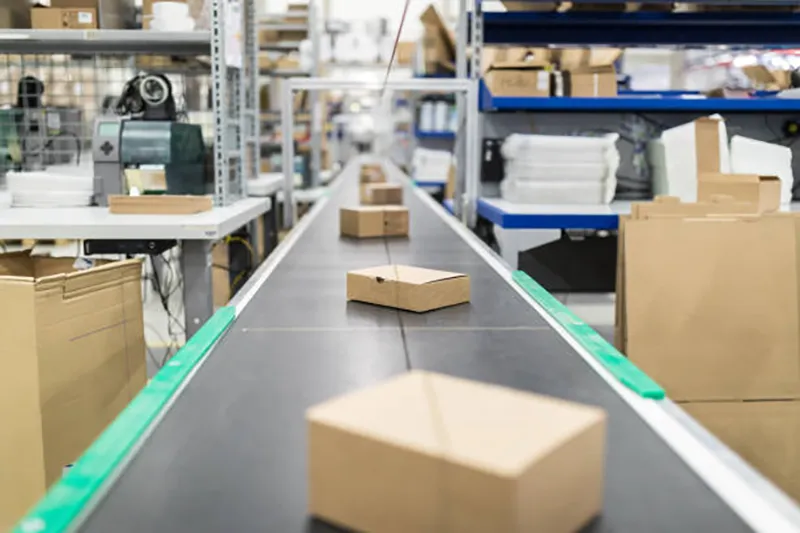
A high-performance automated case packing system supplier must demonstrate the ability to engineer a continuous flow. Any point in the line that requires a human to manually buffer, align, or transfer products is a failure of system design.
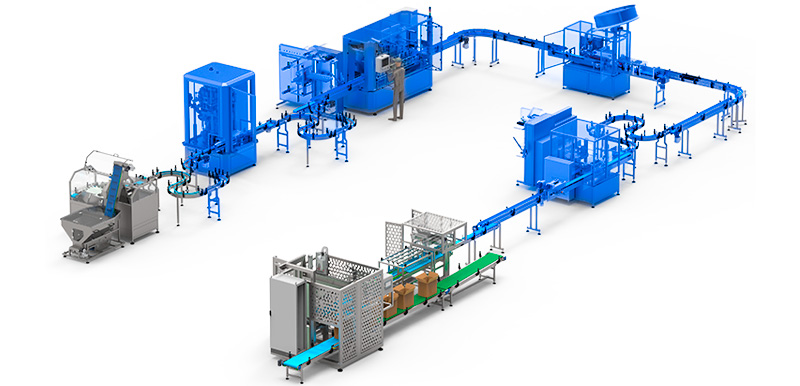
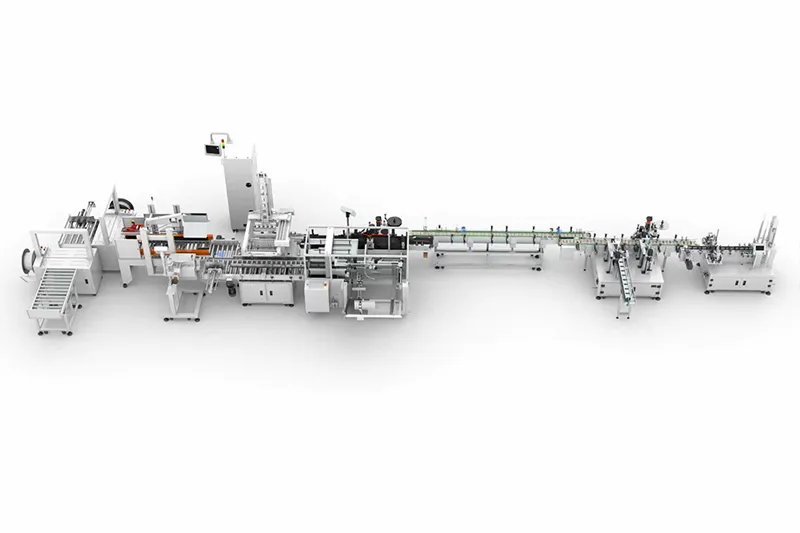
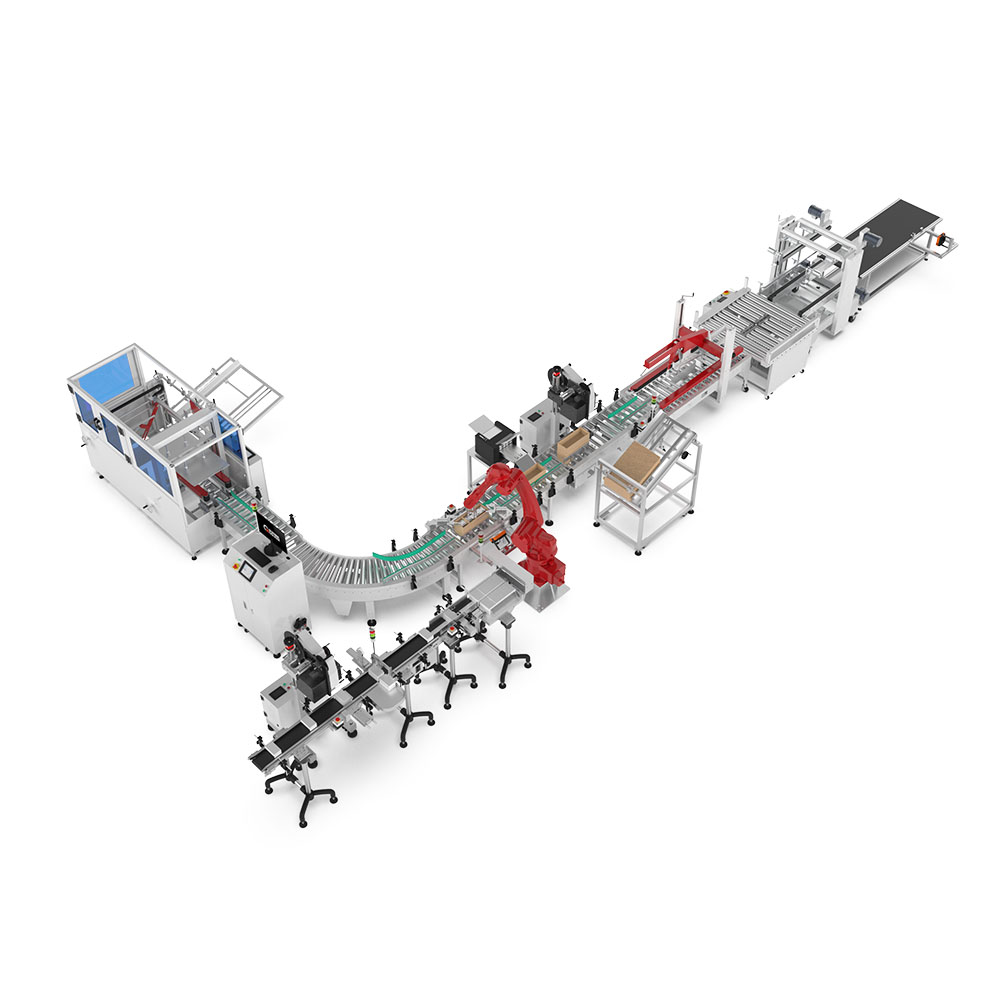
A reliable end-of-line packaging solution provider must deliver a continuous closed-loop system encompassing automatic case erecting, product feeding, robotic packing, sealing, inline weighing, tracking, and palletizing without manual buffering.
When reviewing a supplier’s engineering proposal, you must verify that they have proven full-line engineering experience integrating the following critical modules into a unified architecture:
Erecting and Packing Modules
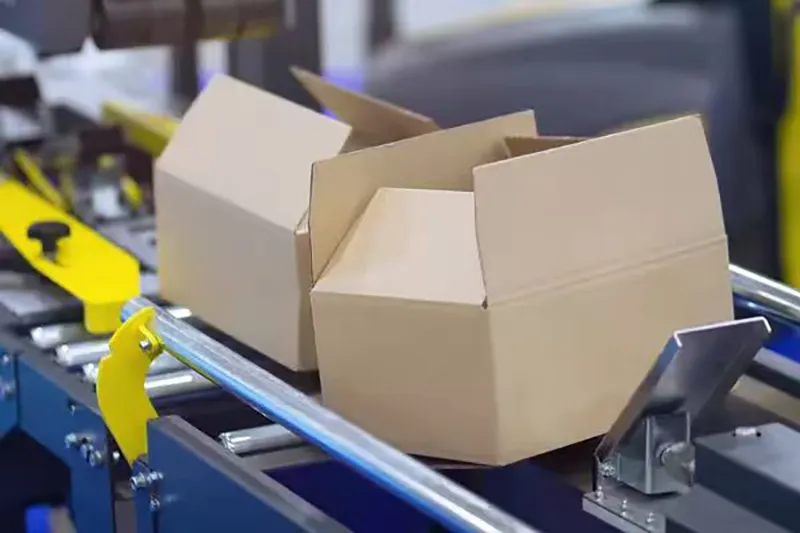
The process begins with an automatic case erector that pulls flat blanks, squares them with perfect right angles, and seals the bottom. Simultaneously, the product collation and feeding system organizes the primary products (bottles, cartons, or loose parts) into the correct matrix. An automatic case packing machine—often utilizing high-speed delta robots or precise Cartesian gantries—then drops or places the product matrix into the erected carton without causing scuffing or impact damage.
Sealing, Inspection, and Dispatch Modules
Once filled, the carton enters the sealing system (tape or hot-melt glue). From there, it passes through an inline check weigher and rejection system. This automated quality control step guarantees that mispacked boxes (e.g., missing an instruction manual or a single unit) are pneumatically kicked off the line without halting production. Finally, the labeling and traceability system applies shipping barcodes before a robotic palletizing system stacks the finished goods for warehouse storage.
5. Benchmarking Throughput, Labor Reduction, and Automation ROI
For automation decision-makers, the capital investment must be justified by hard metrics. A capable smart factory carton packing system manufacturer will provide clear, data-backed performance guarantees.
Standard industrial carton packing lines should consistently output 10 to 30 cartons per minute, achieve 80% to 95% automation coverage, and deliver a rapid ROI by reducing manual labor reliance by 30% to 60%.
The core commercial question every executive asks is, “What is the ROI and labor savings of your system?” The answer lies in calculating the reduction of direct labor and the elimination of ergonomic injuries. By covering up to 95% of the end-of-line process, facilities can typically reduce their packaging headcount by 30% to 60%. These workers can then be reallocated to higher-value, supervisory roles.
Furthermore, operational efficiency is heavily dependent on changeover speeds. In environments with high SKU volatility, a modern system utilizes SKU recipe-based switching. By selecting a pre-programmed recipe on the HMI, servo motors automatically adjust guide rails, packing heads, and tape dispensers. This reduces the SKU changeover time to approximately 10 to 20 minutes, drastically improving machine availability and accelerating the overall investment payback period.
6. Custom Engineering for Complex Application Workflows
Off-the-shelf equipment cannot accommodate the vast differences in factory layouts, product fragilities, and industry-specific packaging standards. The true mark of a reliable partner is their custom engineering capability.
A top-tier manufacturer must possess deep custom engineering capabilities to adapt line layouts, robotic effectors, and software protocols to handle diverse SKU mixes, from standardized FMCG goods to complex industrial components.
A prospective supplier must be able to confidently answer: “Can you customize the line according to our factory layout and products?” Different sectors present unique engineering challenges:
- FMCG Manufacturing Factories: These facilities demand high-speed, stable output for massive volumes of standardized cartons. The primary objective is minimizing mechanical wear while drastically reducing reliance on manual labor.
- E-commerce Fulfillment Centers: Dealing with unpredictable order fluctuations and frequent SKU changes, these operations require highly flexible lines equipped with recipe-driven robotic adjustments to handle high-mix packaging scenarios.
- 3PL Logistics Operators: Fulfilling orders for multiple clients simultaneously requires strict system compatibility. The line must seamlessly interface with various ERP/WMS platforms to enforce unified packaging standards dynamically.
- Industrial Manufacturing Plants: Handling non-standardized, heavy, or highly specialized parts demands robust customization. For instance, packaging dense, heavy industrial parts like precision welding assemblies requires customized weight-bearing conveyors and reinforced case packing robotics. Similarly, handling delicate high-tech components—such as sensitive PCBs, custom electronics enclosures, and high-value composited heat sinks (which have distinct physical and dimensional profiles compared to standard bonded fin heat sinks)—demands specialized static-free routing and highly precise robotic placement to prevent structural damage during the packing process.
7. Ensuring High-Load Stability for Continuous 24/7 Production
The ultimate test of a carton packing production line occurs during peak manufacturing seasons, such as Q4 holiday rushes or major new product rollouts. A system that performs adequately during a low-volume factory test may buckle under the stress of high-load continuous production.
To guarantee continuous 24/7 production during peak manufacturing seasons, the integrated carton packing system must feature robust mechanical engineering, precision servo synchronization, and intelligent fault prediction.
Production managers know that any downtime during peak season destroys profitability. Their primary concern is: “Can the system maintain stable output under continuous production?”
Achieving 24/7 stability requires over-engineering the mechanical framework to absorb high-frequency vibrations. It requires utilizing premium servo motors that will not overheat during extended, high-torque cycles. Most importantly, it requires smart error handling. If a single carton blank is slightly warped and fails to erect properly, a stable system will not trigger an emergency stop. Instead, it will isolate the error, reject the faulty blank automatically, and continue processing the next unit without interrupting the upstream product flow.
Conclusion
Choosing the right carton packing production line manufacturer is a defining strategic decision for any modern factory. To truly automate and future-proof your facility, you must pivot away from buying isolated mechanical equipment and instead partner with an Industry 4.0 turnkey packaging system integrator. By insisting on single-source responsibility, deep WMS/MES software integration, and proven custom engineering for your specific SKU requirements, you can achieve a 60% reduction in manual labor, maximize your ROI, and guarantee stable, high-speed output.
Ready to upgrade to a smart factory packaging solution?
As a specialized Industry 4.0 carton packing system integrator, Joyda Totalpack delivers end-to-end, data-driven automation lines tailored to your exact facility layout and production demands. Contact our engineering consultants today for a comprehensive technical evaluation, custom system design, and detailed ROI analysis for your turnkey packaging project.
FAQ
What is the difference between a carton machine supplier and a turnkey system integrator?
A machine supplier sells individual pieces of equipment, leaving you responsible for connecting them physically and digitally. A turnkey system integrator designs, builds, and programs the entire closed-loop line, taking single-source responsibility for the layout, software integration, and overall guaranteed throughput.
How does an automated carton packing system integrate with our factory’s ERP/MES?
The production line features a centralized PLC and software control layer that communicates directly with your enterprise software via APIs or industrial network protocols. This allows the line to receive packaging recipes automatically and send real-time production and inventory data back to your central system.
What is predictive maintenance in a packaging line?
Predictive maintenance uses IoT sensors installed on critical machine components (like motors and pneumatics) to monitor vibration, temperature, and torque. The system analyzes this data to predict impending failures, allowing maintenance teams to replace parts before a breakdown stops production.
How long does it take to switch the production line to a different carton size?
A modern Industry 4.0 system utilizes SKU recipe-based switching. Operators simply select the new product profile on the digital HMI, and the system automatically adjusts motorized guide rails, robotic gripping heads, and sealing mechanisms. This typically reduces changeover times to between 10 and 20 minutes.
Can an automated line handle highly specialized or heavy industrial products?
Yes, provided you choose a manufacturer with strong custom engineering capabilities. The system can be adapted with reinforced conveyors, heavy-payload robotic arms, and specialized tooling to safely handle non-standardized items, from heavy precision assemblies to delicate electronics.
How quickly can we expect a return on investment (ROI) from a turnkey system?
While it varies based on factory output, a fully integrated line typically reduces manual labor requirements by 30% to 60%. Combined with increased throughput and reduced material waste, most manufacturing facilities achieve full ROI within 18 to 24 months.