In modern manufacturing environments, end-of-line packaging is no longer a collection of standalone machines, but a fully integrated, data-driven system. For decades, manufacturers viewed the packaging floor as an unavoidable bottleneck and a permanent cost center. Today, as the Industry 4.0 market expands at a rapid ~19% CAGR, digital transformation is no longer optional—it is a competitive necessity.
By upgrading to an Industry 4.0 end-of-line packaging architecture, forward-thinking manufacturers are solving chronic operational pain points and turning their packaging lines into controllable, scalable production assets. This guide explores the architectural shifts, hard data, and real-world strategies you need to eliminate packaging bottlenecks and secure a rapid return on investment.
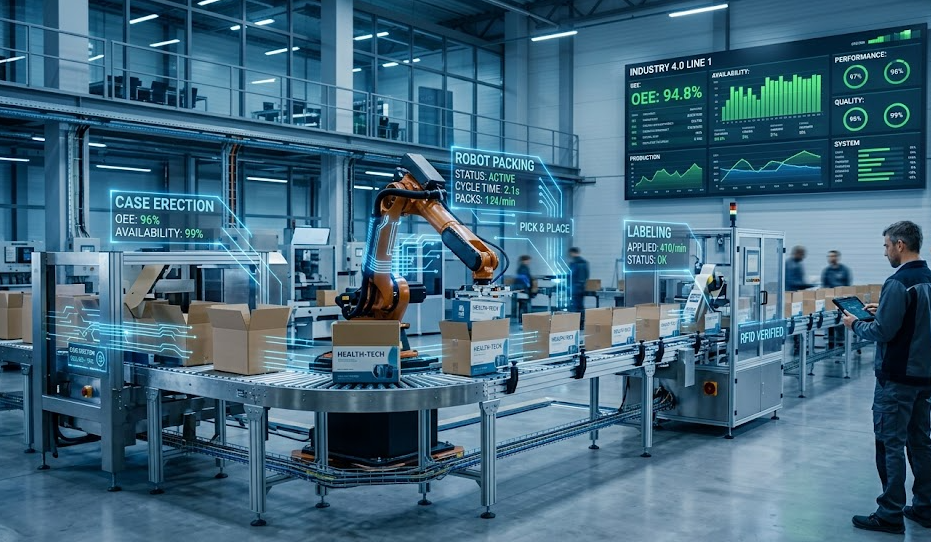
Table of Contents
- The Core Challenge: Why Legacy Packaging Fails
- Defining the Industry 4.0 End-of-Line Packaging Architecture
- The Three Pillars of a Smart Packaging Ecosystem
- Quantifying the ROI: Data-Driven Performance Gains
- Shifting from Reactive to Proactive Control
- Case Study: Transforming a Mid-to-Large Manufacturer
- Future-Proof Your Factory with Joyda Totalpack
1. The Core Challenge: Why Legacy Packaging Fails
Based on real-world deployments of Industry 4.0 packaging solutions, companies transitioning from manual or semi-automated setups consistently face three core operational challenges:
- Fragmented Workflows: Standalone machines create “islands of automation.” A carton erector, a loader, and a sealer operating independently require constant human intervention to bridge the gaps, causing start-and-stop inefficiencies.
- High Labor Dependency: Relying on manual labor for repetitive stacking, loading, and palletizing artificially caps throughput and exposes the facility to rising wage costs and turnover.
- Lack of Real-Time Visibility: Without data connectivity, management relies on clipboard statistics. You cannot optimize an automated packaging system if you cannot see its real-time performance.
2. Defining the Industry 4.0 End-of-Line Packaging Architecture
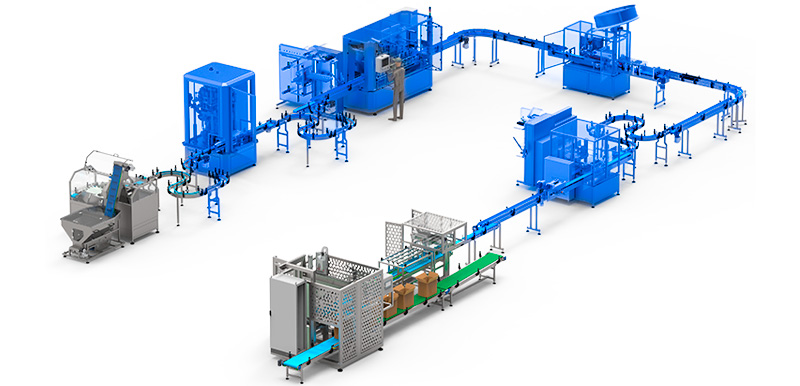
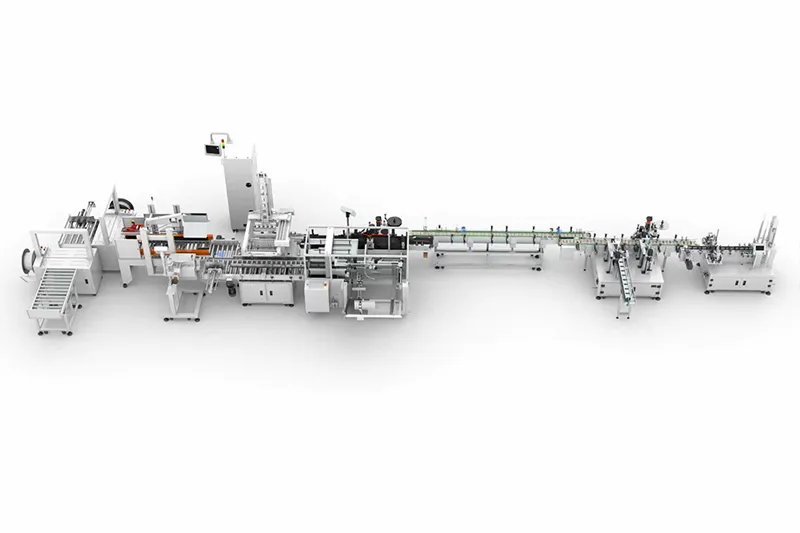
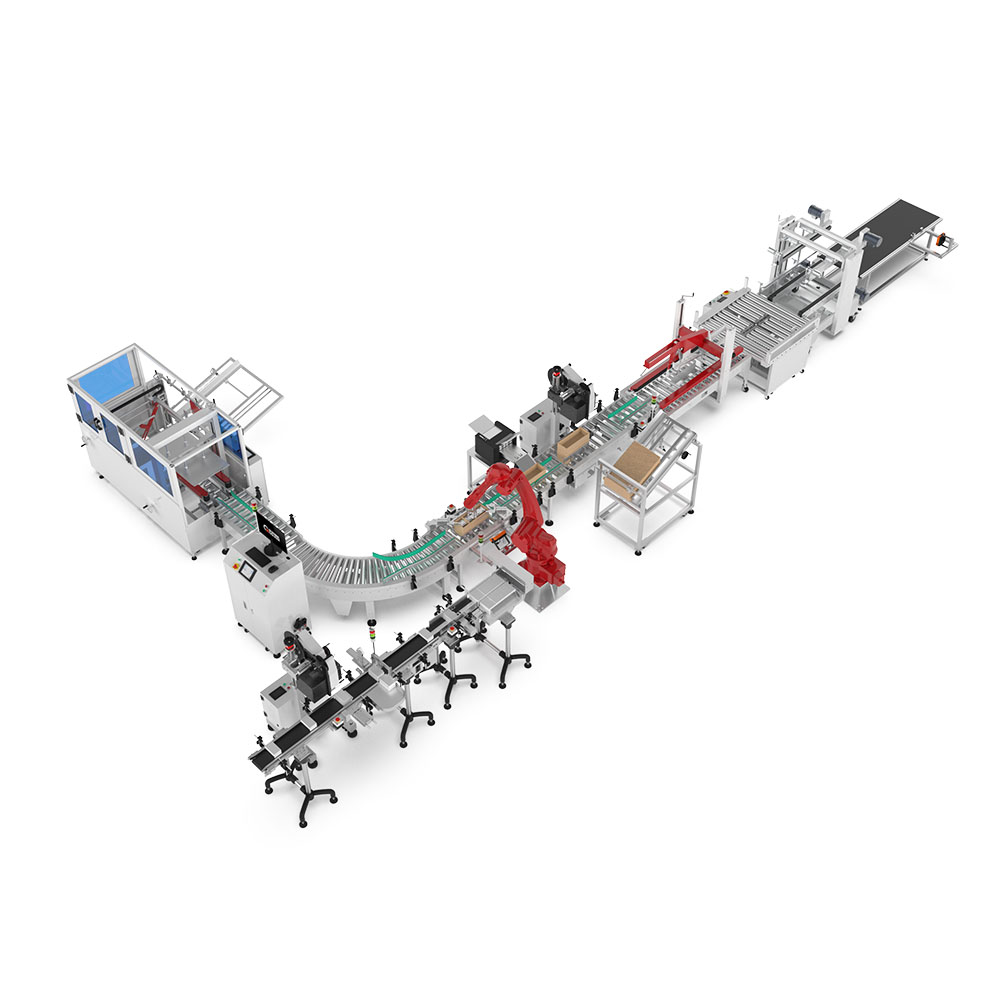
To resolve these challenges, manufacturers must implement a unified architecture that combines mechanical systems, robotics, and proprietary software into a synchronized, closed-loop system. A fully integrated line seamlessly connects carton forming, product insertion, labeling, inspection, and palletizing into one continuous flow, permanently eliminating manual handoffs.
To truly eliminate operational blind spots, these physical components must be paired with interconnected digital sensors. Internet of Things (IoT) devices continuously gather mechanical and environmental metrics from every station on the line, transmitting this information to centralized SCADA dashboards. To better understand this digital transparency, exploring how IoT enables real-time visibility in packaging lines reveals the critical mechanisms behind monitoring machine status, throughput, and error rates instantly.
3. The Three Pillars of a Smart Packaging Ecosystem
In practice, the most effective Industry 4.0 packaging architectures move beyond mere mechanical speed and share three defining characteristics:
- Real-Time Data Visibility: Centralized dashboards replace guesswork, allowing operators to monitor machine status, throughput, and quality metrics live.
- Predictive Control Capability: Systems use sensor data to shift from reactive troubleshooting to proactive optimization, protecting the line’s uptime automatically.
- End-to-End Integration: There must be a seamless connection from upstream primary production to downstream logistics software (such as WMS or ERP).
Connecting the physical packaging line to enterprise software is essential for closing the operational loop, though it requires overcoming specific IT/OT barriers. Bridging the gap between shop-floor machinery and corporate databases involves aligning communication protocols and ensuring secure, two-way data flow. To better understand these technical hurdles, reviewing the process of integrating MES with end-of-line packaging systems: key challenges provides a roadmap for achieving true order-driven production without data latency.
4. Quantifying the ROI: Data-Driven Performance Gains
The strongest justification for Industry 4.0 transformation in packaging is the quantifiable improvement across all major production metrics. By embracing packaging line integration, facilities drastically lower their overhead while boosting capacity.
Table 1: Performance Impact of Industry 4.0 Architecture
| Performance Metric | Expected Improvement | Primary Driver of Change |
| Labor Reduction | 50%–70% Decrease | Transition to continuous robotics and automated material handling. |
| OEE Improvement | Up to 20% Increase | System synchronization and data-driven bottleneck elimination. |
| Error Reduction | Over 30% Decrease | Implementation of inline inspection and automated quality control. |
| Fault Response Time | ~30% Faster Resolution | Real-time monitoring, diagnostics, and precise fault pinpointing. |
| Energy Savings | 20%–22% Reduction | Optimized machine operation and IoT-based power state monitoring. |
| Changeover Time | Reduced from 4-8 hrs to Minutes | Modular, flexible systems utilizing HMI-driven parameter recipes. |
5. Shifting from Reactive to Proactive Control
Perhaps the most profound architectural shift is how an Industry 4.0 line handles maintenance. A smart packaging line actively protects its own uptime by analyzing historical and real-time sensor data to flag component wear—such as motor vibration or pneumatic pressure drops—before a failure occurs.
This proactive approach stops the cycle of emergency repairs that historically destroy factory productivity. To better understand how algorithms achieve this, exploring the principles of predictive maintenance in packaging lines: reducing downtime with data demonstrates exactly how predictive modeling translates into continuous, uninterrupted output and extended equipment lifecycles.
6. Case Study: Transforming a Mid-to-Large Manufacturer
To illustrate this transformation, consider a recent project involving a mid-to-large manufacturer that upgraded from semi-automated packaging stations to a fully integrated Industry 4.0 end-of-line system.
Table 2: Operational Transformation Comparison
| Stage | Operational Profile | Packaging Output & Quality |
| Before Transformation | Manual carton forming and packing. Standalone machines with no data connectivity. Manual palletizing and wrapping. | Random quality checks resulting in high defect variability. Hidden costs from rework and inconsistent throughput. |
| After Transformation | Automatic case erectors, robotic packing (multi-SKU flexibility), and robotic palletizing with automatic wrapping. | Inline check weighers and vision systems achieve 100% inspection. Consistent, zero-defect shipping. |
The Results:
Operationally, the implementation of this smart packaging line resulted in a ~20% throughput increase. The facility saw a significant reduction in rework and hidden operational costs. Management now enjoys full visibility via SCADA dashboards and direct ERP integration, with predictive maintenance completely replacing reactive downtime. More importantly, the packaging line evolved into a vital data-generating node within the smart factory, enabling continuous optimization and long-term scalability.
7. Future-Proof Your Factory with Joyda Totalpack
Transitioning from a fragmented, labor-heavy workshop to a highly synchronized Industry 4.0 end-of-line packaging architecture is a complex but necessary journey. The data is clear: factories that integrate their mechanical, robotic, and software systems experience massive gains in OEE, labor savings, and production stability.
At Joyda Totalpack, we engineer comprehensive, intelligent packaging solutions tailored to your specific facility requirements. Our systems are designed to eliminate your bottlenecks and turn your packaging line into a data-driven competitive advantage.
Are you ready to redefine your packaging operations? Contact our engineering team today to schedule an end-of-line automation audit, and discover exactly how much labor and downtime you can save with a unified Industry 4.0 architecture.