Procuring isolated packaging machines creates disastrous integration bottlenecks, leading to fragmented production data, uncontrolled downtime, and severely diminished ROI. To guarantee high-speed operational success in 2026, facilities must select a carton packing production line manufacturer capable of delivering a fully integrated, Industry 4.0-compliant, single-source turnkey system.
Table of Contents
- Why Turnkey System Delivery Outperforms Single-Machine Sourcing
- Evaluating Full-Line System Architecture and Closed-Loop Capabilities
- Industry 4.0 Integration: The New Baseline for Packaging Automation
- Benchmarking Throughput, Labor Reduction, and ROI Expectations
- Validating High-Load Stability for Continuous Production
- Assessing Custom Engineering for Application-Specific Workflows
1. Why Turnkey System Delivery Outperforms Single-Machine Sourcing
For years, procurement teams operated on an “equipment buying” model—purchasing a case erector from one vendor, a sealer from another, and a labeler from a third. In 2026, the complexity of modern fulfillment has rendered this multi-vendor approach obsolete.
Large-scale manufacturing clients must demand a single-source turnkey carton packing system provider to eliminate the severe risks of undefined integration liabilities, software incompatibilities, and uncontrolled debugging cycles.
As an engineering consultant with over two decades of experience in end-of-line integration, I frequently see the fallout of multi-vendor patching. When a production line halts because the automated case packing machine fails to synchronize with the downstream labeling system, vendors inevitably point fingers at each other’s PLC protocols. This lack of single-point responsibility leads to prolonged Site Acceptance Testing (SAT) and continuous operational friction.
Today, the core procurement question has shifted from “How fast is this specific machine?” to “Can you deliver a fully integrated turnkey carton packing line?” Buyers are no longer purchasing isolated mechanical components; they are selecting production system integrators who take full ownership of the mechanical design, electrical synchronization, software layer, and overall throughput guarantees from the moment a flat carton is erected to the moment a loaded pallet leaves the facility.
2. Evaluating Full-Line System Architecture and Closed-Loop Capabilities
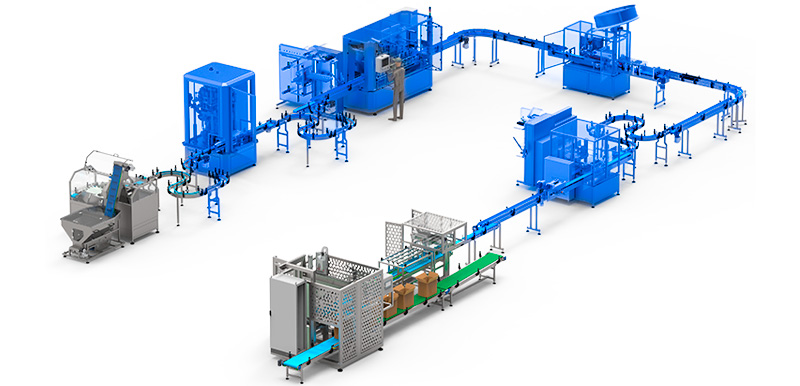
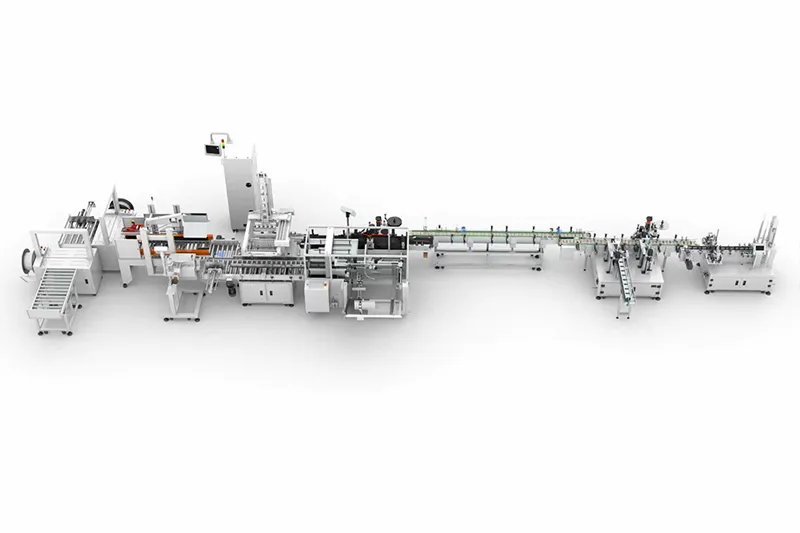
A true turnkey packaging line is not simply a series of machines placed next to a conveyor. It is a highly synchronized, closed-loop mechanical and digital environment where human intervention is engineered out of the process.
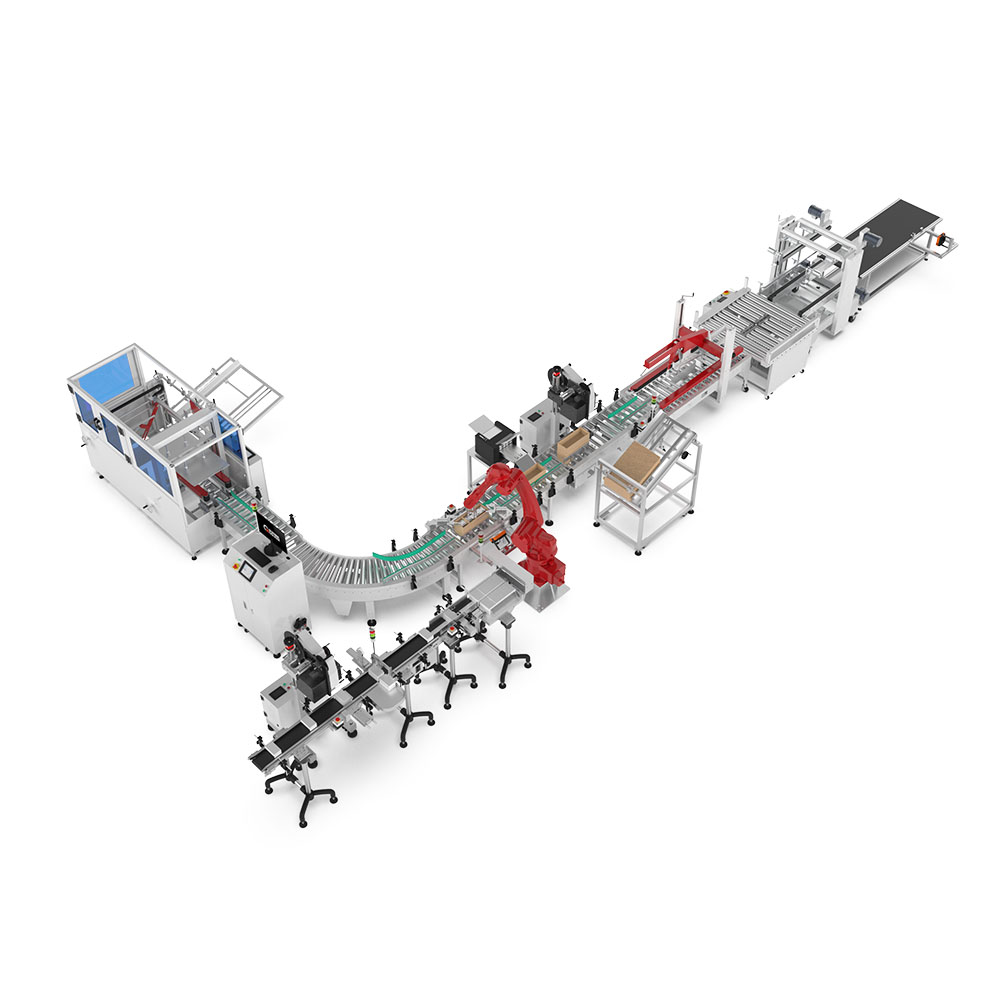
A qualified manufacturer must provide a comprehensive system architecture encompassing automatic case erecting, conveying, packing, sealing, inline weighing, tracking, and robotic palletizing without requiring manual buffering zones.
To accurately evaluate a potential end-of-line carton packaging solution provider, you must inspect the continuity of their proposed architecture. If operators are required to manually push cartons between the check weigher and the labeling station, the integration scope is incomplete.
Core Modules of a Closed-Loop Line
- Automatic Case Erector: Extracts flat blanks from a magazine, forms the carton, and seals the bottom flaps at high speeds with perfect right angles to prevent downstream jams.
- Carton Conveying & Packing System: Utilizes servo-driven pick-and-place robotics or drop-packing mechanisms to smoothly load products into the erected carton without damaging the primary packaging.
- Flap Folding & Sealing System: Automatically folds top flaps and applies tape or hot-melt glue to secure the carton.
- Inline Check Weigher & Rejection System: Dynamically weighs every sealed carton, automatically rejecting units that deviate from the standard tolerance (e.g., missing items or incomplete manuals).
- Labeling & Barcode Tracking System: Applies shipping or tracking labels and verifies legibility via vision sensors.
- Robotic Palletizing System: Organizes sealed cartons into stable pallet patterns for warehouse dispatch.
System Comparison Table
Evaluating the difference between traditional vendors and modern system integrators is crucial for procurement decision-making:
| Evaluation Metric | Traditional Equipment Vendor | Industry 4.0 Turnkey Integrator |
| Delivery Scope | Individual machines (e.g., just a sealer) | Complete end-of-line closed-loop system |
| Control Logic | Independent PLCs per machine | Centralized line-level PLC + PC control |
| Material Handling | Manual transfer between machines required | Fully automated continuous conveying |
| Error Handling | Line stops upon error detection | Automated inline rejection (no line stops) |
| Integration Liability | Limited strictly to the purchased machine | Full system throughput and ROI guarantee |
3. Industry 4.0 Integration: The New Baseline for Packaging Automation
In 2026, mechanical automation alone is insufficient. The defining characteristic of a top-tier carton packing production line manufacturer is their ability to bridge the gap between physical machinery and enterprise data systems.
To support a smart factory ecosystem, an automated carton packing system supplier must embed centralized PLC controls that enable real-time ERP/WMS/MES data synchronization, OEE visualization, and predictive maintenance.
The difference between a traditional equipment vendor and an advanced provider is the transition from “mechanical automation” to “data-driven automation.” High-end clients use digital connectivity as a strict filtering mechanism, frequently asking, “Can your system connect with our digital factory system?”
Enterprise Integration Layer
Modern production requires the packaging line to communicate directly with the Manufacturing Execution System (MES) or Warehouse Management System (WMS). Rather than a floor operator manually keying in batch numbers or label data, the line’s software layer queries the WMS in real-time. As a product approaches the packing zone, the system automatically pulls the specific routing data, applies the correct label, and updates the ERP inventory database the moment the carton is palletized.
Predictive Maintenance and OEE Dashboards
Downtime in a high-volume facility costs thousands of dollars per minute. Industry 4.0 lines utilize smart IoT sensors to monitor motor temperatures, servo torque loads, and pneumatic pressures. Instead of reacting to a broken belt, the system’s predictive maintenance algorithms alert technicians to abnormal friction data days before a failure occurs. Furthermore, real-time OEE (Overall Equipment Effectiveness) dashboards give plant managers complete visibility into line availability, performance, and quality metrics across the entire end-of-line operation.
4. Benchmarking Throughput, Labor Reduction, and ROI Expectations
Capital expenditures for integrated systems must be justified by hard metrics. A world-class integration partner will not hesitate to contractually guarantee performance benchmarks that directly drive profitability.
A standard Industry 4.0 carton packing line must achieve throughputs of 10–30 cartons per minute, cover 80%–95% of the end-of-line process, and reduce manual labor by 30% to 60%, ensuring a rapid ROI.
When a procurement team asks, “What is the ROI of automation vs manual packaging?”, the calculation hinges on sustained throughput and labor reduction.
Throughput and Automation Coverage
A typical industrial configuration yields 10 to 30 cartons per minute depending on the dimensions and payload. More importantly, the system must achieve 80% to 95% automation coverage across the end-of-line process. This eliminates the highly repetitive, ergonomically dangerous tasks associated with manual box erecting, heavy lifting, and hand-taping. By doing so, facilities typically see a 30% to 60% reduction in direct labor costs, depending on their baseline manual setup.
Recipe-Based SKU Switching
E-commerce and modern manufacturing demand high-mix, low-volume flexibility. Traditional lines took hours to adjust for new carton dimensions. A modern system utilizes recipe-based SKU management via the central HMI (Human-Machine Interface). By selecting a new product profile, motorized guide rails, pneumatic pushers, and sealing heads automatically adjust to the new carton size. This reduces changeover time to approximately 15 minutes, drastically improving machine availability.
5. Validating High-Load Stability for Continuous Production
Factory acceptance tests often run under perfect conditions with limited batches. However, the true test of a packaging system is its behavior during Black Friday, holiday peaks, or major product launch cycles.
To ensure continuous stable throughput under maximum load, the system must utilize robust mechanical engineering, precision servo synchronization, and automated error recovery to prevent catastrophic jams during peak production periods.
A critical conversion trigger for experienced plant managers is determining if the line can survive high-load production. They ask, “Can the line run continuously under peak production pressure?”
Stability is rooted in mechanical design. Heavy-duty frames that absorb vibration, premium servo motors that maintain micro-millimeter precision over millions of cycles, and highly tolerant erecting mechanisms that can handle slight variations in corrugated board quality are mandatory. Furthermore, continuous production relies on non-disruptive error handling. If a carton flap is misfolded, an advanced line will automatically reject that single carton into a rework bin without halting the upstream packing process or the downstream palletizer.
6. Assessing Custom Engineering for Application-Specific Workflows
No two factory floors are identical. A manufacturer that only sells standard, off-the-shelf configurations cannot solve the complex spatial and operational challenges of modern industrial facilities.
Because industry requirements vary drastically—from high-speed FMCG lines to multi-client 3PL hubs—the supplier must possess extensive custom engineering capabilities to adapt carton handling, system layout, and software integration to specific SKU mixes.
Buyers must explicitly ask, “Can you customize the system based on our factory layout and SKU mix?” A true automation partner demonstrates proven system engineering experience across diverse sectors:
- FMCG & Consumer Goods: Facilities require continuous stable throughput for high-volume, standardized carton packaging. The engineering focus is on maximum speed and minimal mechanical wear.
- E-Commerce Fulfillment Centers: These centers face frequent SKU changes and extreme order fluctuations. The engineering focus must be on fast changeovers and highly flexible, recipe-driven packaging systems.
- 3PL Logistics & Warehousing: Operators handle multiple clients simultaneously, making unified packaging standards difficult. The engineering priority is seamless ERP/WMS compatibility and dynamic system adjustment to handle mixed client workflows.
- Industrial Product Plants: Handling heavy or irregularly shaped parts requires customized carton handling systems, reinforced robotic grippers, and specialized weight-bearing conveyors.
Conclusion
In 2026, successfully upgrading a packaging facility requires shifting your procurement focus from individual machines to comprehensive system architecture. By prioritizing single-source turnkey delivery, deep Industry 4.0 WMS/MES integration, and robust custom engineering, decision-makers can deploy carton packing production lines that reduce labor by up to 60%, guarantee 15-minute changeovers, and maintain high-speed stability under extreme production loads.
Ready to transform your end-of-line packaging operations?
As a premier Industry 4.0 carton packing system integrator, Joyda Totalpack specializes in designing, deploying, and supporting turnkey end-of-line automation solutions tailored to your exact facility layout and throughput demands. Contact our engineering consultants today to discuss a custom system architecture, request a detailed ROI analysis, or schedule a technical evaluation for your smart factory packaging needs.
FAQ
What is a turnkey case packing production line?
A turnkey line is a completely integrated, end-to-end automation system provided by a single manufacturer. It includes the design, machinery (erectors, packers, sealers, palletizers), centralized software controls, installation, and commissioning, ensuring full-line performance under one vendor’s responsibility.
How does an Industry 4.0 carton packing system connect to our factory software?
The system uses a centralized PLC and a digital integration layer to communicate with your MES, ERP, or WMS via standard API protocols or industrial Ethernet. This allows the line to automatically retrieve packaging recipes, synchronize production data, and update inventory in real-time.
What is the expected ROI and labor reduction from an automated packing line?
Depending on the current level of manual intervention, facilities typically experience a 30% to 60% reduction in packaging labor. By reallocating workers, eliminating manual errors, and sustaining continuous throughput, the ROI is typically realized within 18 to 24 months.
How fast can the line adjust to different carton sizes?
Advanced systems utilize recipe-based SKU switching. Through the HMI, operators select a new product profile, and the line’s servo motors automatically adjust guide rails, sealers, and robotics to accommodate the new dimensions in approximately 15 minutes.
How do you ensure the system remains stable during peak production seasons?
High-load stability is achieved through heavy-duty mechanical engineering, continuous servo synchronization, inline check weighing, and automated rejection systems that remove defective cartons without stopping the entire line. Predictive maintenance sensors also prevent unexpected mechanical failures.
Can the production line be customized for an existing factory layout?
Yes. A capable system integrator will conduct a site analysis and engineer a customized layout using modular conveyors, compact robotic cells, and specialized product handling mechanisms to fit within strict spatial constraints and integrate with existing upstream equipment.