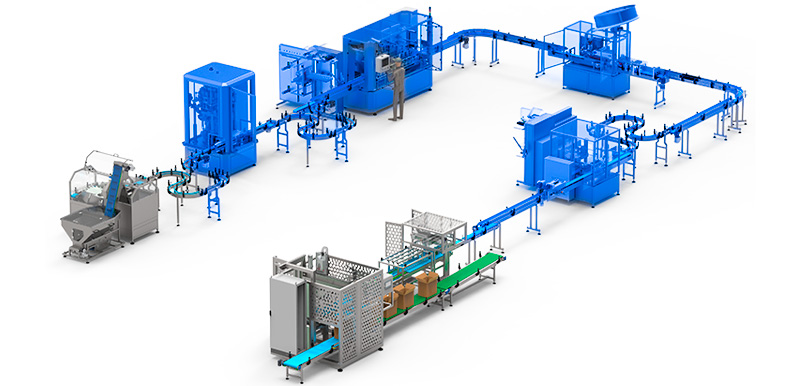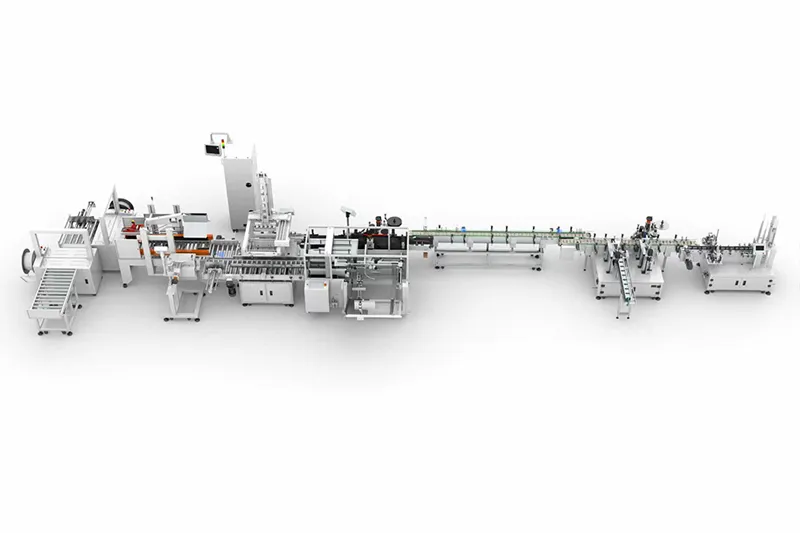
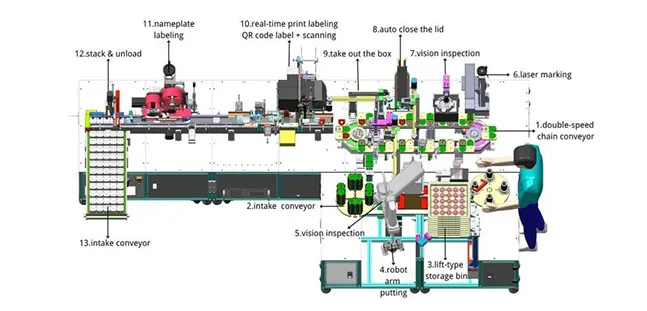
Scoping a flat washer packing production line requires matching upstream feeding, counting accuracy, and secondary cartoning to your exact SKU mix. Choosing mismatched stations causes oil-induced sensor jams, chronic over-filling giveaways, and line bottlenecks that erase automation ROI. A complete industrial system integrates ten sequential stations—from magnetic bulk elevating and optical counting to checkweighing and robotic palletizing—into one synchronized workflow. This buyer guide breaks down all ten stations, technical trade-offs, and supplier verification rules so you can configure the right system before requesting a quotation.
Table of Contents
- Why End-of-Line Washer Packaging Fails Without System-Level Integration
- Stations 1 to 4: Upstream Feeding, Counting, and Primary Bagging
- Stations 5 to 7: Traceability Coding, Conveying, and Quality Verification
- Stations 8 to 10: Secondary Cartoning, Strapping, and Palletizing
- Key Decisions and Trade-Offs: How to Choose the Right Configuration
- Standalone Bagging Machine vs. Full Turnkey Line: Technical Trade-Offs
- Common Procurement Mistakes and How to Scope Your Line Before Quoting
- Conclusion
1. Why End-of-Line Washer Packaging Fails Without System-Level Integration
Buying isolated machines from multiple vendors frequently results in line starvation, film tearing, and signal handshaking failures. A high-output automatic flat washer packaging line achieves target OEE (overall equipment effectiveness, the composite metric combining machine availability, speed performance, and good-pack quality rate) only when every station is mechanically and electrically balanced around the physical behavior of flat washers.
In practice, lines assembled from three or more unrelated vendors typically stabilize at 55% to 65% OEE, versus 80% to 88% for a single-vendor turnkey line engineered as one system. The gap is rarely caused by a single bad machine; it comes from cumulative mismatches—a feeder tuned for 400 pieces per minute (ppm) starving a bagger rated at 600 ppm, or a checkweigher rejecting packs faster than the upstream counter can re-fill. For a mid-volume distributor running 30,000 bags per shift, every 10-point OEE drop equals roughly 3,000 bags of lost throughput per shift, or 7% to 9% of annual capacity before any labor or material savings are counted.
Unlike threaded bolts or hex nuts, flat washers present three severe mechanical challenges in end-of-line washer packaging:
- Oil-Induced Shingling: Stamping oils and rust-preventative coatings create surface tension that pulls flat washers together like wet coins. Two stuck washers easily pass through a standard photoelectric sensor as a single part, creating costly inventory giveaways and inaccurate kit counts. In a field audit of a manual packaging cell, shingled washers caused a 1.8% piece-count giveaway on 500-piece M8 kits—roughly 9,000 washers per 500,000-bag annual run, a direct material loss compounded by downstream quality-claim risk.
- High Impact-to-Thickness Ratio: Large outer-diameter fender washers have sharp stamped edges that slice through standard thin packaging films during vertical free-fall drops. A 30 mm fender washer dropped 400 mm into a 60-micron pouch generates enough impact energy to puncture thin BOPP; angled tube geometry cuts effective drop height to under 150 mm and eliminates the rupture.
- Bulk Density Surges: Bulk hoppers dumped by forklifts can bridge or flood downstream vibratory bowls if no intermediate metering buffer controls the load. A forklift-dumped 1,000 kg hopper can raise local pressure at the bowl inlet by 30% to 40%, bridging the track within seconds unless a metering screw or vibratory tray throttles the feed.
Configuring a synchronized flat washer packing production line solves these bottlenecks by linking all ten stations through a master PLC (programmable logic controller, the industrial computer that synchronizes upstream feeders with downstream packaging stations). Working with a single packaging solutions integrator ensures that feeder discharge rates, bagger cycle times, and cartoner speeds operate with a 15% to 20% downstream capacity buffer.
When to integrate vs. buy standalone: If you run two or more shifts on a stable core SKU set, a single-vendor integrated line pays for its integration premium through OEE alone. If your business is pure contract packaging with 20+ daily SKU changeovers and under 15,000 bags per shift, a modular standalone cell (Stations 1 to 6) is the lower-risk entry point—but specify it with the same PLC architecture you would later extend, so Stations 7 to 10 can bolt on without replacing controls.
2. Stations 1 to 4: Upstream Feeding, Counting, and Primary Bagging
Upstream feeding, singulation, and primary bagging determine 80% of your line throughput and counting accuracy. Your primary packaging stations must separate oil-coated washers before counting and absorb impact energy before heat sealing.
2.1 Station 1: Bulk Hopper and Magnetic Elevating Feeder
Floor-level bulk storage hoppers combined with inclined magnetic or cleated belt elevators transfer 200 kg to 1,000 kg loads of loose washers to the orientation deck without manual lifting. Floor-level electromagnetic vibratory hoppers paired with magnetic belt elevators are ideal for carbon steel washers because magnetic attraction prevents parts from sliding backward while allowing excess stamping oil to drain into a bottom sump. For stainless or non-ferrous washers, magnetic elevation fails, so a cleated belt or centrifugal elevator must be specified instead.
Typical spec envelope: Hopper volume 0.3 to 1.5 m³; elevator belt speed 0.5 to 1.5 m/s; drive power 0.75 to 2.2 kW; integrated ultrasonic level probe with 60% bowl-capacity auto-pause.
Decision note: When evaluating a washer packing machine supplier, verify how the bulk hopper regulates flow into Station 2. Overloading a feeder track stalls vibration amplitude and halts feeding altogether, so the level-sensing probe must automatically pause the elevator belt when the bowl reaches 60% capacity. Choose magnetic elevation for carbon steel; specify cleated belt elevation for stainless and zinc-plated parts.
2.2 Station 2: Vibratory Bowl or Centrifugal Orientation System
Orientation feeders turn chaotic bulk piles into a single-file stream of separated washers. Stepped vibratory bowls with dimpled polyurethane linings are suitable for thin, oil-coated washers from M3 to M24; centrifugal rotary feeders are more appropriate for thick, dry structural washers requiring speeds above 600 ppm.
Typical spec envelope: Vibratory frequency 50 to 60 Hz with adjustable amplitude; throughput 100 to 600 ppm (vibratory) or 600 to 1,500 ppm (centrifugal); air-knife pressure 0.4 to 0.6 MPa; wiper blade set to 1.5× nominal washer thickness.
To defeat oil-induced shingling, the bowl track must incorporate three mechanical separation features:
- Textured or Dimpled Track Surfaces: Breaking the vacuum seal underneath flat washers prevents parts from sticking to the stainless steel ramp.
- Angled Air-Knife Jets: Focused compressed air blasts (0.4 to 0.6 MPa) blow top-riding washers back into the bowl reservoir before the discharge chute.
- Adjustable Mechanical Wiper Blades: Hardened tool-steel gates set to 1.5 times the nominal washer thickness physically block stacked double parts.
Decision note: Specify centrifugal only when parts are dry and you need sustained >600 ppm; the higher capital cost and poorer performance on oily, thin washers make vibratory the safer default for most washer mixes.
2.3 Station 3: Optical Counting or Multi-Head Combination Weighing
Selecting the right metering technology depends directly on your target bag count and part weight tolerance. Optical fiber or vision counting is suitable for small hardware kits of 5 to 250 pieces requiring exact piece counts; 10-head or 14-head combination weighing is more appropriate for bulk bags of 1 kg to 25 kg where cycle speed outweighs single-piece precision.
Typical spec envelope: Vision counting accuracy ±0 pieces (zero minus tolerance) at 30 to 60 bags/min; combination weigher accuracy ±1 to ±3 g at 35 to 60 bags/min; head count 10 or 14; reject rate on overlap detection <0.05%.
For mid-volume OEM fastener suppliers demanding zero-defect accuracy, integrating vision inspection for fastener counting accuracy replaces basic single-beam photo-eyes with high-speed line-scan cameras. Area-scan vision algorithms measure the exact geometric silhouette of falling washers in mid-air, allowing the controller to recognize two overlapping washers and divert the contaminated batch at the reject gate before film sealing.
Decision note: If a single miscounted bag triggers a customer line-down charge, pay for vision counting on every small-kit lane. Reserve combination weighing for bulk bags where weight tolerance—not exact count—is the contractual spec.
2.4 Station 4: Vertical Form Fill Seal (VFFS) Bagging Station
The flat washer bagging machine forms roll-stock polymer film around a stainless steel forming collar, fills the pouch, and seals the longitudinal and horizontal seams. A servo-driven VFFS (vertical form fill seal, a machine that forms roll stock film into a vertical tube, fills it with parts, and heat-seals the seams) unit equipped with angled forming tubes is essential for heavy washers above M12 because tilting the tube at 30 to 45 degrees reduces vertical drop velocity and prevents film punctures.
Typical spec envelope: Cycle speed 25 to 80 bags/min; servo jaw actuation with ±0.5° repeatability; film compatibility 60 to 120 micron; bag clamp rated for 5 kg drop load; micro-perforation for flat stacking.
When comparing flat washer bagging machine price configurations, inspect the jaw actuation and film spec capabilities:
- Film Thickness Compatibility: The sealing jaws must maintain constant pressure and heat transfer across 60-micron to 120-micron LDPE (low-density polyethylene, a puncture-resistant polymer film used for heavy hardware bagging) or laminated PE/PET films.
- Bag Support Clamps: Pneumatic bottom-support plates must catch the weight of 2 kg to 5 kg washer drops inside the bag before the horizontal sealing jaws open for the next cycle.
- Micro-Perforation Needles: Mechanical pin rollers release trapped air inside the pouch so finished bags stack flat inside shipping cartons.
Decision note: For mixed M4-to-M20 volume, a single collar cannot run both efficiently. Specify quick-release forming assemblies, or split miniature and heavy washers across two dedicated bagging lanes rather than accepting compromised speed on one.
Reviewing a dedicated flat washer counting and bagging machine setup helps engineering teams match collar diameters and jaw widths to their narrowest and widest pouch dimensions.
3. Stations 5 to 7: Traceability Coding, Conveying, and Quality Verification
Mid-line stations convert unverified primary bags into traceable, quality-assured packages ready for secondary boxing. Automated coding and 100% inline checkweighing eliminate manual labeling bottlenecks and prevent customer quality claims.
3.1 Station 5: Thermal Transfer Overprinting (TTO) and Laser Coding
Automotive and construction fastener buyers require lot traceability, heat batch numbers, and 2D barcodes on every primary bag. TTO (thermal transfer overprinting, a digital ribbon printer that prints variable barcodes directly onto flexible film prior to bag forming) is suitable for high-contrast black printing on white or clear PE bags; UV or fiber laser marking is more appropriate for permanent, smudge-proof coding on pre-printed patches when stamping oil mist is present in the shop air.
Typical spec envelope: TTO print speed 300 to 600 mm/s with ribbon yield of ~1,200 to 2,000 bags per ribbon; laser marking 30 to 120 W with zero consumable and 20,000+ hour source life; resolution 300 dpi (TTO) or 0.1 mm (laser).
Implementing fastener packaging traceability with laser and QR coding directly links your ERP work order to the printer controller. This eliminates manual USB file loading by operators, which is a leading cause of mislabeled fastener batches.
Decision note: Choose TTO when per-bag ribbon cost is acceptable and bags are clean PE; choose laser when oil mist, smudge risk, or permanent automotive traceability mandates drive the spec. Laser carries higher capital but near-zero recurring consumable cost.
3.2 Station 6: Z-Type Discharge Conveyor and Accumulation Buffer
Once sealed and cut, heavy washer bags drop onto an inclined discharge conveyor that transfers packs to the inspection zone. Heavy-duty modular plastic link belts outperform PVC flat belts at this station because sharp washer edges pressed against film corners will cut standard PVC belts within months.
Typical spec envelope: Belt speed 15 to 30 m/min; accumulation buffer holds 30 to 50 bags during a 90-second cartoner pause; modular plastic link belt rated for 50 kg point load.
The discharge conveyor must also include a low-friction accumulation table or indexing buffer belt. If the downstream cartoner pauses for 90 seconds to replenish corrugated blanks, the accumulation buffer holds 30 to 50 bags so the upstream washer counting and sealing machine does not have to stop and restart.
Decision note: Never specify a PVC belt here regardless of upfront savings—film-corner cutting failures typically appear within 3 to 6 months and cost more in downtime than the belt upgrade.
3.3 Station 7: Dynamic Checkweigher and Reject Diverter
A dynamic inline checkweigher serves as the final quality firewall before bags enter corrugated boxes. Even when upstream optical counting achieves 99.9% accuracy, an inline checkweigher with a pneumatic pusher reject arm is mandatory for automotive OEM contracts because it catches broken washers, foreign stamping slugs, and rare double-shingled parts.
Typical spec envelope: Weigh resolution ±0.2 to ±0.5 g; throughput up to 120 bags/min; reject rate <0.1% of good packs; auto-zero tare tracking per bag.
Ensure the checkweigher strain-gauge load cell features dynamic auto-zero calibration. As residual oil dust settles on the weigh belt over an eight-hour shift, the system automatically re-zeros itself between bags to maintain a verification resolution of +/- 0.2 grams to +/- 0.5 grams.
Decision note: For automotive or aerospace washers, the checkweigher is non-negotiable, not optional. Specify auto-zero and a documented calibration interval in the FAT protocol.
4. Stations 8 to 10: Secondary Cartoning, Strapping, and Palletizing
Secondary and tertiary stations eliminate heavy manual lifting at the end of the line. Automating case packing and palletizing stabilizes labor costs when packing 15 kg to 25 kg master cartons at rates above 6 cartons per minute.
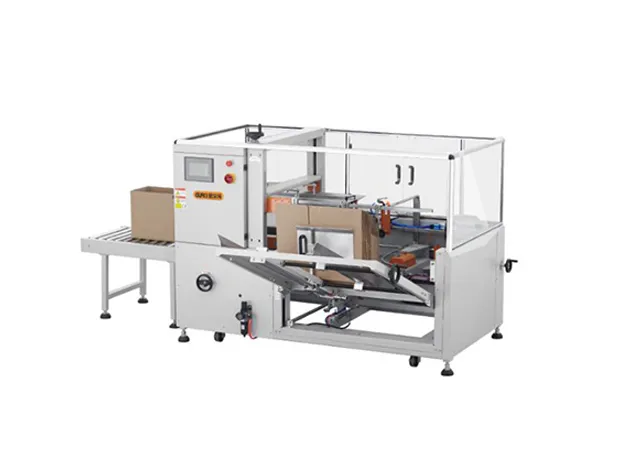
4.1 Station 8: Automatic Case Erector and Bag-in-Box Loader
Manual box making and bag loading require two to three dedicated operators per line. An automatic case erector pulls flat corrugated blanks from a magazine, folds the bottom flaps, applies hot-melt glue or heavy-duty BOPP tape, and positions the open box under a servo gantry loader or drop-packer.
Typical spec envelope: Case erector speed 6 to 12 cases/min; changeover between RSC footprints under 15 minutes; loader payload 5 to 25 kg per drop.
For plants packaging flat washers alongside bolts and hex nuts, integrating a flexible fastener and hardware packaging line allows multiple bagging lanes to converge into one central bag-in-box indexing conveyor. This consolidates multi-bag hardware kits into a single master carton automatically.
Decision note: Choose glue-erected boxes for heavy or export cartons (better burst resistance); choose tape for fast, low-cost changeover on domestic retail cartons.
4.2 Station 9: Carton Sealing, Checkweighing, and Strapping Module
Filled cartons weighing 15 kg to 25 kg exert high lateral force on corrugated walls. Dual-mast top-and-bottom tape sealers combined with twin-head PP (polypropylene) strapping machines secure heavy fastener boxes because standard pressure-sensitive tape alone often splits open during sea freight transit.
Typical spec envelope: Strapping tension 200 to 400 kgf; twin-head PP strap 9 to 12 mm; master-carton checkweigher ±5 to ±10 g; print-and-apply label accuracy ±1 mm.
A heavy-capacity roller checkweigher installed immediately before the strapper verifies that the master carton contains the exact number of primary bags (for example, 20 bags of 500 grams each) and triggers an automatic print-and-apply shipping labeler on the box side panel.
4.3 Station 10: Robotic Palletizer and Stretch Wrapping System
At the end of the line, an articulated 4-axis robotic arm or gantry palletizer picks sealed cartons and stacks them onto wooden or plastic pallets in interlocking column patterns. Robotic clamp/vacuum hybrid grippers are suitable for lines handling multiple carton sizes across two pack lanes; compact Cartesian gantry palletizers are more appropriate for single-line facilities with low ceiling clearance under 3.2 meters.
Typical spec envelope: Palletizer rate 60 to 120 cartons/hour; gripper payload rated minimum 35 kg; stretch-wrapper film pre-stretch 200% to 300%; safety light curtains on all access points.
Below is a complete engineering and procurement reference across all ten stations:
| Station | Core Function | Buyer Value | What to Verify with Supplier |
|---|---|---|---|
| 1. Bulk Hopper & Elevator | Stores 200 to 1000 kg bulk loads and meters parts upward | Eliminates manual bucket lifting and feeds bowl evenly | Oil drainage sump design and ultrasonic level control loop |
| 2. Orientation Feeder | Separates washers into a single-file stream | Prevents oil-coated washers from sticking together | Dimpled polyurethane lining and air-knife separation pressure |
| 3. Counting / Weighing | Counts exact pieces or weighs target bulk mass | Eliminates product giveaway and short-count complaints | Vision overlap detection algorithm or load-cell resolution |
| 4. VFFS Bagging Machine | Forms roll film, fills washers, and heat-seals bags | High-speed primary containment without film tearing | Angled tube geometry, jaw pressure on 100-micron PE, bag clamp |
| 5. Coding & Marking | Prints batch codes, part numbers, and QR codes | Meets OEM traceability and retail barcoding standards | Oil-resistant ribbon formulation or laser fume extraction |
| 6. Discharge & Buffer | Elevates bags and buffers temporary downstream pauses | Keeps upstream counters running during box reloads | Modular plastic link belt durability against sharp part edges |
| 7. Dynamic Checkweigher | Verifies individual bag weight and rejects out-of-spec packs | Guarantees 100% compliant shipments before boxing | Auto-zero tare tracking and minimum part weight resolution |
| 8. Case Erector & Loader | Forms corrugated boxes and loads counted bags in patterns | Replaces 2 to 3 manual packers on repetitive lifting tasks | Changeover time between RSC box footprints (target under 15 min) |
| 9. Carton Sealer & Strapper | Seals top flaps, weighs master carton, and applies PP straps | Prevents heavy fastener cartons from bursting in transit | Twin-strap tension control and print-and-apply label accuracy |
| 10. Palletizer & Wrapper | Stacks master cartons onto pallets and stretch-wraps loads | Removes ergonomic back injury risks on 25 kg cartons | Gripper payload rating (minimum 35 kg) and safety light curtains |
5. Key Decisions and Trade-Offs: How to Choose the Right Configuration
Technical evaluation is where most automation budgets are won or lost. The five decisions below drive 70% to 80% of your total line cost and nearly all of its downstream reliability. Treat each as a configuration gate, not an afterthought.
5.1 Counting Technology: Optical/Vision vs. Combination Weigher vs. Linear Weigher
| Option | Best Bag Size | Accuracy | Speed | Relative Cost | Choose When |
|---|---|---|---|---|---|
| Optical / Vision Counting | 5 to 250 pieces | ±0 pieces (zero minus) | 30 to 60 bags/min | Medium | Exact-count kits, customer line-down penalty on miscount |
| 10/14-Head Combination Weigh | 1 kg to 25 kg | ±1 to ±3 g | 35 to 60 bags/min | High | Bulk bags where weight tolerance is the spec |
| Linear Weigher (2 to 4 head) | 500 g to 5 kg | ±2 to ±5 g | 20 to 40 bags/min | Low | Mid-weight bulk with relaxed tolerance and tight budget |
Recommendation: Default to vision counting for any bag a distributor resells as an exact-count kit. Reserve combination weighing for true bulk, and linear weighers only for the lowest-tier tolerance work.
5.2 VFFS Tube Geometry: Vertical vs. Angled
A standard vertical tube is cheaper and simpler, but washers above M12 carry enough mass to puncture film on impact. Angled tubes (30 to 45 degrees) cut drop height to under 150 mm and eliminate ruptures at the cost of a slightly larger footprint and a dedicated collar set.
Recommendation: Specify angled tubes whenever your heaviest SKU exceeds M12 or 1 kg per bag. The film-savings and reject-rate improvement recover the premium within the first year on most lines.
5.3 Coding Method: TTO vs. Laser
TTO offers low capital entry and crisp barcodes on clean PE, but ribbon is a recurring cost (roughly 1,200 to 2,000 bags per ribbon). Laser has higher upfront cost and near-zero consumable, with permanent coding that survives oil and abrasion.
Recommendation: TTO for domestic, clean-bag, cost-sensitive runs; laser for automotive/aerospace traceability, oily environments, or any contract with permanent-marking requirements.
5.4 Palletizer Type: Articulated vs. Gantry vs. Cartesian
| Type | Footprint | Payload | Best For | Relative Cost |
|---|---|---|---|---|
| Articulated 4-Axis Robot | Medium | 35 to 120 kg | Multi-SKU, two pack lanes, flexible patterns | High |
| Gantry Palletizer | Large | 35 to 80 kg | High-throughput single-line, open floor | Medium |
| Cartesian (Low-Ceiling) | Compact | 35 to 50 kg | Ceiling under 3.2 m, single carton size | Low |
Recommendation: Pick articulated only if you genuinely run mixed carton sizes or two lanes; otherwise a Cartesian or gantry unit delivers the same throughput at lower capital and simpler maintenance.
5.5 Film Material: LDPE vs. BOPP/CPP Laminate vs. PET Laminate
| Film | Puncture Resistance | Cost Index | Best For |
|---|---|---|---|
| LDPE 60 to 120 micron | Good | 1.0 (baseline) | Most washer bags, especially heavy drops with angled tube |
| BOPP/CPP Laminate 50 to 70 micron | Moderate | 1.3 to 1.6 | Retail hang-hole kits needing crisp print and stiffness |
| PET Laminate | High | 1.8 to 2.2 | Export or sharp-edge structural washers with extreme transit stress |
Recommendation: LDPE is the default for washer packaging. Move to laminate only when retail presentation or transit abuse demands it—and pair PET laminate with angled tubes for the sharpest fender washers.
6. Standalone Bagging Machine vs. Full Turnkey Line: Technical Trade-Offs
Not every fastener distributor or stamping plant requires all ten stations on day one. Deciding between a semi-automatic bagging cell and a fully integrated small parts packing system depends on your daily shift volume, SKU changeover frequency, and local labor costs.
A standalone counting and bagging station is suitable for contract packagers running fewer than 15,000 bags per shift across 20+ daily SKU changeovers; a full 10-station turnkey line is more appropriate for fastener distributors and OEM suppliers running 30,000+ bags per shift with standardized carton footprints.
| Evaluation Factor | Standalone Counting & Bagging Cell (Stations 1 to 6) | Full 10-Station Turnkey Packing Line (Stations 1 to 10) | Buyer Recommendation |
|---|---|---|---|
| Daily Throughput | 8,000 to 18,000 bags per 8-hour shift | 25,000 to 60,000+ bags per 8-hour shift | Choose full line if operating 2+ shifts on core SKUs |
| Direct Labor Required | 2 to 3 operators (manual checkweighing, boxing, palletizing) | 0.5 to 1 operator (film/carton replenishment and monitoring) | Calculate payback using fully burdened annual operator wages |
| Floor Space Footprint | Compact cell: 3.5 m x 2.5 m | Linear or U-shaped layout: 12 m x 4.5 m | Use U-shaped configuration to fit tight warehouse bays |
| SKU Changeover Time | 5 to 10 minutes (bowl rail and bag length adjustment) | 15 to 25 minutes (includes case erector and pallet recipe) | Use servo-motorized recipe adjustments if running 5+ SKUs daily |
| Capital Investment | Entry-level equipment budget | Full end-of-line capital project | Start with modular Stations 1 to 7 if capital is phased |
Worked payback example (representative): A distributor packing 25,000 bags per shift across two shifts replaces three manual packers (fully burdened ~$28,000 per year each = $84,000 per year) and eliminates a 1.2% giveaway on 12 million annual bags (at a $0.004 per-washer-equivalent material cost = ~$58,000 per year), plus film optimization of ~$12,000 per year. Total annual benefit is approximately $154,000 against a $160,000 to $220,000 turnkey line, implying a 13 to 17 month payback before any quality-claim reduction is counted.
Before requesting an automatic washer packing system quote, run a structured payback calculation comparing labor displacement, reduced fastener giveaway, and film savings. You can benchmark your current labor and material waste against automated benchmarks using our detailed breakdown on manual vs. automatic flat washer packing ROI.

7. Common Procurement Mistakes and How to Scope Your Line Before Quoting
When evaluating a flat washer packaging line for sale, procurement teams often compare headline machine speeds (bags per minute) while overlooking real-world production constraints. Avoid these three costly engineering pitfalls during technical evaluation:
- Testing With Clean, Dry Sample Parts: Suppliers often run factory acceptance tests (FAT) with clean, tumbled washers. In real production, washers coated in heavy stamping oil move 20% slower in vibratory bowls and stick to optical chute windows. Always send 50 kg of your oiliest, thinnest production washers for trial testing.
- Ignoring Film Width and Collar Changeover Complexity: If your product range spans tiny M4 kits (80 mm bag width) to bulk M20 packs (250 mm bag width), a single VFFS forming collar cannot run both efficiently. Specify quick-release forming assemblies or split the volume across two specialized bagging lanes.
- Purchasing Disconnected Control Systems: When a vibratory feeder, VFFS bagger, and case packer use incompatible PLC protocols without unified handshaking, a downstream box jam fails to pause upstream counting, dumping hundreds of washers onto the floor. Specifying an integrated Industry 4.0 small parts packing line architecture ensures OPC-UA or Ethernet/IP connectivity, centralized recipe selection on one HMI touchscreen, and shift-level OEE reporting.
To get an accurate flat washer bagging machine price or turnkey line layout without weeks of back-and-forth engineering revisions, prepare these five data points before contacting a solutions partner:
- Washer Dimensional Range: Inner diameter (ID), outer diameter (OD), thickness range (mm), unit weight (g), and surface condition (dry, light oil, heavy rust-preventative oil, zinc-plated).
- Primary Bag Specifications: Target piece count or weight per bag, bag style (pillow bag, gusseted bag, euro-slot hang hole), and film material thickness (for example, 80-micron LDPE).
- Target Throughput: Required bags per minute (BPM) for both small retail kits and heavy bulk bags.
- Secondary Packaging Format: Master carton dimensions (L x W x H in mm), bags per carton, and maximum gross carton weight.
- Facility Constraints: Available floor layout dimensions (length, width, ceiling height), power supply (3-phase voltage/frequency), and compressed air capacity.
For a complete vendor audit scorecard and FAT inspection protocol, review our comprehensive flat washer packing machine buyer’s guide.
Conclusion
Designing a high-return flat washer packing production line comes down to controlling oil-induced shingling upstream, preventing film punctures during bagging, and matching downstream cartoning speed to your true shift output. Use vision-verified counting for exact-count kits, heavy-duty angled VFFS baggers for large-OD washers, and modular PLC integration to keep every station running in lockstep. Apply the five configuration gates in Section 5 before committing capital, and validate every station against your oiliest production washers—not the supplier’s clean demo parts.
As a dedicated one packaging partner and end-of-line solutions integrator, JOYDA helps fastener distributors, hardware OEMs, and contract packagers configure, integrate, commission, and support complete washer packaging workflows tailored to your floor space and SKU list. Send us your washer dimensions, bag weights, and target shift output today to receive a custom 10-station line layout and detailed quotation within 48 hours.
FAQ
Should I use optical counting or combination weighing for flat washers?
Use optical or vision counting for small bags under 200 pieces where customers demand exact piece accuracy (zero minus tolerance). Use a 10-head or 14-head combination weigher for bulk bags above 1 kg or 250 pieces, where high-speed throughput of 35 to 60 bags per minute is the primary objective and weight-based tolerances are industry standard.
How does an automatic flat washer packaging line stop oily washers from sticking together?
A properly configured line uses a three-stage separation design: dimpled polyurethane bowl linings to break surface tension, angled compressed air-knife jets to blow away piggybacked washers on the feeder track, and area-scan vision sensors or inline checkweighers to detect and reject any remaining double-stacked parts.
What film thickness is required for a flat washer bagging machine?
For small kits under 250 grams, 50-micron to 70-micron BOPP/CPP laminated film or LDPE is sufficient. For heavy washers or bags weighing 1 kg to 5 kg, specify 80-micron to 120-micron co-extruded LDPE film to prevent sharp stamped washer edges from puncturing the pouch during drop filling and transit.
Can one flat washer packing production line handle both M4 and M24 washers?
A single vibratory bowl and VFFS forming tube cannot efficiently run extreme size spreads like M4 and M24 without long changeover downtime and compromised speed. The best engineering practice is configuring dual interchangeable feeder bowls feeding a versatile mid-frame bagger, or splitting miniature hardware and heavy structural washers into two dedicated lines.
Can I buy Stations 1 to 7 now and add automatic cartoning and palletizing later?
Yes, provided your initial line is engineered with modular PLC interfaces and physical conveyor elevation clearance. When working with a one packaging partner like JOYDA, the upstream bagging and checkweighing control cabinet is pre-configured with communication ports so Stations 8 to 10 can be bolted on later without replacing the core controls.
What is the typical lead time for a turnkey flat washer packing line?
Standard counting and bagging cells (Stations 1 to 7) typically require 35 to 50 days for configuration, integration, and testing with your actual washer samples. Full 10-station turnkey lines incorporating custom case erectors and robotic palletizing generally require 60 to 85 days prior to pre-shipment Factory Acceptance Testing (FAT).
What power supply and compressed air does a full line require?
A full 10-station line typically draws 15 to 35 kW across 3-phase 380 to 480 V power, depending on the number of servo axes and the palletizer type. Compressed air demand runs 600 to 1,200 NL/min at 0.6 MPa for air-knives, bag clamps, case erectors, and strapping heads. Confirm your facility can supply stable 3-phase power and a dedicated compressed-air ring before finalizing the layout.
How should I validate a supplier’s Factory Acceptance Test (FAT)?
Send 50 kg of your oiliest, thinnest production washers—not clean demo parts—and require the supplier to run a minimum continuous 2-hour trial at target speed. Verify counting accuracy on three separate bag sizes, confirm the checkweigher reject rate, and document OEE, film consumption, and changeover time in the FAT report. Treat any trial run on clean parts as invalid for acceptance purposes.