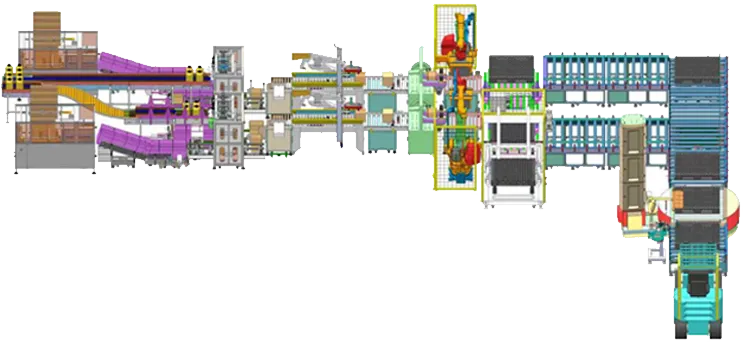
Evaluating an Industry 4.0 smart packaging line OEE predictive maintenance proposal is the riskiest step in hardware procurement because “smart” software claims are the least verifiable items on a supplier quotation, and small-parts lines are where the gap between brochure buzzwords and real shop-floor OEE (overall equipment effectiveness) is widest. A colorful touchscreen displaying a live bag counter does not stop oil-shingled washers from jamming a chute or cut a 35-minute mechanical changeover down to 4 minutes. Below are the 20 specific Industry 4.0 features that actually move the financial needle across the 10-station architecture outlined in our complete flat washer packing production line guide—tiered into Must-Have, Useful, and Nice-to-Have—along with the exact verification protocol to run before you sign a purchase order.
Table of Contents
- Why Small-Parts Lines Are the Hardest Case for Industry 4.0
- The Top 20 Industry 4.0 Features, Tiered by Business Value
- Retrofit an Old Line vs Buy a Natively Smart Line
- How to Verify Industry 4.0 Claims Before You Sign
- The Business Case: What Smart Features Are Worth
- How This Connects to Vision and Traceability Data
- Conclusion
1. Why Small-Parts Lines Are the Hardest Case for Industry 4.0
Standard Industry 4.0 templates were designed for continuous-flow bottling or snack-food lines that run a single SKU for 48 hours straight with predictable mass flow. Applying generic OEE small parts line software to flat washers, screws, and hex nuts fails because hardware packaging is governed by discrete, high-variance mechanical physics.
First, small-parts lines run 5 to 15 SKU changeovers per day across radically different part geometries (from 0.5 mm thin M3 shims to 8 mm thick M24 structural washers). When operators spend 25 to 40 minutes per changeover manually tuning vibratory feeder rails, wiper gates, and bagger collars with hex wrenches, changeover downtime alone eats 2.5 to 4 hours of shift capacity every day. For scale, a dedicated flat washer cell runs at 50 to 60 bags per minute and a full 10-station line at 25 to 60 bags per minute, so a line that looks busy at 30 bags per minute may still be losing 20 to 40 percent of its rated capacity to avoidable micro-stops.
Second, thin-part surface variance makes throughput non-deterministic. Stamping oil viscosity changes with ambient shop temperature, causing flat washers to shingle together unpredictably on vibratory tracks. A batch of heavily oiled carbon-steel washers may feed 18% slower and trigger three times as many optical pre-bag rejects as a dry zinc-plated batch of the exact same M8 dimension.
Third, micro-stop analysis is the hidden killer of fastener packaging profitability. On a small-parts line, major mechanical breakdowns are rare; instead, productivity bleeds out through brief 15- to 90-second micro-stops—a bridged bolt in a confinement rail, two oil-stuck washers tripping a throat sensor, or a curled film edge at the forming collar. Because operators clear these jams in under 5 minutes without logging a maintenance ticket, paper shift reports show “100% uptime” while micro-stops silently destroy 10% to 20% of net OEE.
Finally, count giveaway varies wildly by raw steel heat lot. Manual packing loses 1% to 2% of inventory to over-counting, and generic automated lines without smart feedback still lose 0.5% to 1% when stamping burrs or thickness tolerances drift across supplier mill batches.
2. The Top 20 Industry 4.0 Features, Tiered by Business Value
To prevent overpaying for decorative dashboards while missing critical control loops, evaluate every supplier quote against these 20 small-parts Industry 4.0 capabilities, ranked by commercial payback.
2.1 [Must-Have] Shift-Level OEE Dashboard with Sub-Minute Loss Categorization
The master PLC continuously calculates Availability x Performance x Quality at 100-millisecond polling intervals, capturing every stop lasting longer than 3 seconds rather than relying on manual operator logbooks.
Without a shift-level OEE dashboard, a washer line running at 42 bags per minute against a 60 bags per minute rated speed is indistinguishable from a line that is simply underspecified. The dashboard makes the gap visible as three losses at once: availability (micro-stops and jams), performance (speed shortfalls from thin-part shingling), and quality (rejected bags that consumed upstream capacity). That is why a 55% to 65% OEE multi-vendor line and an 80% to 88% integrated line differ by roughly 8,000 to 12,000 bags per shift on the same nominal speed rating.
Included as baseline software on integrated lines (or $2,500 to $4,500 as a PLC module upgrade), this exposes the hidden 10% to 20% OEE lost to short pauses and lifts net shift output by 8% to 12% within the first 30 days.
2.2 [Must-Have] Automated Micro-Stop and Jam Reason Code Capture
Whenever a feeder track bridge, optical chute block, or VFFS jaw torque trip halts the line for 5 to 300 seconds, the HMI automatically logs the exact sensor tag that triggered the stop and requires a one-tap reason confirmation before resetting.
Adding $1,500 to $3,000 in sensor-tag mapping eliminates “unaccounted downtime” on shift reports and cuts recurring feeder micro-stops by 40% to 60% by showing engineers exactly which bowl rail needs realignment.
2.3 [Must-Have] Changeover Time Tracking and 100-SKU Recipe Library
The HMI stores complete digital parameter sets for 100+ washer and fastener SKUs—including vibratory frequency, air-knife timing, optical part-length thresholds, VFFS bag length, jaw dwell temperature, and checkweigher gram limits—while timing the exact duration from “Last Good Bag of Lot A” to “First Good Bag of Lot B.”
At $2,000 to $3,500 in HMI programming, standardized digital recipes cut parameter entry from 12 minutes to 15 seconds and expose changeover bottlenecks across shifts.
2.4 [Must-Have] Servo-Driven Recipe Recall for Feeder Rails and Forming Tubes
Motorized servo actuators automatically adjust feeder wiper-gate height, linear track width, VFFS film registration rollers, and discharge diverter timing when an operator selects a new washer SKU on the screen.
Adding $8,000 to $15,000 in servo axes across the line compresses full mechanical changeover time from 25–40 minutes down to 3–5 minutes—recovering 2+ hours of productive bagging time every shift on lines running 5 to 15 SKUs daily.
2.5 [Must-Have] OPC-UA and Ethernet/IP Open Architecture Integration
The master line controller exposes all machine states, speeds, fault codes, and batch counters via non-proprietary OPC-UA and Ethernet/IP industrial protocols instead of locking data inside a closed vendor cloud.
Costing $1,800 to $3,500 for the industrial gateway module, open architecture prevents $15,000 to $30,000 in custom middleware programming fees when connecting the packing line to your plant SCADA or MES.
2.6 [Must-Have] Automated ERP/MES Work-Order and Recipe Binding
Scanning a work-order barcode at the line console pulls the BOM, target bag count, customer label template, and steel heat number directly from your ERP via MES ERP packaging integration, configuring the counter, bagger, coder, and checkweigher simultaneously.
At $4,000 to $7,500 in integration engineering, this eliminates 100% of manual keypad entry typos and prevents $8,000 to $25,000 customer chargebacks for mislabeled or wrong-count fastener shipments.
2.7 [Must-Have] Vision Defect Pareto and Thin-Part Shingling SPC Trend
The counting processor logs every pre-bag optical rejection by geometric cause—oil-induced double shingling, unpunched center hole slugs, out-of-spec outer diameter, or stamping burrs—and plots a live SPC (statistical process control) trend line.
Bundled with smart vision counters ($2,000 to $4,000 software module), real-time shingling alerts warn operators when stamping oil viscosity spikes, keeping count giveaway strictly below 0.1% compared to 0.5%–1% on generic automated lines.
2.8 [Must-Have] Giveaway-per-Heat-Lot Tracking and Tare Drift Compensation
The dynamic checkweigher links every sealed bag’s exact gram weight back to the active steel heat lot and automatically feeds average piece-weight variations back to bulk combination weighers while auto-zeroing oil dust accumulation on the weigh belt.
Adding $2,500 to $4,500 in closed-loop weigher logic saves $18,000 to $45,000 annually in over-filled metal giveaway when washer thickness drifts between upper and lower DIN/ISO stamping tolerances.
2.9 [Useful] Predictive Maintenance on Vibratory Feeders and VFFS Baggers
Leaf-spring fatigue in vibratory bowls and servo draw-bar wear on VFFS jaws are tracked by monitoring piezoelectric drive current harmonics and servo torque ripple against baseline signatures. For a deep dive into plant-wide failure prevention strategies, see our dedicated guide on predictive maintenance for packaging downtime avoidance.
Investing $5,500 to $11,000 in current and vibration sensors on a washer line prevents unscheduled 2-day leaf-spring fractures and delivers full payback in 12 to 24 months.
2.10 [Useful] Centralized Pneumatic Air Pressure and Vacuum Flow Monitoring
Digital flow and pressure transducers monitor the 600 to 1,200 NL/min (at 0.6 MPa) compressed air header feeding the washer separation air-knives, memory bucket flaps, and VFFS bag clamps.
At $1,800 to $3,200, automated pressure-drop alarms stop the #1 hidden cause of flat washer double-counting: a 0.15 MPa plant air pressure dip that weakens the bowl air-knife enough to let shingled washers slip past the wiper gate.
2.11 [Useful] Automated Shift Handover and Top-5 Downtime Pareto Reports
At the end of every 8-hour shift, the line automatically emails or pushes a one-page summary to plant management ranking the top 5 micro-stop causes, total good bags, scrap film percentage, and OEE delta versus target.
Costing $1,200 to $2,200 in historian reporting setup, automated shift scorecards cut morning production meeting reviews from 30 minutes to 5 minutes and hold night-shift teams accountable for target speeds.
2.12 [Useful] Remote PLC Diagnostics with Secure VPN Tunnel Access
An industrial hardware firewall and VPN router inside the master electrical cabinet allow integration engineers to securely access the PLC ladder logic, servo drives, and vision camera thresholds remotely within minutes of a support call.
At $1,500 to $2,800 in hardware, remote diagnostics resolve 85% of sensor timing and recipe issues in under 2 hours, avoiding $3,500 to $6,000 in emergency on-site service flights and multi-day line stops.
2.13 [Useful] Real-Time Reject and Scrap Counters Wired to ERP Finance
Photo-eyes mounted inside the pre-bagging waste chute and post-checkweigher reject bin count every diverted batch and reconcile exact usable metal recovery versus scrapped polybag film directly in your ERP inventory ledger.
Adding $1,500 to $2,500 in bin-verify sensors eliminates end-of-month physical inventory write-offs and saves $8,000 to $16,000 per year in unrecorded fastener shrinkage.
2.14 [Useful] Operator Role-Based RFID Login and Parameter Audit Trail
Operators tap an RFID badge to unlock specific HMI permission tiers: Tier 1 Tenders can only load hoppers and clear jams, Tier 2 Setup Techs can adjust bowl vibration and air-knives, and Tier 3 Engineers control checkweigher tolerances and vision algorithms. Every parameter change is time-stamped with the user ID.
At $1,400 to $2,500, role locks stop untrained night-shift operators from widening checkweigher limits or dialing up bowl vibration until washers jam—eliminating 30% of self-inflicted micro-stops.
2.15 [Useful] Stamping Oil Mist and Optical Window Contamination Alerts
The optical counting head continuously measures LED backlight transmission intensity through the oleophobic glass window between falling washers, alerting the operator when stamping oil film reduces light transmission by 12%—long before counting errors occur.
Included in advanced vision gates ($1,200 standalone upgrade), proactive lens-wipe alerts prevent sudden 50-bag false-reject spikes and save 20 minutes of troubleshooting per shift on heavily oiled carbon-steel washers.
2.16 [Useful] Consumable-Life Counters for Cutoff Knives, PTFE Tape, and Ribbons
The PLC tracks exact cycle actuations on serrated bag-cutoff knives (alerting at 450,000 cuts), horizontal jaw PTFE barrier tape, and TTO ribbon meters remaining, prompting scheduled swaps during planned SKU changeovers.
Costing $800 to $1,500 in HMI logic, life counters eliminate mid-run torn bag chains and unscheduled ribbon-out stops, recovering 35 to 50 hours of annual machine availability.
2.17 [Nice-to-Have] Per-Station Energy Metering (kWh per 1,000 Bags)
Smart 3-phase power meters across the 15 to 35 kW (380 to 480 V) main bus and compressed-air flow totalizers calculate the exact kilowatt-hours and cubic meters of air consumed per 1,000 finished washer bags.
At $2,500 to $4,800, station-level energy metering identifies leaking pneumatic cylinders and idle heater draw, trimming line utility bills by 8% to 14% ($2,200 to $4,500 per year) while providing automated Scope 2 carbon data for European OEM customers.
2.18 [Nice-to-Have] Condition-Based Thermal and Vibration Monitoring on Gearboxes
MEMS accelerometers and PT100 temperature probes mounted on incline elevator drive motors, Z-conveyor gearboxes, and case-erector vacuum pumps detect bearing race pitting 4 to 6 weeks before mechanical seizure.
Adding $4,000 to $7,500 in secondary conveyor sensors prevents catastrophic drive failures during peak seasonal shipping runs.
2.19 [Nice-to-Have] Automated Lubrication Cycles Tied to Actual Cycle Counts
Instead of calendar-based manual greasing (which results in over-greased chains that attract metal dust or dry bearings that seize), a PLC-pulsed micro-lubrication pump dispenses exact 0.05 ml oil shots to VFFS jaw guide rods and flighted bucket chains every 25,000 cycles.
At $2,200 to $3,800, cycle-based lubrication extends mechanical wear-part life by 35% and saves 2 hours of weekly maintenance labor.
2.20 [Nice-to-Have] OEE-Driven Dynamic Order Scheduling and Bottleneck Pacing
The line controller modulates upstream vibratory feeder speed and downstream case-erector pacing (6 to 12 cases/min) smoothly based on real-time accumulation buffer levels, while feeding live completion ETAs back to the plant scheduling board.
Costing $5,000 to $9,000 in advanced supervisory software, dynamic pacing reduces mechanical wear from violent start-stop cycling and increases multi-line packing department utilization by 6% to 10%.
3. Retrofit an Old Line vs Buy a Natively Smart Line
Plant managers running legacy equipment often ask whether they should bolt smart sensors onto an existing setup or invest in a natively integrated smart washer packing system. In real-world operations, retrofitting an older mechanically sound line with an OEE dashboard, micro-stop logging, and changeover tracking is a pragmatic way to recover 5 to 15 OEE points at a low upfront cost. However, a bolted-on overlay cannot fix disconnected multi-vendor PLCs or manual mechanical rails—meaning a self-built or older line still hits a ceiling around 65% to 72% OEE, whereas a natively integrated turnkey flat washer packing production line consistently achieves 80% to 88% OEE.
| Comparison Factor | Retrofitting an Existing / Legacy Packing Line | Buying a Natively Smart Turnkey Line | Engineering & Commercial Reality |
|---|---|---|---|
| Upfront Capital Cost | $8,000 to $28,000 (sensors, edge gateway, HMI overlay) | $65,000 to $210,000+ (complete 7- to 10-station line) | Retrofit requires 80% less immediate capex if mechanical frames are sound |
| Installation Downtime | 4 to 10 days of line outage for sensor wiring and PLC tapping | 3 to 5 days on-site commissioning (pre-integrated at FAT) | Retrofitting legacy undocumented PLC code often causes unexpected startup delays |
| Achievable Net OEE | Recovers +5 to 15 OEE points (typically reaching 65% to 72% max) | 80% to 88% sustained OEE across multi-shift runs | Legacy mechanical rails and separate vendor controllers cap retrofit speed |
| Changeover Time Impact | Tracks changeover duration, but rails still require 25-40 min manual tuning | Servo recipe recall cuts physical changeover to 3 to 5 minutes | Only a native line with motorized axes eliminates manual wrench adjustments |
| Integration & Data Risk | Moderate to High (legacy PLCs may lack memory or Ethernet ports) | Zero integration risk (unified master PLC and native OPC-UA register map) | Single-partner turnkey architecture guarantees end-to-end handshaking |
| Remaining Service Life | 2 to 4 years before old mechanical drives require replacement | 8 to 12+ years of supported mechanical and controls lifecycle | Choose retrofit for short-term payback; choose native line for high-SKU growth |
| Data Granularity | Macro station stops and basic bag counts | Sub-second micro-stop sensor tags, per-heat-lot giveaway, and vision SPC | Native PLC integration captures exact root-cause physics inside every station |
4. How to Verify Industry 4.0 Claims Before You Sign
Almost every machinery brochure prints “Industry 4.0 Ready” on the cover, only for the buyer to discover after installation that the HMI merely shows a basic totalizer counter with zero export capability. Execute these 6 verification steps before signing any purchase contract:
- Demand a Live Demo on YOUR Oily Production Parts: Ship 50 kg of your oiliest, thinnest washers to the supplier. During the live or video trial, deliberately trigger a feeder track jam and a film tear, and watch whether the HMI automatically categorizes the micro-stop duration and updates the live OEE score in real time.
- Ask for an Anonymized Shift OEE Report From a Real Fastener Customer: Do not accept simulated graphic mockups. Require the vendor to show an actual exported PDF or CSV shift report generated by a commissioned fastener line running 5+ daily SKU changeovers.
- Require the Explicit OPC-UA / Ethernet/IP Register Map Up Front: Ask the supplier’s controls engineer for their standard communication tag list before placing a deposit. If they cannot provide a documented table of read/write tags (good count, reject count by reason, active recipe ID, micro-stop code, kWh draw), their integration capability does not exist yet.
- Inspect the Raw Micro-Stop Log Format: Verify that the fault historian logs stops lasting between 3 seconds and 5 minutes with millisecond timestamps and specific sensor IDs (e.g., “Station 2 Bowl 1 Air-Knife Pressure Low”), rather than lumping all stops under a generic “Machine Paused” label.
- Require Contractual API and Raw Data Ownership: Write into the contract that your company owns 100% of the PLC tags, SQL/CSV logs, and OPC-UA streams with zero recurring annual SaaS subscription fees required to read your own machine data.
- Reject Suppliers Who Cannot Generate a Live Shift Report on Your SKU During FAT: Make final Factory Acceptance Test (FAT) sign-off contingent on pulling a complete, formatted shift OEE, changeover, and giveaway-per-lot report directly from the line’s Ethernet port after a 2-hour test run on your parts.
Listen carefully for these three supplier red flag phrases during technical meetings: “We can customize any MES interface you want after the machine arrives at your plant” (translation: they have never done it and you will pay for months of on-site debugging); “Our OEE screen shows you how many bags you made today” (translation: it is a basic stroke counter, not an Availability x Performance x Quality engine); and “Operators just type the downtime reason on a tablet” (translation: the PLC has no automated sensor-level micro-stop capture).
5. The Business Case: What Smart Features Are Worth
You do not need to buy all 20 features if your production profile does not justify them. The table below maps the three Industry 4.0 investment tiers to realistic hardware/software add-on costs, expected OEE gains, and capital payback timelines for a two-shift flat washer operation:
| Industry 4.0 Feature Tier | Included Capabilities (From Section 2) | Typical Add-On Investment | Expected OEE Gain | Typical Payback Period |
|---|---|---|---|---|
| Tier 1: Must-Have OEE & Changeover Core | Features 2.1 to 2.8 (OEE dashboard, micro-stop capture, servo recipe recall, OPC-UA/ERP binding, vision SPC, heat-lot giveaway) | $14,000 to $28,000 | +12 to +20 OEE points (cuts changeovers from 35 min to 4 min; stops giveaway) | 3 to 6 months |
| Tier 2: Useful Predictive & Quality Loop | Features 2.9 to 2.16 (Feeder/bagger predictive maintenance, air/oil-mist monitoring, VPN diagnostics, RFID role locks, life counters) | $12,000 to $22,000 | +4 to +8 OEE points (eliminates unscheduled leaf-spring/jaw failures and lens fouling) | 12 to 24 months |
| Tier 3: Full Natively Smart Line Suite | All 20 Features (Adds 2.17 to 2.20: per-station kWh metering, gearbox vibration sensors, auto-lubrication, dynamic order pacing) | $35,000 to $62,000 (bundled into turnkey line) | Achieves 80% to 88% total line OEE + 10% utility & wear-part savings | 18 to 30 months (on smart delta; 13-17 mo total line) |
For a high-mix distributor running 8 SKU changeovers per day across two shifts (at a fully burdened operator rate of $22/hour and a line billing value of $85/hour), Tier 1 pays for itself in under 5 months purely by recovering 2.5 hours of daily changeover downtime and eliminating 0.8% in metal over-count giveaway.
6. How This Connects to Vision and Traceability Data
An Industry 4.0 architecture reaches peak commercial value when efficiency metrics (OEE and micro-stops) live inside the exact same database as your quality and compliance records. Disconnected plants store OEE logs in maintenance software while quality engineers keep separate spreadsheets for customer claims.
By unifying your master PLC historian with upstream vision inspection for fastener counting accuracy, every optical reject event—whether caused by two oil-shingled washers, an unpunched center slug, or a warped ring—feeds both the real-time OEE Quality multiplier and the batch defect Pareto chart simultaneously. If the line’s OEE drops by 6% during the Tuesday night shift, the plant manager can see in two clicks that throughput did not fall because of mechanical machine failure; it fell because a specific batch of washers had excessive stamping burrs that triggered 42 pre-bag vision rejections.
Furthermore, linking that unified OEE/vision database to inline fastener packaging traceability with laser and QR coding attributes every micro-stop, false reject, and gram of metal giveaway to the exact steel heat lot and upstream stamping press. You gain objective, machine-verified data to charge back defective raw material lots to your steel supplier while proving 100% lot-level process control to IATF 16949 and AS9100 auditors.
7. Conclusion
Separating real Industry 4.0 smart packaging line OEE predictive maintenance value from brochure buzzwords requires focusing on the exact physics that slow down small-parts lines: invisible sub-minute micro-stops, 35-minute manual rail changeovers, oil-induced washer shingling, and heat-lot giveaway drift. By demanding Tier 1 Must-Have controls (sub-second micro-stop capture, 3-to-5-minute servo recipe recall, and open OPC-UA/ERP work-order binding) and verifying live shift reports on your own oily washers during FAT, you bypass the 55% to 65% OEE trap of fragmented equipment and lock in 80% to 88% turnkey performance.
As your dedicated one packaging partner and end-of-line solutions integrator, JOYDA configures, integrates, commissions, and supports natively smart flat washer and fastener packaging lines with open, verifiable data architectures. Contact our engineering team today to request our editable 20-Point Industry 4.0 Capability Comparison Sheet—showing exactly how JOYDA implements each feature alongside a side-by-side vendor audit column—and get a tailored smart line configuration and quotation within 48 hours.
FAQ
Why do multi-vendor small-parts packing lines only achieve 55% to 65% OEE while integrated turnkey lines hit 80% to 88%?
When you buy a vibratory feeder from one supplier, a VFFS bagger from a second, and a checkweigher or cartoner from a third, each machine runs on an isolated PLC with basic dry-contact relay signals. A 20-second downstream pause causes upstream bowls to overfill chutes, and operators must manually adjust speeds on four separate screens during every SKU changeover. A turnkey line integrated by one packaging partner uses a single master PLC to pace every station dynamically and execute 3-to-5-minute servo recipe changes from one screen.
How do micro-stops destroy 10% to 20% of OEE without showing up on traditional shift reports?
On paper logbooks, operators only write down major stops lasting longer than 10 or 15 minutes (such as a mechanical breakdown or waiting for a forklift). Yet a flat washer line typically experiences 25 to 40 brief jams per shift—lasting just 20 to 60 seconds each when two oily washers bridge at a chute or a bag edge curls. Those unrecorded 40-second stops add up to 90 minutes of lost production per 8-hour shift (an 18.7% Availability loss) that only automated sub-second PLC logging can expose and eliminate.
Can I retrofit Industry 4.0 OEE and micro-stop tracking onto my existing flat washer bagging machines?
Yes. If your existing vibratory feeders and baggers are mechanically sound, deploying an industrial edge gateway with independent optical/inductive cycle sensors, air-pressure transducers, and an overhead OEE/micro-stop HMI overlay typically costs $8,000 to $28,000 and recovers 5 to 15 OEE points within 3 to 6 months. However, if you also need 3-to-5-minute motorized mechanical changeovers and unified closed-loop vision rejection, investing in a natively smart line is more cost-effective.
How does servo recipe recall cut washer SKU changeover time from 35 minutes down to under 5 minutes?
Manual changeovers require a technician to use hex wrenches and feeler gauges to reset vibratory bowl wiper gates, confinement rail widths, optical sensor heights, and VFFS film registration rollers by trial and error. Servo recipe recall replaces manual screws with closed-loop motorized actuators: when the operator scans the new ERP work order, every rail, gate, and roller drives to the exact micron position stored in the SKU recipe in under 60 seconds, leaving only a quick 3-minute film-collar or hopper swap.
What communication protocols should I demand for ERP and MES packaging integration?
Require native OPC-UA and Ethernet/IP (or Profinet for Siemens-standardized plants) built directly into the master PLC, accompanied by a fully documented read/write register map. Never accept proprietary serial protocols or locked cloud dashboards that charge monthly per-machine subscription fees just to export your own shift production counts and heat-lot records into SAP, Oracle, or Microsoft Dynamics.
How does an Industry 4.0 washer packing line track and reduce product giveaway per steel heat lot?
By linking the barcode-interlocked floor hopper (which logs the raw steel heat number) to the upstream vision counter and downstream dynamic checkweigher (+/- 0.2 to 0.5 g resolution), the PLC calculates the exact average piece weight and over-fill percentage for every steel batch. If a new heat lot of M10 washers runs 3% heavier due to stamping die wear, the system automatically recalibrates the target weight on combination weighers and tare-zeros oil accumulation so you never give away extra metal.
Does predictive maintenance on a small-parts packing line require expensive monthly cloud subscriptions?
No. On JOYDA-integrated lines, predictive maintenance algorithms—monitoring vibratory bowl leaf-spring current harmonics, VFFS jaw servo torque ripple, and compressed air pressure drops (600 to 1,200 NL/min at 0.6 MPa)—run locally inside the master PLC and HMI edge controller at zero recurring license cost. The system alerts your maintenance team on the local screen and via plant email weeks before a spring cracks or a heater cartridge fails.
How do I get JOYDA’s 20-Point Industry 4.0 Capability Comparison Sheet for our upcoming RFQ?
Simply reach out through our inquiry form with your washer size range, daily SKU changeover frequency, and current ERP/MES environment. We will send you the editable 20-Point Capability Comparison Sheet immediately—complete with required OPC-UA tag lists and FAT verification tests—along with a customized smart line layout and quotation within 48 hours.