For modern manufacturers and fulfillment centers, dealing with a high variety of products—known as a high-SKU (Stock Keeping Unit) environment—creates a severe operational bottleneck at the end of the production line. As order structures fluctuate and consumer demands shift rapidly, relying on manual packaging becomes a massive financial drain. Finding enough temporary labor during peak seasons is difficult, and human fatigue inevitably leads to inconsistent packaging, higher error rates, and costly shipping mistakes.
How can operations scale efficiently without linearly increasing their headcount? The answer lies in transitioning from manual workstations to an automatic box folding packing line. By integrating mechanical precision, smart sensors, and software connectivity, this system replaces repetitive manual labor with a synchronized, high-speed automated workflow.
This guide will break down how high-SKU operations can leverage intelligent automation to slash labor costs, accelerate changeover times, and build a highly responsive, data-driven packaging floor.
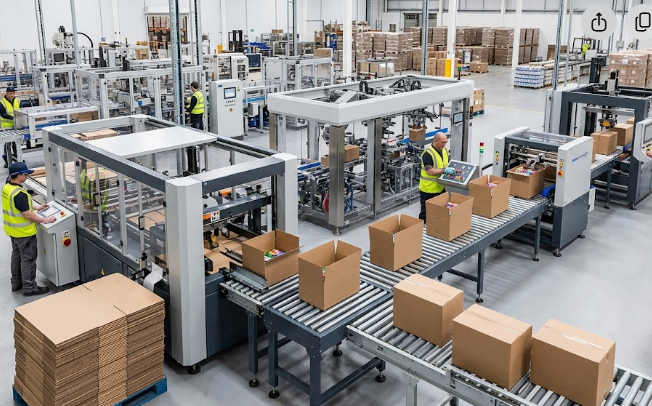
Table of Contents
- Why Do High-SKU Operations Struggle with Manual Packaging?
- What is an Automatic Box Folding Packing Line?
- How Does Smart Packaging Automation Reduce Direct Labor Costs?
- Can an Automated Carton Folding System Handle Frequent SKU Changes?
- How Do Inline Quality Checks Prevent Costly Shipping Errors?
- What Role Does Industry 4.0 Play in End-of-Line Packaging?
- What is the Real ROI for a Box Folding Packing Production Line?
- Frequently Asked Questions (FAQ)
1. Why Do High-SKU Operations Struggle with Manual Packaging?
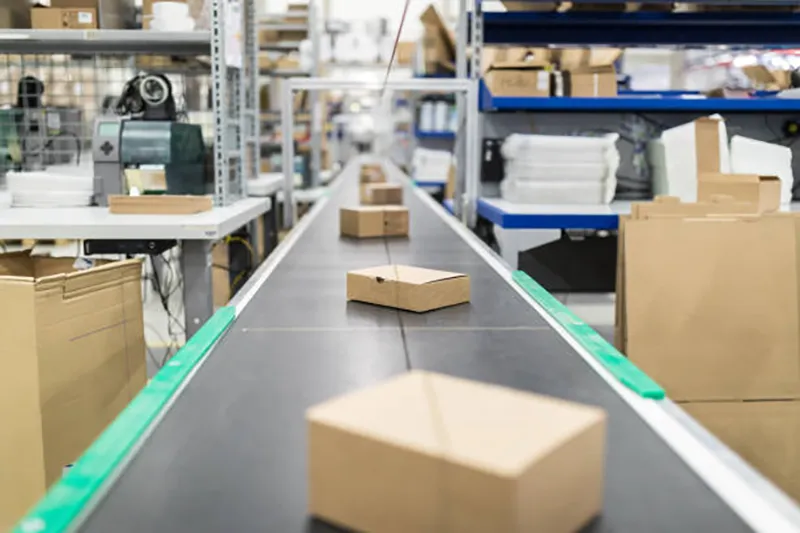
Industries such as e-commerce fulfillment, Fast-Moving Consumer Goods (FMCG), electronics, and medical packaging face a unique set of challenges. Unlike traditional mass production, where a single product is packaged continuously for weeks, high-SKU environments operate on high-mix, low-volume production models.
When packaging relies on manual labor in these environments, several pain points emerge:
- Labor Shortages and Turnover: Finding and retaining workers for highly repetitive tasks like folding boxes and applying tape is increasingly difficult. During seasonal peaks, relying on temporary labor introduces high training costs.
- Inconsistent Throughput: Manual carton forming is slow. Human operators cannot maintain a steady pace across an 8-hour shift, causing upstream manufacturing equipment to pause while packaging catches up.
- Quality and Error Risks: When workers are rushing to pack dozens of different SKUs, the risk of placing the wrong item in the wrong box, applying incorrect labels, or failing to seal a box properly skyrockets.
To solve these issues, manufacturers must adopt a high-SKU packaging automation strategy that decouples production capacity from human labor dependency.
2. What is an Automatic Box Folding Packing Line?
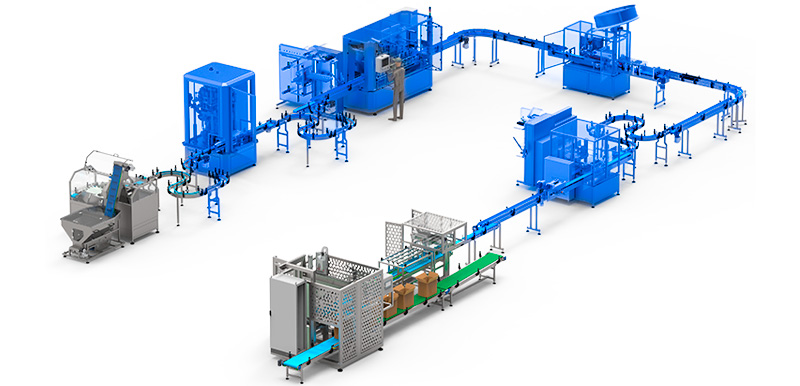
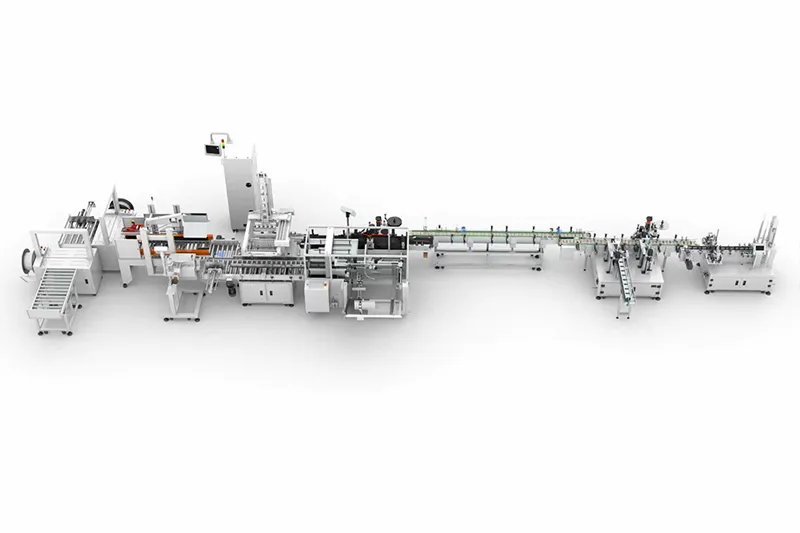
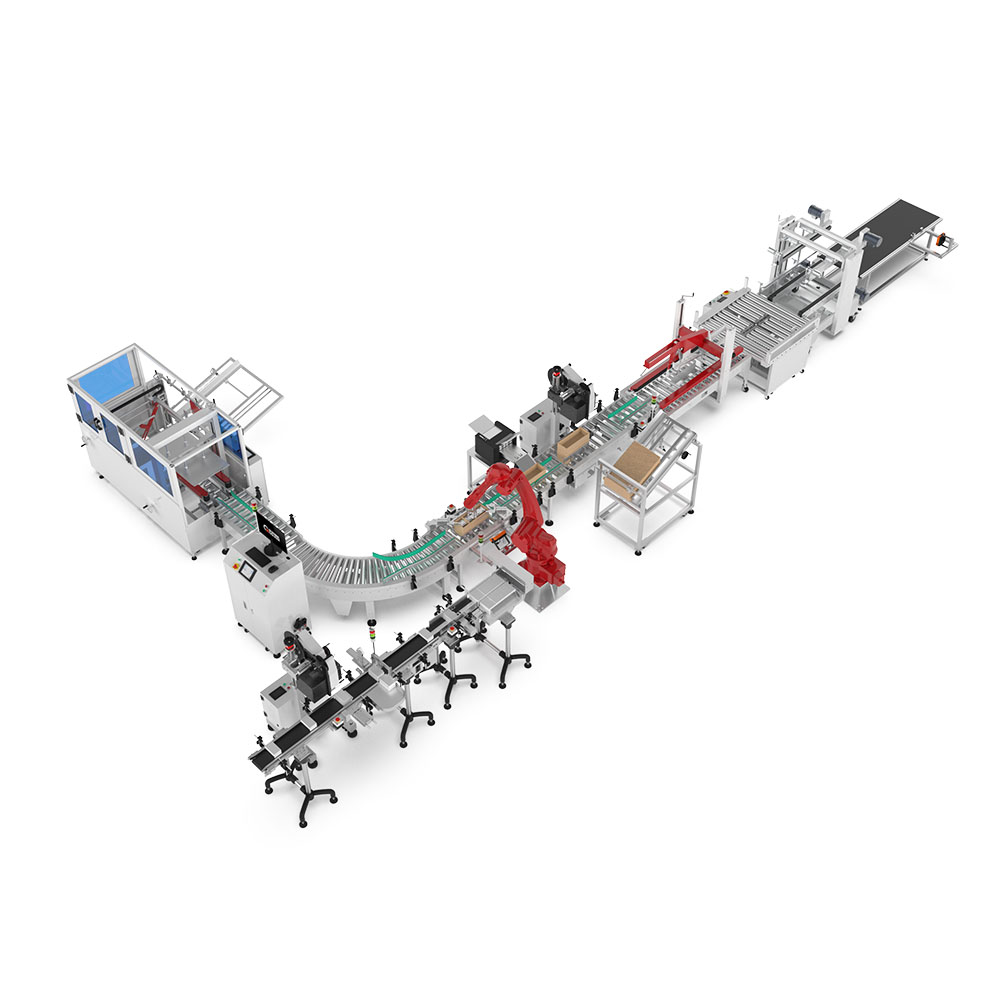
An automatic box folding packing line is a comprehensive, end-to-end mechanical and digital system designed to handle a carton from its flat state all the way to a wrapped pallet, completely untouched by human hands.
Rather than functioning as isolated standalone machines, this integrated system creates a continuous workflow consisting of several synchronized modules:
- Carton Forming: The system automatically pulls a flat cardboard blank from a magazine, erects it, and folds the bottom flaps.
- Robotic Product Loading: Delta or 6-axis robots pick up the products and carefully place them into the erected cartons, adjusting their grip based on the specific SKU.
- Flap Folding and Sealing: Once loaded, the system automatically folds the top flaps and applies tape or hot-melt glue to seal the carton securely.
- Inline Weighing and Inspection: Sensors verify the weight and scan barcodes to ensure the correct contents are inside.
- Labeling and Strapping: Automated print-and-apply labelers affix shipping labels, and strapping machines secure the box for transit.
- Palletizing: Finally, robotic arms stack the finished boxes onto pallets in optimized patterns.
By utilizing a complete carton forming and sealing line, facilities eliminate the manual handling that traditionally slows down the outbound shipping process.
3. How Does Smart Packaging Automation Reduce Direct Labor Costs?
The most immediate and highly visible benefit of upgrading to a box folding packing production line is the drastic reduction in manual labor required to operate the end-of-the-line.
In a traditional setup, you might need six to ten workers managing carton erecting, manual packing, taping, labeling, and palletizing. With an automated line, the human requirement shifts from “manual execution” to “system supervision.” Instead of folding boxes, a single operator simply replenishes raw materials (like stacks of flat cartons and rolls of tape) and monitors the system via a digital touchscreen interface.
Operational data shows that implementing these systems can lead to a direct labor cost reduction of up to 30%. Furthermore, because the automated system runs at a constant, predictable rhythm—unaffected by fatigue or shift changes—the overall operational efficiency of the packaging floor can improve by over 40%. This allows manufacturers to reallocate their existing workforce to higher-value tasks, such as quality assurance or complex assembly, rather than spending wages on repetitive box folding.
4. Can an Automated Carton Folding System Handle Frequent SKU Changes?
A common misconception is that automation is only suitable for rigid, single-product manufacturing. In reality, modern automatic case packing systems are specifically engineered for maximum flexibility.
When a factory produces multiple carton formats, manual changeovers can take hours of downtime as technicians use wrenches to adjust guide rails, tape heads, and conveyor widths.
Case Study: FMCG Manufacturer
Consider a consumer goods manufacturer handling multiple carton formats. Previously, they suffered severe downtime due to manual format adjustments. By deploying a servo-driven automated carton folding system with digital recipe management, the operation transformed. Today, operators simply select the new carton size from the HMI (Human-Machine Interface) touchscreen. Servo motors automatically adjust the machine parameters to the new box dimensions.
This technology reduces packaging specification changeover times from several hours to just 15 minutes. For facilities dealing with high-mix, low-volume orders, this fast changeover capability ensures production continuity, improves line flexibility, and drastically cuts down on setup errors.
5. How Do Inline Quality Checks Prevent Costly Shipping Errors?
In high-SKU operations, putting the right product in the right box is just as critical as speed. Human error in packing leads to costly returns, damaged brand reputation, and expensive reverse logistics.
Intelligent automation integrates quality control directly into the workflow. As boxes move down the line, they pass through inline check weighers. If a box is too light, the system instantly knows a product is missing and automatically diverts the box to a reject lane. Simultaneously, vision inspection systems and barcode scanners verify that the product matches the shipping label.
Case Study: E-commerce Fulfillment Center
An e-commerce warehouse processing thousands of daily SKU variations previously struggled with frequent packing errors and inconsistent labeling during peak seasons. After implementing an automated line with barcode verification, inline weighing, and robotic case loading, their shipment accuracy skyrocketed. They achieved faster SKU switching and highly stable packaging throughput during peak periods. Moreover, by removing manual handling, the product damage rate was reduced dramatically from 3% to just 0.2%, ensuring goods reached customers in perfect condition.
6. What Role Does Industry 4.0 Play in End-of-Line Packaging?
Modern packaging is no longer just about mechanical speed; it is about data. An Industry 4.0 packaging line connects the physical machinery with the factory’s digital management systems, creating a synchronized, smart packaging ecosystem.
JOYDA Totalpack specializes in these deeply integrated architectures. A truly smart system supports seamless connectivity with upper-level enterprise software:
- ERP and MES Integration: Customer orders flow directly from the Enterprise Resource Planning (ERP) software to the packaging line, automatically instructing the machines on what size box to form and what labels to print, eliminating manual data entry.
- WMS and AGV Logistics: The system communicates with the Warehouse Management System (WMS) to coordinate with Automated Guided Vehicles (AGVs) or Autonomous Mobile Robots (AMRs), ensuring that as soon as a pallet is finished, a robot is already there to transport it to the shipping dock.
- IoT Monitoring and Predictive Maintenance: Sensors monitor motor vibrations, temperatures, and cycle times. IoT-based monitoring can predict when a part is wearing out and alert maintenance teams before it breaks. This intelligent foresight reduces fault response time to under 30 seconds and reduces unplanned downtime by up to 75%.
Case Study: Smart Factory Integration Upgrade
A factory upgrading toward Industry 4.0 required equipment that wasn’t isolated. By utilizing an integrated smart packaging automation line, they achieved real-time production monitoring, automated traceability, and centralized digital control. It transformed their packaging floor into a data-generating asset rather than a blind cost center.
7. What is the Real ROI for a Box Folding Packing Production Line?
When evaluating the investment in a box folding packing production line, the Return on Investment (ROI) is calculated across multiple dimensions: reduced labor, increased throughput, eliminated waste, and massive drops in downtime.
Additionally, optimized carton sizing and precise mechanical handling reduce packaging material waste. Furthermore, intelligent automation systems optimize power usage during idle times, effectively reducing energy consumption by over 20%.
Here is a clear comparison of how an automated system outperforms manual operations across key performance indicators:
| Performance Indicator | Traditional Manual Packaging | Automated Box Folding Packing Line | Operational Impact |
| Direct Labor Dependency | High (6-10 operators per line) | Low (1-2 supervisors) | Up to 30% reduction in direct labor costs. |
| Standard Throughput Speed | 3–8 boxes/minute (fluctuates) | 10–30 boxes/minute (up to 60) | Highly stable; massive capacity increase. |
| SKU Changeover Time | 2–4 hours (manual calibration) | ~15 minutes (HMI recipe control) | Maximizes uptime for high-mix production. |
| Product Damage Rate | ~3% (handling errors/drops) | 0.2% | Drastically lowers product write-offs. |
| Unplanned Downtime | Reactive to breakdowns | Reduced by up to 75% | IoT predictive maintenance prevents stops. |
| Fault Response Time | 10+ minutes (manual search) | < 30 seconds | Pinpoints exact errors on the digital dashboard. |
Conclusion: Scaling Intelligently with JOYDA Totalpack
For manufacturers and fulfillment centers facing rising wages and increasing SKU complexity, throwing more manual labor at the problem is no longer a viable strategy. Upgrading to an automatic box folding packing line provides the speed, precision, and data connectivity required to thrive in a modern supply chain.
With JOYDA Totalpack’s modular architecture, you don’t have to overhaul your entire factory on day one. You can start with automated carton forming and sealing, and gradually expand by integrating robotic loading and palletizing as your volume grows. By bridging the gap between advanced mechanical engineering and Industry 4.0 software, you can secure a measurable, long-term return on investment.
Ready to eliminate packaging bottlenecks and reduce your labor costs? Contact the automation experts at JOYDA Totalpack today to discuss a customized solution for your high-SKU facility.
8. Frequently Asked Questions (FAQ)
1. What is the maximum speed of an automatic box folding packing line?
Standard configurations typically operate comfortably between 10 and 30 boxes per minute. However, depending on the carton size, material quality, and packaging complexity, fully integrated, high-speed configurations can reach up to 60 boxes per minute.
2. Can the system handle completely different box sizes on the same day?
Yes. Modern systems use servo-driven automatic adjustments. By saving box dimensions as “recipes” in the digital HMI, operators can switch from a small carton to a large shipping box in approximately 15 minutes, making it ideal for e-commerce and FMCG.
3. Does implementing this system require a complete factory shutdown?
No. Thanks to modular design architecture, installation can often be phased. We can deploy standalone modules (like the carton erector and sealer) over a weekend, minimizing disruption to your ongoing operations, and integrate robotic loading later.
4. How does the automated line deal with defective products or incorrect weights?
The line is equipped with inline check weighers and vision inspection cameras. If a carton is underweight (indicating a missing item) or has a scannable barcode error, the system automatically pushes the carton onto a separate reject conveyor belt without stopping the main production flow.
5. We use our own ERP software. Can this packaging line communicate with it?
Absolutely. Industry 4.0 packaging lines are designed with open communication protocols (such as OPC UA or EtherNet/IP) that seamlessly integrate with upper-level ERP and MES software, allowing for automated order-driven packing and real-time inventory updates.
6. What happens if a machine component fails or jams?
The system features IoT-based monitoring and intelligent sensors. If a jam occurs, the machine stops instantly to prevent damage and displays the exact location and cause of the fault on the control screen. This targeted alerting reduces fault response times to under 30 seconds.
7. Are these systems environmentally friendly?
Yes. Automated lines apply the exact amount of tape or glue required, eliminating consumable waste. Furthermore, intelligent automation systems utilize smart drives that optimize power usage, reducing overall energy consumption by over 20% compared to legacy pneumatic machines.